Buy JSW Energy Ltd For Target Rs.644 by Prabhudas Liladhar Capital Ltd
Strong capacity expansion
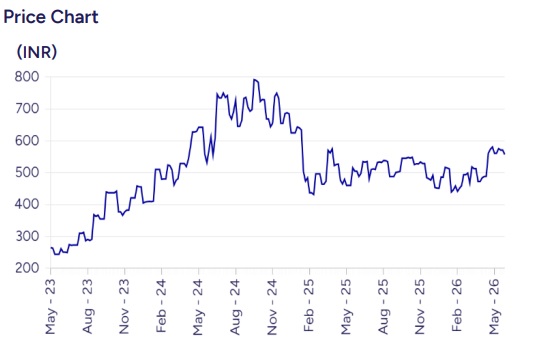
JSW Energy reported a strong Q4FY26 performance, with EBITDA rising 72% YoY, ~11% ahead of consensus estimates. The company added ~2.6 GW of capacity during FY26 through a mix of organic and inorganic routes, taking total operational capacity to ~13.45 GW, while maintaining a robust pipeline of ~14 GW under construction and ~32 GW of locked-in capacity. Over FY26–28E, operational capacity is expected to grow at a 19% CAGR, with EBITDA projected to deliver a 15% CAGR. JSW Energy continues to focus on renewable expansion, with renewables contributing 58% of FY26 operational capacity and expected to increase to 71% by FY28E, alongside scaling its energy storage portfolio with a ~29.6 GWh pipeline. We have Buy rating with a SOTP-based target price of INR 644 and stock offers one of the best EBITDA growth in the power sector. Net debt increased to ~INR 658 bn in FY26 due to ongoing capex, with ~INR 200 bn capex planned for FY27; however, leverage remains within the company’s guidance, with Net Debt-to-Equity at 2.1x and Operational Net Debt-to-EBITDA at 5.2x as on FY26.
Earnings Surge:
JSW Energy reported a strong Q4FY26 performance, with revenue at INR 45 bn (+41% YoY) driven by ~48% YoY growth in generation. EBITDA rose sharply to INR 22 bn (+86% YoY), supported by operating leverage, lower fuel logistics costs, improved efficiencies, higher renewable contribution, and premium merchant realizations. PBT -48% YoY, with growth moderated by higher depreciation (INR 8 bn, +68% YoY) due to capitalization of new capacities and interest costs. Generation growth was led by both segments—renewables grew ~68% YoY on capacity additions (including O2 Power), while thermal grew ~43% YoY driven by strong PLFs at KSK Mahanadi (~93%) and improved performance at Utkal and Vijayanagar plants.
Strong Expansion Pipeline:
JSW Energy expanded its installed capacity to ~13.45 GW in FY26, adding ~2.6 GW through a balanced mix of organic renewable commissioning and inorganic acquisitions, including O2 Power. The company has a strong growth pipeline, with ~14 GW under construction (fully tied-up under long-term PPAs) and an additional ~4.6 GW pipeline, providing high visibility on future capacity and earnings. Total locked-in capacity stands at ~32.1 GW, keeping it on track to achieve its 30 GW target by 2030 under Strategy 3.0. Renewables account for ~58% of installed capacity and ~77% of under-construction capacity, reflecting a clear strategic shift toward clean energy. The company is also scaling energy storage (~29.6 GWh pipeline) and enhancing vertical integration through battery assembly (5 GWh) and supply chain initiatives.
Capex and Net Debt trajectory:
JSW Energy plans a capex of ~INR 200 bn for FY27, primarily towards renewable capacity additions, thermal expansion (Salboni), and energy storage, with ~INR 40–50 bn allocated to enabling projects and the balance to renewables. Net debt increased to ~INR 658 bn as of Mar’26, reflecting ongoing investments and acquisitions. Despite this, leverage remains within management’s guardrails, with operational net debt to EBITDA at ~5.2x and cost of debt improving to ~8.36%, supported by strong liquidity (~INR 100 bn). Deleveraging is expected to be gradual, driven by rising EBITDA from newly commissioned assets, with a medium-term target of ~5–5.5x net debt to EBITDA by 2030
Please refer disclaimer at https://www.plindia.com/disclaimer/
SEBI Registration No. INH000000271










.jpg)