India's renewable power equipment opportunity may touch $400 billion by 2035
India’s rapid electrification and renewable expansion could make it one of the world’s largest markets for power equipment by 2035, a new report has said.
The report from Asian Power cited McKinsey's estimates that renewable energy equipment and high-end cables alone could represent a global opportunity of $350-400 billion by 2035, while the global power electronics market could exceed $140 billion.
The consultancy said domestic electrical-equipment consumption reached $59 billion in FY25 after an 11 per cent compound annual growth rate over the past five years and could reach $170–205 billion by 2035.
However, India risks becoming heavily import-dependent unless domestic manufacturing scales up, the report said.
The import dependence has already climbed from 22 per cent in 2020 to 33 per cent in 2025 and, under a business-as-usual scenario it could exceed 70 per cent by 2035, creating a potential production shortfall of more than $130 billion.
"The four segments with the greatest localisation urgency are power electronics, batteries, solar photovoltaic cells and modules, and subcomponents," the report said.
The report urged a fivefold expansion in domestic capacity across these areas, as well as in AC compressors, transformers, and cables, to reduce overall import dependence from 33 per cent today to less than 14 per cent by 2035.
The report flagged grid stabilisation technologies and power software as emerging high-growth segments in order to manage complexity of renewables-heavy electricity systems.
Further, subsea and high-speed rail cables were also mentioned as priority areas where India could build global export competitiveness.
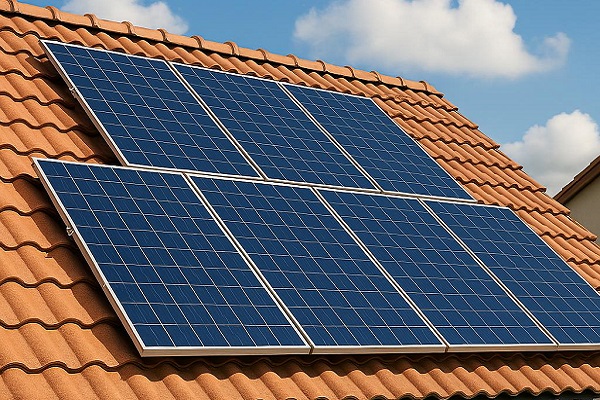
India has crossed a historic milestone by connecting 40 lakh homes to rooftop solar under the 'PM Surya Ghar Muft Bijli Yojana'.
According to the International Energy Agency (IEA), nearly half of India’s additional electricity demand between now and 2030 is expected to be met through solar energy.
Another quarter is likely to come from other low-carbon sources including wind, hydroelectric and nuclear power, the report said.





.jpg)



.jpg)