Buy Granules India Ltd for the Target Rs. 800 by Emkay Global Financial Services Ltd
We initiate coverage of Granules with BUY and SOTP-based Mar - 27 TP of Rs800 (implied target EV/EBITDA of ~12x; ~30% upside). Granules fits into our framework of backing companies with a smaller US base + a US portfolio construct with strong near-term growth visibility. Granules’s margin resilience over the last 6 quarters, despite its flagship Gagillapur facility being impacted by a regulatory escalation, has been a positive surprise for us (as well as a large section of the street). Strong share gains in the US controlled substance market, as seen in the case of Granules, lead to a virtuous cycle (the ability to fulfill quotas in a particular year leads to higher quotas in the subsequent year). While FY27 growth will be driven by further scale-up in recent launches, we expect controlled substances (FY26E consolidated sales share at close to 30%) to be a key multi-year growth driver, given the expected addition of more products to the portfolio starting FY28. The company is witnessing a transition on 3 fronts - API/PFI to FDF, B2B to B2C, and legacy to complex generics - all of which are margin-accretive. Gagillapur clearance in FY27 could pose an upside to our formulation sales estimates + growth in Senn (peptide CDMO), subject to the conversion of a few large-scale project opportunities, could turn out to be nonlinear in the medium term. The recent capital raise will keep inorganic opportunities in play. We expect EPS CAGR of ~20% over FY26-28E. Granules is our high - conviction small-cap pick.
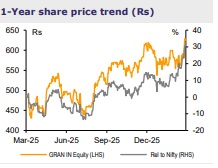
Controlled substances - Key driver of a derisked US business model
We believe a major driver of the company’s recent US sales + overall margin performance is not well understood. The sharp 950bps gross margin improvement seen over FY24- 26E has been a function of an evolved formulation-focused US business model and, more importantly, a successful pivot to controlled substances (a post-FY23 phenomenon and a high-margin portfolio). While controlled substances is admittedly a sticky business (we attempt to demystify the highly-regulated, shortage-prone US controlled substance landscape to the extent possible) with a relatively favorable pricing environment, the business has not been kind even to some larger generic peers. Granules, with its Virginia facility, has ensured supply reliability, validated by its rapid share gain in new launches. Hence, the segment’s revenue share has sharply risen in FY26E (vs ~10% in FY23E).
Unique case of margin resilience in the face of regulatory challenges
Granules’s has been a rare case of a company growing its US base/expanding margins despite facing remediation-linked challenges at its key FDA - approved site (refer to Exhibit 40 for a list of warning letters issued in the past to peers and the impact on their margins). Notably, the company’s margin resilience (~270bps expansion over FY24 - 26E and expansion of a similar magnitude expected over FY26 - 28E) has come in the face of Gagillapur-linked remediation expenses, elevated R&D spend, and EBITDA loss in Senn.
Stellar execution in a highly challenging albeit rewarding US controlled substances market
US controlled substances is a market where even late entrants in a genericized market can drive meaningful sales subject to strong execution (for instance, in Lisdexamfetamine Mesylate, Granules is now among the top - 3 players despite over 10 incumbents in the market at the time of Granules’s entry). API security + dedicated formulation capacities are crucial to a company’s ability of meeting its DEA - authorized quota commitments. Consistency in supply is contingent on streamlining incoming API and outgoing FDF volumes. The market is also characterized by high failure-to-supply penalties. A combination of such challenges has led to the exit of larger generic peers in several product markets in the past and persistent drug shortages. Per our estimate, Granules’s controlled substance revenue doubled YoY in FY26E (also, ~1.9x over FY23-25). Over the next 3 years, Granules intends to further expand its presence in an overall market worth ~USD10bn (brand + generics with generic pricing remaining attractive). The company’s DEA-approved Virginia facility has sufficient capacity to cater to 2x the current volume, with no incremental capex required in the medium term.
Transition on 3 fronts—API/PFI to FDF, B2B to B2C, and legacy to complex generics with backward integration—all of which are margin-accretive
Granules’s overall revenue mix has decisively shifted in favor of formulations post-FY23, and the API/PFI to FDF shift will continue to play out (FY28E FDF share at ~78% vs ~50% in FY23). Share of formulations in Europe, for instance, is still relatively low at ~50%. Genome Valley + Gagillapur EU clearance and transfer of high-volume commercial products from Gagillapur to Genome Valley eliminate capacity constraint, which was a key hurdle in scaling up FDF in Europe and RoW markets. The pivot to B2C in US + Europe as well as new markets will also be margin accretive, with the company aiming to establish control over the entire value chain over the next 5 years. Legacy molecules (consolidated sales share has now nearly halved vs 84% in FY23, per our estimate) such as Guaifenesin and Methocarbamol are no longer among the top-5 products within the FDF portfolio (ex - controlled substances).
In oncology formulations (a key post-FY28 growth driver), the focus will be on launching in the first wave while remaining backward-integrated. The company is also working on backward integration projects at its Vizag unit for certain non - legacy formulation products, where margins are currently lower on account of reliance on external API manufacturers. Even in formulation products where the generic market is well-formed, Granules’s backward integration + ongoing process improvements have been the key competitive levers (the company is among the top - 3 players in terms of prescription share in ~50% of its commercialized US portfolio). In products where in-house API itself might not serve as a competitive advantage, the company has chosen the relatively lucrative OTC path (for instance, Ibuprofen).
Multiple optionalities—including non-linear growth in Senn, Gagillapur clearance, and inorganic opportunities - in play
Senn offers Granules a differentiated CDMO platform with Liquid - Phase Peptide Synthesis (LPPS) capabilities and a team with strong technical expertise (Senn’s patent registries indicate collaborations with the likes of J&J on their oral IL - 23 peptide platform). Even as Solid - Phase Peptide Synthesis (SPPS) is currently the dominant technology for peptide manufacturing, a hybrid approach that combines SPPS (for fragment formation) and LPPS (for coupling) is increasingly being evaluated by companies for high-volume peptides, given that LPPS can address the twin hurdles of cost and scalability. While generic GLP - 1 could be a medium-to-long term growth driver (given that Granules’s focus is largely on regulated markets), Senn will showcase its clinical to commercial CDMO capacities and focus on monetizing its capabilities in non-GLP - 1 peptides to sweat the asset in the near term. We expect a reversion to the pre-acquisition revenue of ~Rs2bn for Senn in FY27. The funds raised via the recent preferential allotment and issuance of warrants could also be deployed toward value-accretive M&A opportunities, likely with a focus on the US market. Potential regulatory clearance for Gagillapur in FY27, in line with the management’s expectations, could result in a flurry of new product approvals and lead to an upside potential for our formulation sales estimates for FY27/28.
For More Emkay Global Financial Services Ltd Disclaimer http://www.emkayglobal.com/Uploads/disclaimer.pdf & SEBI Registration number is INH000000354