Hold Bharat Forge Ltd For Target Rs. 1,843 By InCred Equities
India biz recovery to be followed by exports
* 3Q standalone EPS growth of 6% qoq was above our estimate, but in line with Bloomberg consensus estimate. India sales growth of 24% yoy is impressive.
* Early signs of US class-8 truck new order improvement & US-India trade deal provide hope of strong export recovery soon. Raise EPS estimates by 2-4%.
* Feb 2026 spike in stock price makes the risk-reward ratio unfavourable near +1SD P/E valuation. Maintain HOLD rating with a higher TP of Rs1,843.
India sales recovery impressive in 3QFY26 Bharat Forge’s standalone 3QFY26 EBITDA dipped 7% yoy to Rs5.7bn but rose by 3% qoq. This was just 2% above our estimate, aided by a 70bp beat in EBITDA margin of 27.2% (-110bp qoq). The weakness in exports (-3% qoq and -21% yoy) was overcome by strong 24% yoy and 17% qoq rise in domestic sales. Strong growth in India industrial and commercial vehicle segments, and exports to Europe are impressive. Lower interest costs (-14% qoq) and flat depreciation led to 6% qoq rise in normalised PAT to Rs3.4bn, 6% above our estimate. Consolidated entity’s PAT rose by 10% qoq to Rs3.3bn, aidd by 3% qoq EBITDA growth.
Management indicates the worst is behind The bottoming out of US class-8 truck net orders in the Dec 2025 quarter and a spike in Dec 2025 (Fig. 7) provide hope of a better CY26F ahead. With the India-US trade deal signed recently and India truck cyclical demand recovery being strong, guides for the worst in terms of sales is behind, as sales weakness was seen from Sep 2024 onwards. Management indicated that Rs23.9bn of orders were received during the quarter and gave guidance of gun order execution for Indian Army to commence in 2HFY27F. Castings subsidiary J S Auto raised equity funding of Rs3bn to support its next phase of growth. The Orissa plant capex of Rs30bn may be incurred early in FY28F.
Consolidated EPS upgrade by 2-4% While signs of bottoming out were visible, the extent of recovery is debatable. We support domestic truck demand recovery, while global recovery may be gradual and geopolitical risks can still result in volatility. Hence, we limit sales upgrade to 2-3% for FY27F-28F. With the trade deal helping ease import duties from current peak levels, we raise EBITDA by 4- 5% for FY27F-28F. Easing interest costs and deprecation leads to EPS upgrade of 2-4% for FY27F-28F.
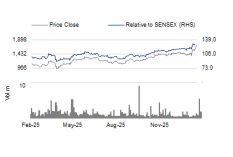
Recent stock price spike demands quick recovery; maintain HOLD The sharp stock price rise so far in Feb 2026 on the back of US trade deal has pushed forward P/E and PBV valuations to near +1SD above 10-year mean level, thereby demanding a quick recovery in its sales and profitability. Considering global geopolitical challenges, we feel the ask is tall and so we maintain our HOLD rating on the stock with a higher DCF-based target price of Rs1,843 (Rs1,209 earlier). Upside risk: Quick resolution of trade tensions. Downside risk: Global recession prolonging profitability challenges.
India biz recovery to be followed by exports
Management conference-call highlights
* Outlook: Management indicated that the worst is behind and things are starting to look up in 4QFY26F and FY27F. With both domestic and export markets looking strong across sectors, and the commencement of ATAGS execution in 2HFY27F, it expects high double-digit topline growth and its commensurate impact on profitability.
* Order book: In 3Q, the company secured new orders worth Rs23.88bn including Rs18.78bn in defence segment. As of 31 Dec 2025, the defence order book stood at Rs111.3bn. Signed the CQB carbine contract with the Ministry of Defence for supply of more than 250,000 units to Indian armed forces. This order unlocks significant growth opportunities for small arms vertical within the defence business. Small arms biz has four years execution time, while the remaining orders have five years execution plan.
* Standalone business: Revenue was up 7% qoq and EBITDA up 4.6% qoq, translating into an EBITDA margin of 27.3%, while the traffic impact was Rs.310m. The performance was aided by strong growth in domestic automotive business and execution of defence order book.
* Domestic CV business: Performance was driven by higher production volume in 3Q across OEMs, as benefits of Goods and Services Tax (GST) rates cut percolated in lower TCO (total cost of ownership) to end-users.
* Domestic passenger car: The segment saw GST-related benefits resulting in higher demand. Expect these tailwinds to support demand in the near term. In the long term, the expanding per capita car ownership to drive meaningful growth in this sector.
* Domestic industrial: Business saw strong performance driven by better execution in defence segment and good traction in heavy horse-power engines
* Subsidiaries’ performance: In 3Q, JS Auto’s castings business (JSA) recorded revenue of Rs2.03bn (+22% yoy), EBITDA of Rs320m (+39% yoy) and 15.7% EBITDA. K-Drive mobility, a supplier of axle assembly across segments witnessed muted topline but a sharp jump in profitability. with EBITDA margin moving up from 3.1% in 2QFY26 to 5.1% in 3Q. Expect the margin profile to continue to improve over a three-year time frame.
* Overseas business: Export revenue witnessed a 3% qoq decline, with auto sector down 13%. The US & European operations reported modest operating profit despite seasonal weakness in the passenger vehicle market. Review of the European steel manufacturing footprint is on track, and company expects to have concrete measures in place by the end of this fiscal.
* CV export business: Lower production and inventory destocking impacted commercial vehicle (CV) exports to North America (NA) sharply. NA truck revenue declined by 51% yoy. Early indicators such as net orders and increasing order backlog give comfort that the worst may be over for the truck sector.
* Passenger car export business: Performed well in a seasonally weak quarter. As trade disputes subside, we anticipate a recovery in consumer confidence, leading to higher personal mobility spending.
* Industrial export business: Saw a mixed performance; HHP engines and aerospace saw better performance driven by improved execution; oil & gas continued to suffer from weak crude oil prices.