Economy Macro-Cap : Rural demand: Down, but not out by Motilal Oswal Financial Services Ltd

* Channel checks: Our interactions with corporates and farmers across Karnataka, Maharashtra, Telangana, Rajasthan, and Madhya Pradesh indicate that the weak monsoon has not yet translated into a sharp deterioration in rural activity. Tractor demand remains more resilient than expected, while farmers report that sowing activity has accelerated following the revival in July rainfall. Management commentary from NBFCs indicates cautious optimism so far. Reservoir levels are adequate, though not abundant, and rainfall over the coming weeks will remain critical for crop development and rural demand. At this stage, channel checks suggest that rural conditions have softened but are not showing the signs of distress that were feared at the start of the monsoon season.
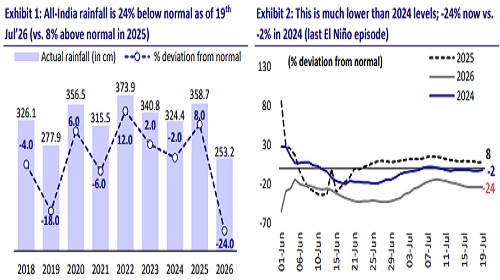
* Rainfall has improved, but monsoon remains significantly below normal: Cumulative rainfall remains 24% below the long-period average (LPA) as of 19th Jul’26 (vs. 40% in Jun'26), with 23 of 36 meteorological sub-divisions still reporting deficient rainfall. Weakness remains concentrated across the Eastern, Southern, and several key agricultural states.
* Of the 111 districts identified by the government as most vulnerable to El Niño due to low irrigation coverage, 69 are already facing deficient rainfall. This strengthens our view that food inflation risks remain tilted to the upside, particularly for rain-fed crops such as pulses and oilseeds.
* Total kharif sowing contracted 6% YoY (as of 17th Jul'26), with the sharpest declines in pulses (-15.1%), coarse cereals (-11.2%), cotton (-6.0%), and oilseeds (-5.5%). Rice sowing (-0.9%) has proved relatively resilient because of extensive irrigation coverage and favorable rainfall across key Eastern states.
* Live storage across major reservoirs has improved to 34% of capacity as of 16th Jul'26 from 26% at the beginning of July, reflecting stronger rainfall over recent weeks. However, storage remains well below last year's levels (57%), with Southern and Eastern India continuing to experience significant water stress.
* The spatial extent of drought has continued to increase despite the improvement in rainfall during July. As of 15th Jul’26, 35.5% of the country's geographical area was classified under abnormally dry (D0) or worse conditions, up from 30.7% a week earlier. Of this, 16.1% of the area was under moderate drought (D1+), 6.0% under severe drought (D2+), and 1.1% under extreme drought (D3).
* Rural CPI inflation accelerated to 4.7% YoY in June, compared with 3.9% in urban India, reflecting the higher weight of food in rural consumption baskets. We maintain our FY27 CPI inflation forecast of 5.2%, relative to RBI's 5.1%, taking into account El Niño risks and energy-led price increases
* RBI likely to remain on hold through CY26: The RBI has identified the weak monsoon as one of the principal macroeconomic risks for FY27 but continues to view weather-related food inflation as a temporary supply-side shock. With average CPI inflation at 3.9% in 1QFY27, below the RBI's 4.2% forecast, the MPC has room to remain patient while assessing the persistence of food inflation. We, therefore, expect the policy rate to remain unchanged through CY26, with any potential rate hike deferred to 2027, contingent on sustained food inflation, monsoon outcomes, and evidence of second-round inflationary pressures.
Rainfall deficit remains broad-based despite improvement in July
* The Southwest monsoon has recovered from its exceptionally weak start but continues to remain significantly below normal, with rainfall deficits persisting across most parts of the country. As of 19th Jul’26, cumulative rainfall stood 24% below the long-period average, improving considerably from the 42% deficit recorded in late June but remaining substantially weaker than the 8% surplus witnessed during the corresponding period last year. The improvement reflects a revival in monsoon activity during early July following a prolonged dry spell in June. However, the recovery has been insufficient to eliminate the large cumulative rainfall deficit accumulated during the critical sowing period.
* The weakness in the monsoon continues to be broad-based across all four meteorological regions, although the intensity of rainfall deficiency varies considerably. East and Northeast India remain the weakest-performing region, with cumulative rainfall 35% below normal, followed by the Southern Peninsula (-27%), Northwest India (-23%), and Central India (-14%). The improvement in Central India is encouraging, given that the region had recorded one of the sharpest rainfall deficits during June and accounts for a significant share of India's soybean, cotton, and pulse production.
* Rainfall deficiency has become significantly more widespread this year. As of 19th Jul’26, 23 of India's 36 meteorological sub-divisions reported deficient rainfall, compared with 8 during the same period last year and 12 in 2024. At the same time, none of the sub-divisions recorded excess or large excess rainfall, versus 10 in 2025.
* State-level rainfall data further highlight that the current monsoon weakness remains concentrated across several major agricultural states. Large rainfall deficits continue to persist across Bihar (-44%), Punjab (-41%), Jharkhand (-41%), Goa (-38%), Kerala (-34%), Gujarat (-33%), Assam (-31%), Telangana (-31%), Andhra Pradesh (-30%), Karnataka (-28%), Rajasthan (-28%), Uttar Pradesh (- 27%), Haryana (-24%), and Chhattisgarh (-22%). Although rainfall has improved materially in Madhya Pradesh (-16%) and Maharashtra (-14%), both states continue to remain below normal after recording exceptionally weak rainfall during June. In contrast, only a handful of states have received normal or excess rainfall, including Odisha (+14%), Sikkim (+11%), West Bengal (normal), and Tamil Nadu (-1%).
* The geographical distribution of rainfall deficiency is also becoming increasingly concerning. The Center had earlier identified 111 districts with less than 25% irrigation coverage as highly vulnerable to El Niño-related agricultural stress. According to recent assessments, 69 of these priority districts are already reporting deficient rainfall, indicating that rainfall weakness is becoming concentrated in some of India's most rain-fed farming regions. Since these districts rely heavily on monsoon rainfall, a prolonged dry spell could disproportionately affect pulse, oilseed, and coarse cereal production, reinforcing upside risks to food inflation during 2HFY27.
* The agricultural implications of the current rainfall pattern depend not only on the magnitude of rainfall deficits but also on irrigation coverage across producing states. The outlook for rice production appears relatively resilient despite below-normal rainfall in several major producing states. Punjab, Haryana, Telangana, and Andhra Pradesh together account for more than onefourth of India's rice output and have irrigation coverage exceeding 95%, significantly reducing their dependence on monsoon rainfall. Similarly, Uttar Pradesh irrigates over 86% of its rice acreage. Moreover, the two largest Eastern rice-producing states West Bengal, which contributes 13.4% of national rice production, and Odisha, accounting for 7% have received normal and abovenormal rainfall, respectively. Thus, aggregate rice production remains relatively well protected owing to extensive irrigation infrastructure and favorable rainfall across parts of Eastern India (Exhibit 6).
* In contrast, the outlook for pulses remains considerably more vulnerable because production is concentrated in states with relatively poor irrigation coverage and persistent rainfall deficits. Madhya Pradesh and Maharashtra together account for over 40% of India's pulse production, followed by Rajasthan, Gujarat, Uttar Pradesh, and Karnataka. Irrigation coverage remains particularly low in Maharashtra (12.5%), Karnataka (10.8%), Jharkhand (11.8%), and Rajasthan (22.2%), making pulse cultivation highly dependent on monsoon rainfall. Most of these states continue to report rainfall deficits ranging between 14% and 41%, increasing the risk of lower yields if rainfall does not improve during the remainder of the season (Exhibit 7)
For More Research Reports : Click Here
For More Motilal Oswal Securities Ltd Disclaimer
http://www.motilaloswal.com/MOSLdisclaimer/disclaimer.html
SEBI Registration number is INH000000412