The Sovereign Collateral Crisis: U.S. Debt-to-GDP, Gold Backing, and the Re-Anchoring of Fiat Reserves by Amit Gupta, Kedia Advisory

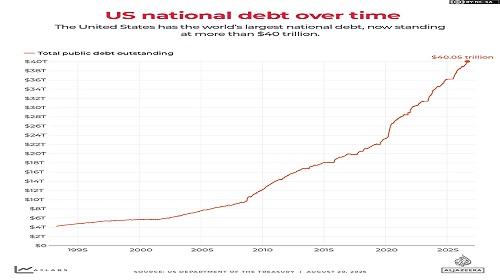
While headline discussions focus on Federal Reserve rate expectations and Treasury auction bid-to-cover ratios, the structural foundation of the U.S. sovereign debt market has reached a historical breaking point. The U.S. debt-to-GDP ratio currently exceeds World War II records—yet the hard asset backing behind these obligations has collapsed from over 50% to roughly 3%.
During the debt build-up of the 1940s, global confidence in U.S. Treasuries was secured by the world's largest physical gold reserve, where nearly half of total outstanding liabilities were backed by bullion. Today, the expansion of sovereign debt is entirely uncollateralized by hard assets. For gold to re-establish historical debt-backing ratios in modern fiat terms, mathematical modeling implies exponential upward adjustments to the price of gold.
Key Data Insights & Structural Disconnects
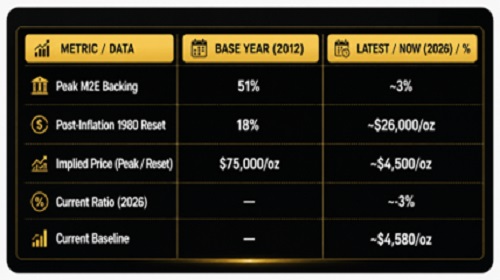
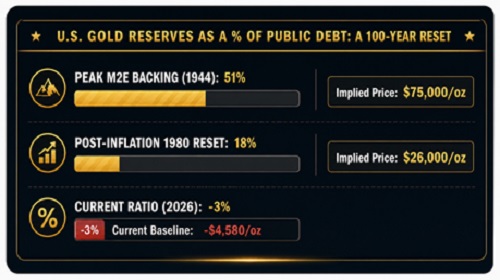
- The World War II Parallel vs. Reality: When U.S. debt-to-GDP surged during the 1940s, the nation held over 20,000 tonnes of gold. Backing stood at 51%, providing an absolute balance sheet anchor. The current debt load carries a comparable leverage ratio on gross output, but without the physical asset backstop.
- The 1980 Mean-Reversion Target: During the monetary crisis of the late 1970s and 1980, market repricing of bullion restored the gold-to-debt backing ratio to 18%. Replicating merely this secondary historical norm against current outstanding public debt ($36T+) implies a gold equilibrium near $26,000/oz.
- The Full Reset Mathematical Implication: Restoring the peak 1940s backing level of 51% against current debt loads yields an implied nominal valuation of $75,000/oz. This highlights the vast divergence between expanding paper debt and constrained physical gold supply.
Macro Strategy: Rebalancing the Reserve Architecture
This multi-decade divergence drives key strategic shifts in macroeconomic portfolio allocations:
Sovereign De-Dollarization as Collateral Management: Eastern and emerging-market central banks are actively diversifying away from U.S. Treasuries toward physical gold reserves. With paper claims yielding diminished structural security, sovereign treasuries are replacing fiat reserve IOUs with non-sovereign hard collateral.
Commodity-Over-Debt Long-Term Positioning: In a macro environment defined by sticky fiscal deficits, negative real yields, and compounding interest outlays, sovereign debt transitions from a "risk-free asset" into a "return-free risk." Hard monetary assets (Gold, Silver) and industrial feedstocks represent the primary balance-sheet hedge against structural fiat dilution.
Above views are of the author and not of the website kindly read disclaimer

















.jpg)