Economy Update : Price Pressures Broaden as Second-Round Effects Emerge by Choice Institutional Equities Ltd
Key Highlights -
* Headline CPI rose to 4.4% in July 2026, up 6 bps from June and sharply higher than 1.6% a year ago; the disinflation phase has clearly reversed.
* FMCG price hikes have only begun to bite, as just 30% of raw material cost increases have been passed through so far, with another 2–5% hike flagged for the current quarter.
* Real incomes are under strain, especially in rural areas where income perception worsened to -8.7% from -2.2% in November 2025.
* Households expect prices to keep rising, creating a self-reinforcing inflation feedback loop.
* Risks are tilted above the RBI's 5.9% peak forecast and we see FY27 inflation at 5.2--5.6%, with volatile crude and weak monsoon dispersion as key upside risks
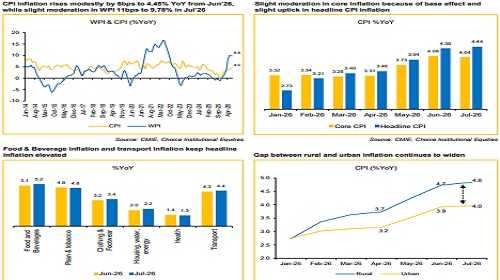
Headline CPI inflation edged up to 4.44% YoY in July 2026, a modest rise of 6 bps from June 2026 and a substantial increase from 1.6% YoY in July 2025. Rural inflation rose by 10 bps to 4.84%, outpacing the 3-bps increase in urban inflation to 3.96% and continues to substantially exceed urban levels. Meanwhile, wholesale inflation (WPI) moderated slightly by 11 bps to 9.78% in July 2026.
What's Driving the Pressure
* Persistently rising food inflation at 5.5% YoY in July 2026 from 2.1% in Jan 2026. Protein segments, such as Meat (15.3%) and milk (4.8%) have risen significantly. This reflects a price hike of INR 2/litre undertaken by both, Amul and Mother Dairy, across India in May. Additionally, from mid-August, major cooperative and private dairies again increased milk prices by Rs 2/litre. This would further drive protein inflation higher as fuel, packaging and procurement cost remain elevated.
* Hikes undertaken by FMCG companies reflect in the readymade food inflation - Inflation in the ready-made food segment has been rising persistently and reached an all-time high of 9% YoY in July 2026 in the new series. This is due to the price hikes taken by the FMCG companies in Q1, as input cost pressure from global commodity shocks and domestic fuel hikes feed through.
* Commercial LPG cut may provide some support to inflation in the restaurant and hotel services - Inflation in the restaurant and accommodation services has also edged upwards to an all-time high of 7.7% YoY in July 2026 due to elevated LPG prices and food inflation. However, the recent reduction in commercial LPG prices in July and August by approx. INR 390/cylinder will provide some breathing room, going forward.
* Transport inflation continued to inch upwards to 4.4% vs no growth in January 2026, reflecting the cumulative effect of elevated fuel and vehicle prices.
* Moderation in wholesale inflation (WPI) was driven by slowing down of inflation in petroleum & natural gas and minerals. However, the downside was limited by surging wholesale inflation in segments, such as manufactured products, electricity and broader non-food articles. This indicates that secondround effects of higher commodity prices are beginning to appear more broadly.
Households Brace up for Higher Prices
In the recent RBI's Consumer Confidence Survey (Rural & Urban), both highlight that households are expecting prices to go up, going forward. Net responses (people expecting prices to increase minus people expecting prices to decrease) on current price perception for rural areas have been rising since November 2025: 90.5% in July 2026 from 87.4% in November 2025. Similarly, the net responses on current price perception in urban areas have been rising since November 2025: 92.7% in July 2026 from 78.9% in November 2025. This perception of rising prices is working as a feedback loop for rising inflation.
Real Incomes under Strain
This is having an impact on wages, especially in rural areas. Net responses on current income perception for rural areas worsened to -8.7% in July 2026 from - 2.2% in November 2025. In urban areas, this remains in positive territory at 1.9% but has remained low since January 2024. Therefore, rising inflation would squeeze real income, reducing the disposable income of households.
FMCG Price Hikes set to Feed Through
From the market standpoint, in the recent Q1 results, the FMCG companies have highlighted margin pressure concerns on the back of rising input cost due to commodity inflation and geopolitical uncertainty, along with weather-related risks. This has prompted leading FMCG makers to implement calibrated price hikes. The sector undertook an average hike of around 2–5% in Q1 and is going for shrinkflation by reducing grammage or selective pricing actions to protect margins. Additionally, until now, only 30% of the rise in RM cost has been passed through by taking price hikes, which is reflected in the margin pressure and there lies significant scope for undertaking further price hikes. Several firms are inclined to undertake a further 2–5% price hike in the current quarter, thereby furthering headline inflation. Overall, consumer staples are benefiting from price hikes, but input costs are squeezing margins.
Outlook: Risks Tilted above RBI's Forecast
In the recent MPC, RBI forecast inflation to peak in 3Q at 5.9% and is expected to slow down, thereafter. Given the scenario where crude persistently remains volatile and the rainfall dispersion and intensity remain weak, CPI inflation may surpass RBI's forecast. Therefore, we continue to project inflation for FY27 to be around 5.2%–5.6%.
For Detailed Report With Disclaimer Visit. https://choicebroking.in/disclaimer
SEBI Registration no.: INZ 000160131