Rs 61 Lakh Crore UPI Merchant Payments Hold Rs 30,000 Crore MDR Potential by CareEdge Ratings
Synopsis
• India’s payments ecosystem has undergone a structural transformation from being cash-led to digitally dominant, with digital modes accounting for 99.8% of the total transaction volume and 97.9% of value as of Q1FY27. This shift has been enabled by strong policy support, interoperable infrastructure (UPI-led) and rapid fintech adoption alongside rising financial inclusion and merchant digitisation. (Click here to read our previous research: India’s Payments ecosystem)
• This transformation is further catalysed by strong network effects and ecosystem depth, with P2M transactions accounting for 29% of UPI transaction value as of Q1FY27.
• As UPI scales, the focus is increasingly shifting towards the long-term sustainability of the ecosystem, with proposed measures around targeted Merchant Discount Rates (MDR) on select higher-value merchant transactions. At MDR rates of 0.25%–0.50%, this could translate into a potential gross revenue opportunity of Rs 15,000–30,000 crore.
Overview of Retail Payments System in India
India’s retail payments ecosystem, where UPI accounts for the majority of share, is acknowledged by the International Monetary Fund (IMF) as the world’s largest real-time payment system by transaction volume. Anchored by regulatory oversight from the Reserve Bank of India (RBI) and powered technologically by the NPCI, India today operates a payment landscape that seamlessly integrates traditional instruments such as cheques and cards with modern digital platforms including UPI, IMPS, ABPS and PPIs.
UPI Expected to Account for Major Chunk of All Retail Digital Transactions in India
The Indian government and the RBI are promoting digital adoption nationwide, particularly in Tier-II and Tier-III cities, supported by initiatives such as the PIDF, which aims to accelerate digital payments in underserved regions. While credit cards are still widely used for e-commerce and high-value purchases, debit cards and Prepaid Payment Instruments (PPIs) are losing ground to UPI for smaller transactions.
Chart 1: UPI at Core: India’s Payments Shift Underway
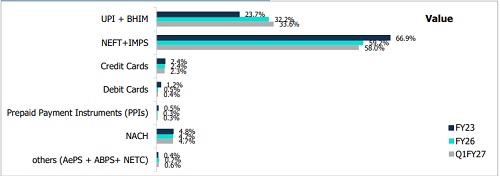
NEFT and IMPS still dominate with a majority share, but their share has declined gradually compared to FY23. UPI (including BHIM) has emerged as a key driver of structural growth, increasing its value share. The ecosystem is rapidly converging toward a UPI-led payments architecture, with continued headroom for share expansion.
Chart 2: UPI Cementing Leadership in Retail Payment Volumes
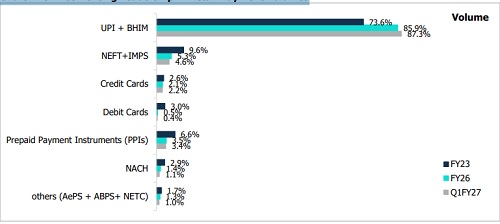
UPI has become the default rail for retail payment volumes, rising from 73.6% (FY23) to 86.8% (Q1FY27), with other modes now marginal. Its dominance is driven by wide QR acceptance, seamless real-time experience, almost zero-cost structure, and strong fit for everyday transactions. UPI is not just gaining share; it is entrenching itself as the core payments infrastructure, with sustainable drivers supporting further scale and limited disruption risk.
UPI’s Shift Towards Sustainable Growth
India’s UPI ecosystem is entering its next phase, with the government emphasising the need to balance rapid transaction expansion with the long-term sustainability and resilience of the digital payments infrastructure
Above views are of the author and not of the website kindly read disclaimer