India's private space sector reaches orbit as European industry still struggles
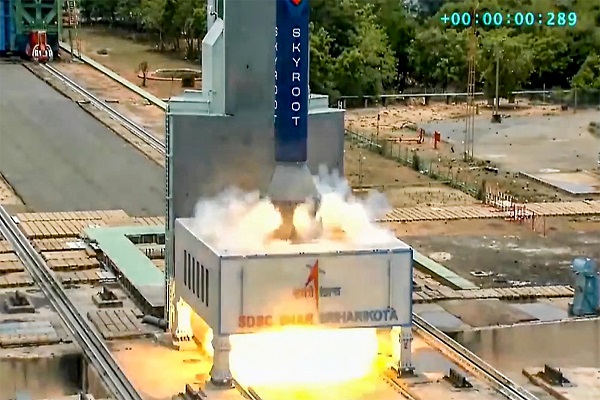
India’s private space sector marked a milestone in July, which Europe is yet to achieve, when Skyroot Aerospace became the first Indian private company to reach orbit with a domestically developed launcher, according to a new report.
"The achievement is significant despite the vehicle’s relatively modest size compared with launch systems operated by competitors in China, Russia, or the United States," the report from The European Conservative said.
Skyroot Aerospace successfully placed multiple payloads into low Earth orbit with its Vikram?1 rocket.
The report argued that India can offer competition, additional capacity and “a new reference point for the European space industry.”
The United States and China no longer remain the only contenders in the commercial space race as “India has now entered it with its own hardware, and Europe has every reason to pay attention,” it added.
The report suggested European operators collaborate with India for certain commercial, university or scientific payloads, diversifying an international launch market that remains heavily dependent on the United States.
Despite increased launches in 2025 following the introduction of Ariane 6 and Vega?C, it remains only a small fraction of a global market overwhelmingly dominated by the United States and China.
Further, the European Space Agency faces a potential capacity crunch for strategic programmes such as Galileo and Copernicus between 2029 and 2031 as new requirements could exceed the launch capacity available.
Several state?backed private launcher projects in Europe have yet to deliver an operational orbital service.
India’s space programme was almost entirely dominated by the state for over half a century. ISRO took the country from its first experiments in the 1960s to developing indigenous launch vehicles, reaching Mars in 2014 and landing near the Moon’s south pole with Chandrayaan-3 in 2023.
In 2020, the government opened the sector to private companies and created IN-SPACe to facilitate their access to public facilities, testing infrastructure and launch sites. The 2023 space policy completed the reform by separating ISRO’s research role, public commercial activity and the emerging private ecosystem.
That long-term strategy has shown results, with India now hosting over 400 space startups and targeting to increase the value of its space economy from around $8.4 billion in 2022 to $44 billion by 2033, including $11 billion in exports, the report noted.