Cotton Report 18th December 2025 by Amit Gupta, Kedia Advisory

Fundamentals
Swot Analysis
Strengths
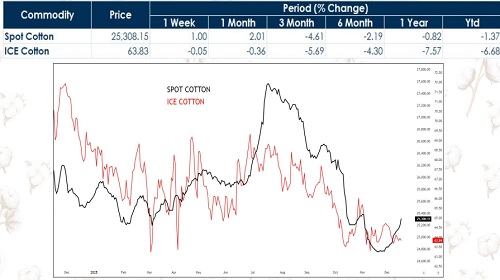
* Prices gained around 2% in a month amid export hopes amid a weaker rupee.
* Unseasonal weather conditions are emerging across parts of South India as Cyclone Bakung strengthens
* CCI initiated cotton procurement from October 1 across 14 centres at MSP.
* For 2024-25, Cotton production dropped 8.60% to 297.24 Lakh bales from 325.22 Lakh bales.
* Excess rains in AP–Telangana created yield concerns, tightening crop outlook regionally.
* Government increased MSP for 2025–26 season by nearly 11.84% annually.
Weaknesses
* Cotton arrival in mandis in northern belt records 49.66% surge compared to 2024
* India’s 2024–25 cotton imports surged to 39 lakh bales on cheaper global prices.
* Brazilian cotton imports rose nearly tenfold, intensifying pressure on domestic producers.
* Weak Chinese textile demand and synthetic competition continued weighing heavily on lint prices.
* China trimmed 2024–25 cotton import forecast by 300,000 tonnes, reducing demand expectations.
* The U.S., which takes nearly 29% of India's $38 billion annual textile exports, doubled tariffs on imports from India to as high as 50%, effective August.
Opportunities
* As per 1st Advance Estimates, 2025-26 cotton production seen at 292.15 Lakh Bales, down by 1.70% compacted to 2024-25.
* Total cotton pressing numbers for 2025-26 season are increased by 4.50 lakh bales and estimated the same at 309.50 lakh bales - CAI
* The CAI has increased its cotton exports for the 2025-26 season by 1.00 lakh bales to 18.00 lakh bales
* Global cotton production for 2025–26 was slashed by nearly 300,000 bales to 119.79 million bales
* Global ending stocks cut by 800,000 bales to 73.1 million, four-year low.
* USDA projects 2% decline in India’s 2025–26 production, tightening supply outlook.
* Pakistan cotton production dropped 30%, with only 594,000 bales reaching ginning centres.
Threats
* CAI has urged the Indian government to permanently remove the 11% import duty on raw cotton.
* Total cotton supply for the full 2025–26 season (up to September 2026) is projected at 420.09 lakh bales, compared with 392.59 lakh bales last year.
* The CAI has increased its cotton imports for the 2025-26 season by 5.00 lakh bales to 50.00 lakh bales of 170 kgs.
* Closing stock at the end of 2025-26 season on 30th September 2026 is estimated at 107.09 lakh bales which is higher by 46.50 lakh bales.
* Global consumption for 2025–26 lowered by almost 300,000 bales to 118.61 million bales, reflecting weaker mill use
* Higher MSP raises mill input costs, weakening India’s competitiveness in global markets.
CAI Crop Report
CONSUMPTION
The CAI has estimated total cotton consumption during 2025-26 season i.e. upto 30th September 2026 at 295.00 lakh bales of 170 kgs each as against 314.00 lakh bales of 170 kgs each in last year. Upto 30th November 2025, the consumption is estimated at 48.40 lakh bales of 170 kgs each.
COTTON PRESSING
As per the latest report submitted by upcountry associations and trade sources at the meeting of the CAI Crop Committee, total cotton pressing numbers for 2025-26 season are increased by 4.50 lakh bales and estimated the same at 309.50 lakh bales of 170 kgs each +/-3% from 305.00 lakh bales of 170 kgs each estimated previously.
IMPORTS
The CAI has increased its cotton imports for the 2025-26 season by 5.00 lakh bales to 50.00 lakh bales of 170 kgs each from 45.00 lakh bales of 170 kgs each estimated previously. The cotton imports estimated by the CAI for the season are higher by 9.00 lakh bales of 170 kgs each than 41.00 lakh bales of 170 kgs each estimated for the last year. Upto 30th November 2025, about 18.00 lakh bales of 170 kgs each are estimated to have arrived the Indian Ports.
EXPORTS
The CAI has increased its cotton exports for the 2025-26 season by 1.00 lakh bales to 18.00 lakh bales of 170 kgs each from 17.00 lakh bales of 170 kgs each estimated previously. Cotton exports for 2025-26 are maintained at the same level as estimated last crop year. Upto 30th November 2025, about 3.00 lakh bales of 170 kgs each are estimated to have been shipped by the country
CLOSING STOCK AS AT 30TH SEPTEMBER 2026
The closing stock at the end of 2025-26 season on 30th September 2026 is estimated at 107.09 lakh bales of 170 kgs each which is higher by 46.50 lakh bales of 170 kgs each from the closing stock of 60.59 lakh bales of 170 kgs each for the previous year on 30th September 2025.
Fundamentals
Domestic Supply Tightness Intensifies
At the domestic level, cotton fundamentals remain structurally tighter. Cyclone Montha’s impact across Telangana and Andhra Pradesh brought heavy rainfall, affecting boll development, fibre quality, and slowing harvesting operations. These key producing states experienced localized yield stress that is now evident in lower production expectations. Furthermore, India’s cotton acreage is down 2.60% at 110.03 lakh hectares, tightening the supply base even before weather disruptions occurred.
MSP Hike and CCI Procurement Support Farmers
The government’s decision to increase the MSP by 11.84% for 2025–26 and the CCI’s procurement at 14 centres from October 1 has offered significant support to growers. However, these measures cannot offset the drop in overall output. According to the third advance estimates, India’s cotton production has fallen 5.6%, declining from 32.52 million bales to 30.69 million bales. Additionally, unseasonal rains through late October have slowed arrivals further, adding uncertainty regarding immediate supply.
Imports Surge to Record Highs
Domestic tightness is being counterbalanced by a steep rise in imports. India’s cotton imports for the 2024–25 crop year have reached a record 39 lakh bales, supported by global price advantages and domestic supply shortfalls. Imports from Brazil have surged tenfold, reflecting a clear preference among textile mills for competitively priced overseas fibre. Weak Chinese textile demand, increased adoption of synthetic fibres, and lower global lint prices have collectively exerted pressure on spinning margins in India.
Global Demand Softens but Stocks Tighten
China’s agriculture ministry reducing its 2024–25 cotton import forecast by 300,000 tonnes signals subdued global consumption trends. Despite this, the global cotton balance sheet remains tightening. For 2025–26, the USDA has raised global consumption by 850,000 bales while cutting beginning stocks by nearly 1 million bales from last month. Global ending stocks are now projected at 73.1 million bales, marking the lowest level in four years. Additionally, Pakistan’s cotton sector continues to struggle, with production down 30% and only 594,000 bales reaching ginning factories by end-July.
Policy Measures and Their Market Impact
The Indian government’s extension of import duty exemption until December 2025 is likely to support continued high import volumes. At the same time, CAI estimates closing stocks at 60.59 lakh bales, almost double last year, ensuring near-term supply comfort for mills. However, the higher MSP significantly inflates mill input costs and may erode India’s competitiveness in global yarn and fabric markets.
Overall Fundamental Outlook
Taking all factors into account, the cotton market displays a neutral-to-slightly supportive fundamental tone. Domestic supply remains tight due to lower acreage and weather-related disruptions, but record imports and weak downstream demand prevent an overly bullish setup. Globally, tightening stocks and reduced production in key countries counterbalance softer Chinese buying, creating a fundamentally balanced market with mild upward undertones.
Above views are of the author and not of the website kindly read disclaimer
















More News

Quote on Silver up 30% in 2026 & the Outlook for the metal heading forward by Aamir Makda, C...