The Economy Observer :Jan’26 IIP: Grew at a three-month low by Motilal Oswal Financial Services Ltd
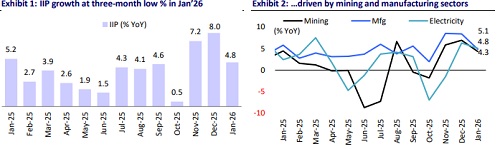
* India’s industrial production grew 4.8% YoY in Jan’26, marking a three-month low. The moderation follows a strong 8% YoY growth in Dec’25 and reflects unfavorable base effects rather than a sharp deterioration in underlying activity.
* The manufacturing sector, which carries the highest weight in the index, expanded 4.8% YoY in Jan’26, slowing from 8.4% in the previous month. Despite the moderation, the expansion was broad-based: 14 out of 23 manufacturing sub-sectors registered growth, while nine contracted.
* Investment-oriented industries such as metals, machinery, and motor vehicles continued to show resilience, indicating that the capex cycle remains supportive of industrial activity.
* In contrast, consumption-linked segments exhibited weakness. Sectors such as leather, wearing apparel, and pharmaceuticals saw muted or negative growth, pulling down overall manufacturing momentum
* The divergence is clearly visible in use-based classification: infrastructure and construction goods grew 13.7% YoY, the fastest pace in 29 months, supported by strong steel and cement output.
* Consumer durables output remained healthy with 6.3% YoY growth in Jan’26, but consumer non-durables contracted 2.7% YoY and remain broadly flat in FYTD terms, highlighting continued softness in mass consumption demand.
* Electricity generation recorded a sharp acceleration, possibly reflecting stronger seasonal demand, and partially offset slower growth in mining and manufacturing.
* Geopolitical tensions in the Middle East pose near-term risks through potential oil price volatility and export disruptions, given that the region accounts for a meaningful share (15%) of India’s goods exports.
* Overall, while industrial momentum has moderated, macro fundamentals remain consistent with GDP growth sustaining in the 7–7.5% range
Data highlights
IIP growth moderates to three-month low in Jan’26
* Industrial output grew 4.8% YoY in Jan’26, marking a three-month low. The print came on the back of an upwardly revised 8% YoY growth in Dec’25 and a relatively strong base of 5.2% YoY in January last year. On a sequential basis, growth momentum softened, largely reflecting unfavorable base effects and some moderation in key segments.
* For FYTD26, average IIP growth stands at 4.0% YoY, marginally lower than 4.2% YoY recorded in the corresponding period last year. While the overall trend remains stable, the January reading suggests that industrial activity is normalizing after the sharp acceleration seen in the previous month.
* Mining and manufacturing growth moderated compared to the same period last year, contributing to the overall deceleration in IIP. In contrast, electricity generation more than doubled on a YoY basis, likely reflecting stronger demand amid colder temperatures during the month. The surge in electricity output provided partial support to overall industrial growth.
Manufacturing growth eases but remain broad-based
* The manufacturing sector, which carries the highest weight in the IIP, expanded 4.8% YoY in Jan’26, almost halving from the strong 8.4% YoY growth recorded in Dec’25. Despite the moderation, the expansion was broad-based: 14 out of 23 manufacturing sub-sectors registered positive growth, while 9 contracted.
* Investment-linked industries such as metals, motor vehicles, and machinery continued to post robust growth, reflecting sustained capital expenditure momentum. However, consumption-oriented sectors showed weakness. Leather, textiles and apparel, and pharmaceuticals registered muted activity, weighing on overall manufacturing performance.
* The sharpest contractions were seen in wearing apparel, and leather & related products. That said, production of passenger vehicles and two-wheelers recorded double-digit growth during the month, indicating resilience within select discretionary segments.
Infra leads, consumption lags
* Use-based data reflects a clear divergence between infrastructure and consumption segments. Infrastructure and construction goods grew 13.7% YoY, the fastest pace in 29 months, supported by strong output in core sectors such as steel and cement. This underscores continued public and private investment activity and aligns with sustained capital expenditure trends.
* On the consumption side, performance was mixed. Consumer durables output grew 6.3% YoY, building on a healthy 7.1% YoY expansion a year ago. However, consumer non-durables contracted 2.7% YoY, even against a weak base of 0.1% YoY last year.
* In FYTD terms, consumer non-durables production remains broadly flat, highlighting subdued mass consumption demand. The relatively stronger 5.7% YoY growth in consumer durables remains a silver lining within the broader consumption basket.
External risks and outlook:
* Geopolitical tensions in the Middle East pose a near-term risk to industrial production, particularly through their impact on global oil prices and trade flows. With nearly 15% of India’s goods exports directed toward Middle Eastern countries, prolonged conflict could disrupt shipments and delay export demand.
* Overall, while IIP growth has moderated from recent highs, the underlying trend remains constructive. Strong infrastructure activity, stable investment momentum, and improving external trade conditions should help anchor industrial performance. We expect India’s GDP growth to sustain in the 7–7.5% range, even as IIP growth stabilizes at moderate levels in the near term.
For More Research Reports : Click Here
For More Motilal Oswal Securities Ltd Disclaimer
http://www.motilaloswal.com/MOSLdisclaimer/disclaimer.html
SEBI Registration number is INH000000412