Leading cement players accelerate green energy push; green power capacity likely to rise by nearly 50% to 5.8-6.0 GW by FY2028: ICRA
Rating agency ICRA expects India’s major cement companies to increase their green power capacity to 5.8-6.0 GW by March 2028 from around 4.0 GW as of March 2026, supported by planned investments of Rs. 12,000-13,000 crore over the next two years. The additional capacity is likely to generate annual savings of Rs. 6,200-6,700 crore, implying an attractive payback period of 1.8-2.2 years.
While cement remains one of the most emission-intensive industries, the major cement producers have laid out net-zero emission roadmaps over the next 15-20 years. The calcination process accounts for 57-60% of total emissions, while fuel combustion and electricity consumption account for 27-30% and 10-13%, respectively. This underscores the need for a multi-pronged decarbonisation strategy. The Indian cement industry is accelerating its decarbonisation efforts through increased adoption of green power, blended cement, alternative fuels and clinker efficiency improvements. Apart from sustainability commitments, this transition is also being driven by the need to mitigate fuel cost volatility and enhance cost competitiveness.
Providing further insights, Anupama Reddy, Vice President and Group Head, Corporate Ratings, ICRA, said: “The highly energy-intensive nature of cement manufacturing, coupled with persistent fuel price volatility and supply-side risks, is driving the sector’s transition towards green power. Among the various decarbonisation pathways available to cement producers, green energy remains one of the most commercially attractive options, ensuring both emission reduction and meaningful cost savings. Every 5% increase in green power replacement can lower power and fuel costs by Rs. 15-16 per tonne. Consequently, a 25% replacement level could translate into cost savings of Rs. 75-80 per tonne and support an operating margin expansion of 140-160 basis points.”
Exhibit 1: Trend in green power capacity for ICRA’s sample set
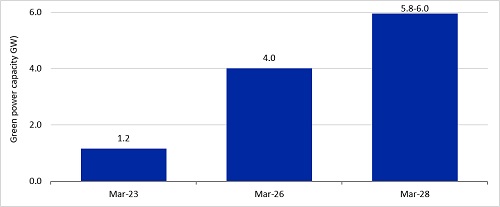
Source: ICRA Research
ICRA’s sample includes Ultratech Cement Limited, Shree Cement Limited, ACC Limited, Ambuja Cements Limited, Birla Corporation Limited, Dalmia Bharat Limited and The Ramco Cements Limited. The sample set accounts for 65% of installed cement capacity as of March 2026.
The industry is also evaluating advanced technologies such as carbon capture, utilisation and storage (CCUS). The Government of India has proposed an outlay of Rs. 20,000 crore over five years to support CCUS deployment across key sectors, including cement. However, large-scale commercial adoption is likely to remain gradual due to high implementation costs, significant energy requirements for carbon capture and processing, and limited CO? transportation and storage infrastructure.
“Blended cement remains an important lever for reducing emissions, although its adoption is expected to increase gradually due to application-specific requirements and customer preferences. At the same time, India's thermal substitution rate (TSR) of around 6% remains significantly below global benchmarks, indicating substantial headroom for greater use of alternative fuels such as biomass, municipal waste and industrial waste. Major cement companies are targeting TSR levels of 10-15% over the next three to five years, which should support both a reduction in emissions and an improvement in profitability,” Reddy added.
Green financing is also emerging as an important enabler for the industry's decarbonisation journey. While adoption remains at a nascent stage in India, some of the leading cement manufacturers have tapped sustainability-linked bonds and loans to finance renewable power projects, waste heat recovery systems and other sustainability-focused projects. With significant capital expenditure planned towards energy transition initiatives, green financing is expected to become a meaningful funding avenue in the coming years.
Above views are of the author and not of the website kindly read disclaimer