Weighted average cost of SGS rose by 64 bps to 7.72% in H1 FY2027 amid a tilt in preference for longer tenor papers by most states
In H1 FY2027, 25 states and two Union Territories (UTs) raised gross State Government Securities (SGS) issuances of Rs. 4.98 trillion, marginally lower than Rs. 5.01 trillion raised in H1 FY2026 (YoY growth of ~30%). The SGS issuances in H1 FY2027 were Rs. 754 billion or 13% lower than the indicated amount. Notably, 19 states had adopted the Benchmark Issuance Strategy (BIS) in a phased manner in H1 FY2027 that was introduced by the RBI in Q1. The variation between actual and indicated borrowings in H1 FY2027 was driven by three non-BIS states Karnataka, Haryana and Tamil Nadu (TN). A noteworthy trend in H1 FY2027, was the sharp increase in reissuance of SGS by states, with two-thirds of the total borrowing in this period took place through reissuances. In terms of tenor wise preference, most states preferred to borrow in the greater than 10-year segment in H1 FY2027. The Weighted Average Cost (WAC) of SGS rose by 64 bps to 7.72% in H1 FY2027 from H1 FY2026 amid a wide variation in the increase in WAC of states reflecting their change in tenor preferences as well as timing of borrowings.
Sharp pick-up in the trend of reissuances in SGS in H1 FY2027: Following the introduction of the BIS, 24 states opted to reissue SGS in H1 FY2027, up from 4-9 states during H1 FY2023-FY2026. These states borrowed Rs. 3.3 trillion through SGS reissuance, equivalent to two-thirds of the total Rs. 4.98 trillion borrowed by all states in H1 FY2027. These trends suggest that reissuance could become the default mode of borrowing by states in the coming months, in line with the GoI’s approach for issuing G-secs. In our view, the strategy of reissuances should increase the trading volumes of SGS in the secondary market, which at present seem to be constrained by the large number of ISINs of each state with low outstanding amount.
Most states display a shift in their preference for longer-tenor securities from the 10-year: The share of more than 10-year or longer-tenor borrowings jumped to 74% in H1 FY2027 from 50% in H1 FY2023 while the share of borrowings in the 10-year segment declined to 7% from 33%. Within the longer-tenor segment, the issuances have been concentrated in the 11-20-year maturity, which has accounted for over 40% of total issuances in recent years. Moreover, the share of 21-30-year securities has risen significantly to 30% in H1 FY2027 from just 6% in H1 FY2023.
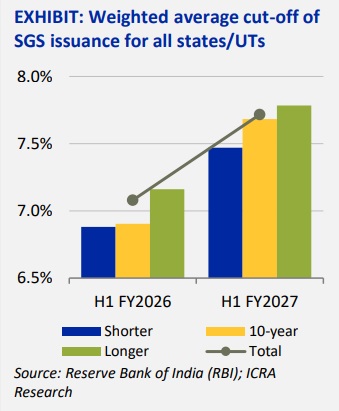
WAC of SGS rose by 64 bps to 7.72% in H1 FY2027: This reflected the broader hardening of bond yields and was a reversal of the declining trend in yields seen during H1 FY2024 to H1 FY2026. The WAC for shorter-tenor SGS, 10-year and longer tenor rose by 59 bps, 78 bps and 62 bps, respectively, in H1 FY2027 from H1 FY2026. However, among the 18 sample states, the WAC of SGS was up in a wide range of 40-131 bps in H1 FY2027 from H1 FY2026, mainly reflecting shifting tenor preference and timing of borrowings. The spread between the 10-year SGS and G-sec yields averaged above 70 bps in H1 FY2027 compared to 55 bps in H1 FY2026. The sharp decline in the share of 10-year SGS issuances in recent years compared to a sizable share of 10-year G-sec in total supply, has made the spread between the two somewhat less meaningful.
Above views are of the author and not of the website kindly read disclaimer