ICICI Prudential Mutual Fund launches ICICI Prudential Nifty Pharma ETF
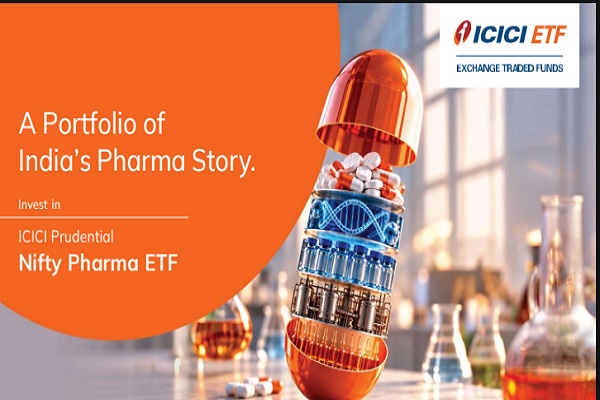
ICICI Prudential Mutual Fund today announced the launch of ICICI Prudential Nifty Pharma ETF, an open ended Index Exchange Traded Fund tracking the Nifty Pharma Index. The Nifty Pharma Index is designed to reflect the behaviour and performance of pharma companies forming part of the sector. This ETF is the latest addition to the fund house's sectoral ETF range.
India is the third largest pharma producer and supplies roughly 20% of the global generic medicines in terms of volume. Furthermore, India plays a major role in affordable HIV treatment and is a leading provider of low-cost vaccines. The industry has a market size of about USD 60 billion with over 3,000 companies, 10,500 manufacturing units, and 60,000 generic brands across 60 therapies. This market is projected to reach USD 80 billion by 2031.
Commenting on the launch, Chintan Haria, Principal - Investment Strategy, ICICI Prudential AMC said, “India's pharma sector is moving up the value chain, from generics towards complex generics, injectables, specialty medicines and biologics, while global majors are increasingly outsourcing higher-margin work such as biosimilars and CDMO (Contract Development and Manufacturing Organization) to Indian companies. With the ICICI Prudential Nifty Pharma ETF, we are offering investors a simple, exchange-traded way to take a diversified exposure to the pharma sector through a portfolio of scaled, global leaders.”
Why Indian Pharma Now?
Domestic growth: Domestic demand remains strong. The Indian pharmaceutical market grew by 13.5% year-on-year in June 2026, with new launches leading the way. Overseas, the picture is similarly encouraging. A patent cliff for biologic blockbusters between 2024 and 2026, together with rising demand from contract development and manufacturing organisations (CDMOs), is funnelling high-value work to India's speciality manufacturers. Source: NITI Aayog.
Policy support: Biopharma SHAKTI, the government's Strategy for Healthcare Advancement through Knowledge, Technology and Innovation, aims to secure record exports and attract deeper investment
in the sector. Supportive regulation in the form of closer harmonisation with the standards of America's Food and Drug Administration, the European Medicines Agency and the Pharmaceutical Inspection Co-operation Scheme is streamlining launches across several jurisdictions and cutting approval times. Even in terms of manufacturing, production-linked incentive schemes continue to support self-reliance in active pharmaceutical ingredients, reducing reliance on Chinese intermediates and, over time, improving margins. Together, these three measures reinforce one another and provide the industry with a robust policy backdrop. Source: Department of Pharmaceuticals
New growth vertical: GLP-1 drugs for obesity and diabetes have emerged as a new growth vertical following semaglutide's loss of patent protection. Once exclusivity ends, other manufacturers can enter the market. Because the drugs address two large therapeutic areas at once, capable companies gain a new line of business, adding to the policy tailwinds. Source: Department of Pharmaceuticals
Above views are of the author and not of the website kindly read disclaimer