Drone Cameras: Features and Uses – A Complete Guide to Modern Aerial Photography Technology
Drone cameras have transformed the way people capture photographs, record videos and explore the world from above. Once primarily used for military and specialised industrial applications, drones have become increasingly popular among photographers, filmmakers, travellers, content creators and businesses. With advanced camera systems, intelligent flight controls and improved battery technology, modern drone cameras offer exciting possibilities for both personal and professional use.
From capturing breathtaking aerial landscapes to inspecting infrastructure and monitoring agricultural fields, drone cameras are becoming valuable tools across multiple industries. Understanding their features, applications and limitations can help buyers choose the right device for their needs.
What Is a Drone Camera?
A drone camera is a camera mounted on an unmanned aerial vehicle (UAV) that can fly without a pilot physically onboard. It is usually controlled through a remote controller, smartphone application or automated flight system.
Most consumer drone cameras feature built-in cameras that capture high-resolution photographs and videos from different heights and angles. Advanced models also include stabilisation systems, GPS navigation, obstacle detection and intelligent flight modes.
Drone cameras are available in different sizes and configurations, ranging from compact beginner-friendly models to professional equipment designed for filmmaking, surveying and industrial applications.
Key Features of Modern Drone Cameras
Modern drone cameras combine advanced imaging technology with intelligent flight capabilities. Some of their most important features include:
1. High-Resolution Camera Quality
Camera resolution plays an important role in determining the clarity and detail of aerial photographs and videos.
Many modern drone cameras offer 4K video recording, while selected professional models support higher resolutions. Better image sensors can also improve low-light performance, colour reproduction and dynamic range.
High-resolution cameras are particularly useful for professional photography, real estate marketing, filmmaking and landscape documentation.
2. GPS Navigation and Positioning
GPS technology helps drones determine their location and maintain stable flight positions. It also supports automated navigation and return-to-home functionality on compatible models.
These features make drone operation easier, particularly for beginners who may not have extensive flying experience.
3. Gimbal Stabilisation
Camera stabilisation is essential for capturing smooth aerial footage.
Many advanced drones use mechanical gimbals, often with three-axis stabilisation, to reduce unwanted camera movements caused by wind or changes in drone direction.
This technology helps produce professional-looking videos with reduced shaking and smoother transitions.
4. Obstacle Detection and Avoidance
Obstacle detection systems use cameras, infrared sensors or other technologies to identify objects around a drone.
Depending on the model, these systems can help detect trees, buildings and other obstacles during flight. Some drones can automatically slow down, stop or adjust their movement when an obstruction is detected.
However, obstacle avoidance is not guaranteed in every direction or lighting condition, so pilots must remain attentive.
5. Intelligent Flight Modes
Many drone cameras offer automated flight features that simplify aerial photography and video recording.
Common intelligent flight modes include:
Follow Me: Allows compatible drones to track a moving subject.
Orbit Mode: Makes the drone circle around a selected subject.
Waypoint Navigation: Allows users to plan a flight path.
Return to Home: Helps the drone return to a designated location.
Panorama Mode: Captures wide-angle aerial photographs.
Timelapse: Records footage that can be combined into a faster-motion sequence.
These features are especially useful for travel photography, sports recording and content creation.
6. Battery Life and Flight Time
Battery capacity directly influences how long a drone can remain in the air.
Consumer drone models commonly offer approximately 20–45 minutes of advertised flight time per battery, although actual performance depends on wind, temperature, flying speed, payload and other conditions.
Buyers should also consider battery charging time and the availability of additional batteries.
7. Live Video Transmission
Modern drones often provide real-time video transmission to a remote controller or connected smartphone.
This feature allows pilots to view the camera's perspective while controlling the drone. It is useful for framing photographs, recording videos and navigating aerial environments.
Major Uses of Drone Cameras
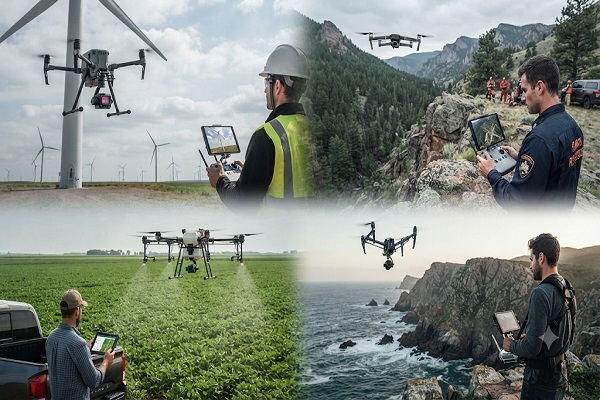
Drone cameras are no longer limited to recreational photography. Their applications now extend across several industries.
1. Aerial Photography and Videography
Drone cameras allow photographers and filmmakers to capture landscapes, buildings, beaches, mountains and cityscapes from unique perspectives.
They are widely used for:
Wedding photography and cinematography.
Travel videos and tourism promotions.
Wildlife and nature documentaries.
Real estate photography.
Commercial advertisements.
Sports and event coverage.
Aerial footage can add depth and visual appeal to professional productions.
2. Agriculture and Farming
Agriculture is one of the growing application areas for drone technology.
Agricultural drones equipped with suitable cameras and sensors can help farmers monitor crops, assess field conditions and identify areas that may require attention.
Their applications include:
Crop health monitoring.
Identifying irrigation-related issues.
Mapping agricultural land.
Monitoring crop growth.
Assessing damage after extreme weather.
Specialised agricultural drones can also support precision spraying, subject to applicable regulations and safety requirements.
3. Real Estate and Construction
Drone cameras provide aerial views of residential properties, commercial buildings and construction sites.
Real estate professionals use them to showcase property layouts, surrounding neighbourhoods, gardens and access roads.
In construction, drones can help monitor project progress, document site conditions and create aerial maps. Specialised surveying workflows can also support measurements and three-dimensional site models.
4. Disaster Management and Emergency Response
Drone cameras can provide valuable aerial information during natural disasters and emergency situations.
They may help authorities assess flood-affected areas, monitor forest fires, locate damaged infrastructure and identify difficult-to-access locations.
Thermal imaging drones can also help trained emergency teams detect heat signatures during certain search-and-rescue operations.
Their ability to access challenging environments can improve situational awareness while reducing the need to immediately send personnel into dangerous areas.
5. Travel and Tourism
Travel enthusiasts increasingly use drone cameras to capture destinations from above.
They can record beaches, mountain ranges, historical landscapes and scenic roads, creating engaging travel content.
However, flying drones near airports, heritage monuments, national parks and crowded tourist destinations may be restricted or prohibited. Travellers should always check local rules before flying.
6. Infrastructure Inspection
Drone cameras are useful for inspecting structures that are difficult or expensive to access manually.
Industries use specialised drones to examine:
Bridges and highways.
Electricity transmission lines.
Wind turbines.
Solar power installations.
Industrial facilities.
Telecommunications infrastructure.
Factors to Consider Before Buying a Drone Camera
Selecting a drone requires more than comparing camera resolution or advertised flight time.
Here are some important factors to evaluate:
1. Camera specifications: Check resolution, sensor size, video frame rates and image quality.
2. Stabilisation: Look for suitable gimbal stabilisation if smooth video recording is important.
3. Battery performance: Compare realistic flight times and the availability of spare batteries.
4. GPS and safety features: Consider positioning systems, return-to-home functions and obstacle detection.
5. Portability: Foldable drones are convenient for travel and outdoor photography.
6. Ease of use: Beginners should look for simple controls, tutorials and useful automated flight features.
7. Repair and maintenance: Check the availability of replacement propellers, batteries, service centres and spare parts.
8. Legal requirements: Verify registration, permissions, airspace restrictions and other applicable drone regulations before purchasing or operating a drone.
Drone Camera Regulations in India
Drone operations in India are governed by the Drone Rules, 2021, along with subsequent amendments and applicable government directions.
Before operating a drone, users should understand the relevant requirements.
Important considerations include:
Check the Digital Sky platform and official airspace maps before flying.
Understand whether the drone category requires registration and a Unique Identification Number.
Follow applicable remote pilot certificate requirements.
Obtain permissions where required.
Respect restrictions around airports, military installations and other sensitive locations.
Avoid flying over restricted areas or violating privacy.
Follow applicable operating conditions for green, yellow and red airspace zones.
The requirements can vary according to drone category, weight and intended operation. Users should consult the Directorate General of Civil Aviation (DGCA) and official government resources for the latest rules.
Advantages of Drone Cameras
Drone cameras offer several benefits for personal and commercial applications.
Unique aerial perspectives: Capture photographs and videos from angles that traditional cameras cannot easily achieve.
Improved accessibility: Reach certain difficult-to-access locations without extensive equipment.
Time efficiency: Support faster site inspections and visual documentation.
Creative flexibility: Enable innovative photography and filmmaking techniques.
Versatile applications: Serve industries ranging from agriculture to construction and entertainment.
Remote operation: Allow users to capture footage from a distance while maintaining visual awareness of the drone.
Limitations of Drone Cameras
Despite their advantages, drone cameras have certain limitations.
Limited battery life restricts continuous flying time.
Strong winds and adverse weather can affect flight stability.
Advanced models can be expensive.
Repairs and replacement batteries may increase ownership costs.
Some locations have strict flying restrictions.
Camera performance may vary in low-light conditions.
Privacy and safety concerns require responsible operation.
Understanding these limitations helps users make informed purchasing and operating decisions.
The Future of Drone Camera Technology
Drone camera technology is expected to continue evolving with improvements in artificial intelligence, imaging systems, battery technology and autonomous navigation.
AI-powered features are making it easier for drones to recognise subjects, track movement and assist with automated photography. Improvements in thermal imaging, multispectral sensors and three-dimensional mapping are also expanding their industrial applications.
Future developments may include more efficient batteries, improved obstacle detection, better low-light photography and increasingly sophisticated autonomous flight systems.
As technology advances, drone cameras are likely to become even more useful for creative professionals, businesses, researchers and public services.
Conclusion
Drone cameras have become versatile technological tools that are transforming photography, filmmaking, agriculture, construction, tourism and infrastructure inspection. Their combination of aerial mobility, high-resolution imaging, intelligent flight modes and stabilisation features offers opportunities for both personal and professional use.
Before purchasing a drone, users should consider camera quality, battery performance, safety features, portability and intended applications. It is equally important to understand local flying regulations and operate responsibly.
With continued technological innovation, drone cameras are set to play an increasingly important role in how people capture images, collect information and interact with the world around them.