Digital Guest Services in International Tourism: Contactless Hotels, Mobile Check-In and Smart Travel
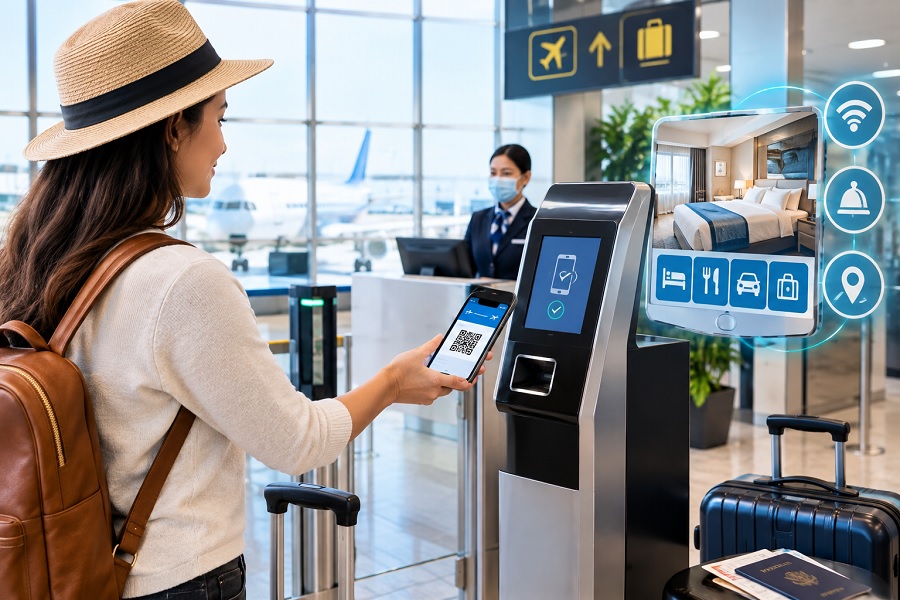
Contactless International Travel and Digital Guest Services: Trends for 2026
Contactless international travel is becoming an important part of the digital transformation of tourism. Airlines, airports, hotels and tourism businesses are increasingly using digital identity, biometrics, mobile applications, digital payments and automated services to reduce manual processes and make travel more convenient.
In 2026, the International Air Transport Association's One ID programme is working toward an end-to-end journey in which travellers can use trusted digital credentials and biometric verification instead of repeatedly presenting physical travel documents. IATA reported in April 2026 that proof-of-concept projects had demonstrated contactless, biometric-enabled international travel across multiple airlines, airports and digital identity systems.
At the accommodation stage, digital check-in, mobile room keys, in-app messaging and digital checkout are also becoming part of the guest experience. Hilton, for example, offers digital check-in and Digital Key at participating properties, while Oracle Hospitality provides technology for mobile check-in, ID scanning, secure payments and mobile keys.
What Is Contactless International Travel?
Contactless international travel refers to travel processes that reduce the need for repeated physical document handling and face-to-face administrative interactions.
It can involve:
Digital travel credentials
Mobile boarding passes
Biometric identity verification
Automated airport checkpoints
Digital immigration processes where available
Contactless payments
Mobile hotel check-in
Digital room keys
App-based guest services
Digital checkout
The concept does not mean that every traveller can currently travel internationally without a physical passport. Availability depends on the country, airport, airline, government systems and technology being used.
How Digital Identity Is Changing International Travel
Digital identity is one of the most important components of contactless travel.
IATA's One ID framework envisions travellers receiving digital credentials in a trusted wallet, sharing the required information with airlines or other authorised parties with consent, completing pre-travel checks and then using biometric recognition at participating airport touchpoints.
The purpose is to reduce repeated document checks while allowing passengers to share only the information needed for a particular transaction.
Biometric Airport Experiences
Biometric technology can allow passengers to be identified using facial recognition or other approved biometric methods.
Potential airport applications include:
Check-in
Bag drop
Security access
Immigration
Lounge access
Boarding
IATA's 2026 proof-of-concept results found that digital identity and biometric verification can support contactless journeys across different systems and borders, although broader adoption still requires governments to establish the legal and technical frameworks needed for Digital Travel Credentials.
Mobile Travel Credentials
A future contactless journey can begin before the traveller leaves home.
Passengers may be able to store digital travel credentials in a mobile wallet and share relevant information in advance. IATA describes this as part of digitalisation of admissibility, where airlines can verify travel requirements before the passenger reaches the airport.
This could reduce paperwork and make the airport process more predictable.
Contactless Airport Journey
A digital airport journey can potentially follow this sequence:
Booking → Digital Identity → Pre-Travel Verification → Check-In → Bag Drop → Security → Immigration → Boarding
Not all airports currently offer every stage. Travellers should check the specific requirements of their airline and destination before departure.
Benefits of Contactless International Travel
Faster Passenger Processing
Automated identity verification can reduce repetitive manual document checks at participating airport touchpoints.
Greater Convenience
Travellers may be able to manage identity information, boarding credentials and travel documents through a mobile device.
Reduced Paper Dependence
Digital processes can reduce the need to repeatedly print or physically present travel documents.
Better Operational Efficiency
Airlines and airports can automate parts of passenger processing and potentially manage growing passenger volumes more efficiently.
More Personalised Travel
Digital platforms can connect travel information, booking details and services in one place, creating opportunities for a more integrated passenger experience.
Privacy and Data Protection
Convenience is only one part of digital travel. Privacy and data security are equally important.
IATA's One ID framework emphasises passenger control, informed consent and selective disclosure, meaning that participating systems should request only the information required for a particular transaction.
Travellers should understand:
What information is being collected
Who receives the information
How biometric data is handled
How long information is retained
Whether participation is optional
What alternative manual process is available
Digital systems should also comply with applicable privacy and data-protection laws.
Digital Guest Services in Hotels
Contactless travel does not end at the airport. Hotels are also developing digital guest services that allow travellers to manage parts of their stay through smartphones.
Common services include:
Digital check-in
Room selection
Digital room keys
Mobile payments
In-app messaging
Restaurant reservations
Service requests
Digital checkout
Digital receipts
Hilton's 2026 mobile-app information describes digital check-in, room selection, Digital Key, hotel messaging, restaurant reservations and digital checkout as available features at participating properties.
Digital Hotel Check-In
Digital check-in allows guests to complete some arrival steps through a mobile application before reaching the hotel.
For example, Hilton's Digital Check-in lets eligible members select an arrival time and, where available, choose their room before arrival.
Hotels can also use kiosk or mobile systems to collect identification information and support automated check-in processes.
Oracle Hospitality describes contactless check-in solutions covering booking, pre-check-in, check-in, stay and checkout, including room assignment, ID scanning, secure payments and mobile keys.
Mobile Room Keys
Digital room keys allow guests to use a smartphone instead of a traditional physical key card where the hotel supports the technology.
Hilton's Digital Key, for example, can be used for equipped guest rooms and selected key-controlled areas such as elevators, fitness centres, parking areas and pools.
Digital key systems can also provide flexible access for families and travel companions. Hilton currently allows eligible users to share a Digital Key with up to four additional guests.
Digital Hotel Communication
Mobile hotel applications can also provide a communication channel between guests and hotel staff.
Guests may be able to:
Ask questions
Request housekeeping
Request maintenance
Ask for local recommendations
Make restaurant reservations
Request additional amenities
Receive hotel announcements
Hilton's current app experience includes in-app communication with hotel team members for questions, support and recommendations.
Contactless Payments
Digital payment systems are another important element of contactless hospitality.
Hotels can use secure electronic payment systems for:
Room charges
Restaurants
Spa services
Parking
Additional hotel services
Checkout
Oracle Hospitality describes contactless payment solutions that use secure payment interfaces and tokenisation to reduce exposure of sensitive card data.
Travellers should still verify that their payment method is accepted in the destination country.
Digital Checkout
Digital checkout allows guests to review charges and complete departure procedures through a mobile application or other digital system.
This can reduce waiting time at reception and provide a digital record of the stay. However, physical checkout may still be required at some properties.
Benefits of Digital Guest Services
Convenience
Guests can manage services from their phones without visiting the reception desk for every request.
Personalisation
Digital systems can use booking information and stated preferences to provide more relevant information during the stay.
Better Communication
In-app messaging can provide a direct channel between guests and hotel teams.
Operational Efficiency
Automation can help hotel staff manage routine administrative processes while focusing on guest-facing service.
Contactless Experience
Guests who prefer fewer physical interactions can complete some hotel tasks digitally.
Challenges of Contactless Travel
Despite the advantages, digital travel also has limitations.
Technology Dependence
Travellers may become dependent on a working smartphone, internet connection, battery and compatible applications.
Digital Exclusion
Not every traveller is equally comfortable with digital systems or biometric technology.
System Compatibility
Different airlines, airports, hotels and governments may use different technologies.
Privacy Concerns
Biometric and identity systems involve sensitive information and require strong privacy protections.
Technical Failures
Application errors, connectivity issues or device problems can interrupt the travel experience.
Are Physical Documents Disappearing?
Not completely.
The long-term vision of One ID is more digital, but today's international travel still depends on national passport, visa and border requirements. IATA notes that global adoption requires countries to establish systems capable of issuing and accepting Digital Travel Credentials across borders.
Travellers should therefore continue to carry and protect their required physical travel documents unless their airline and destination explicitly confirm an accepted digital alternative.
Contactless Travel for Families
Digital services can be particularly useful for families travelling with children.
Possible benefits include:
Shared digital hotel keys
Mobile boarding information
Digital room selection
App-based hotel communication
Paperless booking information
However, parents and guardians should keep necessary identification and travel documents available and understand the specific requirements for children.
Contactless Travel for Business Travellers
Business travellers can benefit from faster airport and hotel procedures.
A digital journey can potentially allow travellers to:
Complete check-in before arrival
Access airport services digitally
Use mobile room keys
Make digital payments
Communicate with hotels through apps
Receive electronic receipts
This can be useful for travellers with tightly scheduled itineraries.
Accessibility and Digital Travel
Digital travel can also support accessibility when systems are designed inclusively.
Applications can provide information through multiple formats, while digital communication may help some travellers request assistance before arrival.
However, accessibility varies by provider. Travellers should contact airlines, airports and hotels in advance when specific assistance is required.
Sustainable Benefits of Digital Travel
Digital processes can reduce some paper-based documentation and administrative materials.
Technology can also help tourism businesses understand passenger flows and manage resources more efficiently.
However, digitalisation itself has an environmental footprint through devices, data centres, networks and electronic equipment. Sustainability therefore requires efficient technology alongside responsible digital infrastructure.
Future of Contactless International Tourism
The future of international tourism is likely to involve greater integration between identity, travel bookings, airport processing, accommodation and destination services.
A possible future journey could look like:
Digital Booking → Digital Travel Credential → Pre-Travel Verification → Biometric Airport Journey → Digital Hotel Check-In → Mobile Room Key → In-App Guest Services → Digital Checkout
IATA's 2026 One ID programme demonstrates that important parts of this journey are already being tested or implemented, although global availability remains uneven.
What Travellers Should Check Before Booking
Before relying on contactless services, travellers should confirm:
Whether their airline supports digital identity or biometric processing.
Whether the departure and arrival airports support the required technology.
Whether their destination accepts the necessary digital travel credentials.
Whether their hotel provides digital check-in or mobile keys.
Whether a physical passport or identification document is still required.
Whether the smartphone application works in the destination.
Whether an alternative manual process is available.
Conclusion
Contactless International Travel and Digital Guest Services are changing how travellers interact with airlines, airports and hotels. Digital identity, biometrics, mobile check-in, digital room keys, contactless payments and in-app hotel services can reduce repetitive manual processes and create a more connected travel experience.
In 2026, IATA's One ID initiatives and proof-of-concept projects demonstrate that biometric and digital-identity-based international travel is technically achievable, while hotel platforms are already offering several digital services to participating guests.
At the same time, digital travel should not be viewed as completely passport-free or universally available. Privacy, cybersecurity, accessibility, interoperability and reliable alternatives remain important considerations.
The future of international tourism is likely to be increasingly digital, but the most successful systems will need to combine technological convenience with secure identity management, traveller choice and dependable human support.