Jeera Research Report 21st January 2026 by Kedia Advisory

Supply Tightness Meets Improving Technical Structure

Key Highlights
* Rabi 2025–26 acreage in Gujarat estimated at 4.08 lakh hectares, ~7% below the three-year average.
* Weather variability and moisture stress raise yield and quality risks in key belts.
* Carryover stocks remain limited after steady domestic and export offtake in 2025.
* Weekly charts show a Rounding base formation, indicating medium-term trend reversal.
* Prices trade above key retracement supports, with momentum improving alongside volumes
Jeera fundamentals remain tight as the 2025–26 rabi season progresses, supported by measurable supply-side constraints. In Gujarat, which accounts for over 60% of India’s cumin output, planted area has declined to 4.08 lakh hectares, nearly 30,000 hectares lower than the recent three-year average. This reduction reflects crop switching and moisture stress during early sowing.
Field reports from Rajasthan and Gujarat also indicate dew-related crop stress, raising concerns over seed weight and export-quality recovery. On the demand side, limited carryover stocks—following consistent exports of around 2.2–2.4 lakh tonnes annually and firm domestic consumption—have reduced buffer availability entering the new season. Harvest arrivals from February onward are expected to improve gradually, but overall availability is unlikely to be comfortable.
Technical Outlook with Key Levels (Weekly Chart)
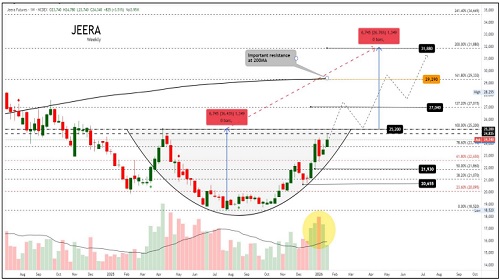
Jeera futures are showing a clear technical trend reversal on the weekly chart after a prolonged corrective phase. Prices have formed a well-defined rounding bottom between Rs 18,500–19,000, indicating sustained accumulation at lower levels. The subsequent breakout above the neckline zone of Rs 23,000–23,300 confirms a shift from a bearish to a bullish medium-term structure.
Post-breakout, prices are trading comfortably above the 38.2% and 50% Fibonacci retracement levels, reinforcing the strength of the move. The immediate support zone is placed at Rs 23,400–23,800, which coincides with the previous resistance-turned-support area. A deeper corrective support lies near Rs 21,900–22,100, while the broader trend remains intact as long as prices hold above Rs 20,600–20,900, the pattern invalidation level.
On the upside, the first technical resistance is seen at Rs 27,000–27,200 (127.2% Fibonacci extension). A sustained breakout above this zone can open the path toward Rs 29,200–29,500 (161.8% extension), followed by a stretched medium-term objective near Rs 31,800–32,000 (200% extension).
Overall, the price structure of higher highs and higher lows, combined with improving volumes on rallies, suggests that dips are likely to remain buy-on-decline opportunities within the prevailing uptrend.
Above views are of the author and not of the website kindly read disclaimer