Earnings Deliver, FIIs Return: India's Breadth Widens as Gold Surges and AI Finds Its Footing

AQUA PMS returned 3.07% in August 2026 against –0.09% for the BSE 500 TRI, taking its since-inception CAGR to 18.93% versus 13.55% for the benchmark · ATOM PMS delivered 9.9% against a 0.1% decline for the BSE 500 TRI — its strongest monthly alpha since inception · MADP returned 2.84% versus 0.28% for the Nifty Multi Asset Index · Domestic institutional buying extends to a 38th consecutive month as FIIs return with their strongest monthly inflow since September 2024, even as Q1 FY27 earnings mark a 10-quarter high and gold surges 10% on renewed dollar-debasement fears
PL Asset Management, the asset management arm of PL Capital Group, has released its PMS Monthly Newsletter for August 2026. India's Q1 FY27 corporate earnings accelerated to a ten-quarter high, foreign institutional investors returned with their strongest monthly inflow since September 2024, and mid- and small-cap stocks led the market's advance — even as the Nifty 50 slipped 1.24% amid a hawkish Fed, a surging gold price and an Nvidia-led revival in global AI sentiment.
Four global forces shaped August. Nvidia's blowout second-quarter results and a 70% revenue-growth projection reignited the AI capex cycle, sending the stock up ~9% in a day and lifting semiconductors and hyperscalers worldwide (MSCI World +2.9%; MSCI EM +3.6%). A nascent Iran-Oman shipping framework eased the Strait of Hormuz bottleneck without reversing July's oil surge — Brent rose 7.9% for the month, touching ~$94.83/bbl after a 21 August Iranian missile launch before settling near $86–$89/bbl. Fed Chair Kevin Warsh struck a hawkish tone at Jackson Hole, keeping a September hike in play, even as a surprise US Treasury long-bond buying programme weighed on the dollar (DXY –0.5%) on fresh fiscal-debasement fears. That narrative drove gold up 10% to a three-month high of ~$4,657/oz intra-month, Bitcoin up 23% to ~$77,357, and the Bloomberg Agriculture Spot Index up ~13.4% on continuing Hormuz-linked shipping disruption.
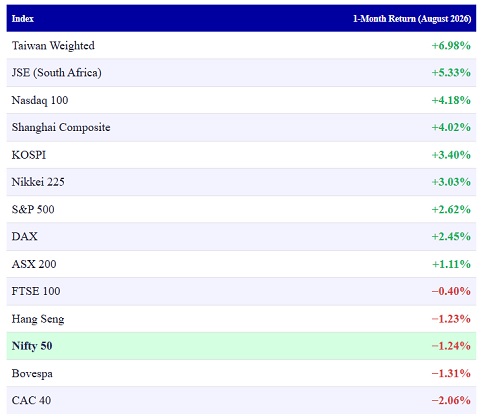
Global equities diverged again. Taiwan Weighted led (+6.98%), followed by Nasdaq 100 (+4.18%) and Shanghai Composite (+4.02%) as the AI trade found its footing, while CAC 40 (–2.06%) and Bovespa (–1.31%) lagged. The Nifty 50 slipped 1.24% to close August at 24,074.86, with the rupee up 0.25% to 95.18/$ as India's 10-year yield eased 13 bps to ~6.64% — even as the earnings and flow story continued strengthening beneath the index-level dip.
Domestic Buying Streak Extends as Foreign Flows Turn Decisively
DIIs — mutual funds, insurers and pension funds — extended their net buying streak to 38 consecutive months in August, the longest since 2007, absorbing the FII selling that persisted between March and June. FIIs delivered the reversal the market was waiting for: Rs 29,631 crore invested in August, the strongest monthly inflow since September 2024 and a 23-month high, a second straight month of buying after four months of heavy selling that totalled ~Rs 2.1 lakh crore. Combined with July's Rs 20,200 crore, the two-month FII total of Rs 49,831 crore broadly offset the entire June outflow.
The buying was selective, not index-wide: financials led (Rs 6,535 crore in the first fortnight), followed by autos, IT, consumer services and healthcare, while telecom, capital goods, power and realty saw outflows — explaining why the Nifty 50 still dipped even as broader indices outperformed. The ownership base keeps broadening: stocks with meaningful foreign holding have grown from ~900 to ~1,300 over four years, even as aggregate foreign ownership sits near a multi-year low as a share of market cap — rotation and re-engagement rather than a wholesale return, leaving more room than usual for incremental buying to move prices.
Structural domestic demand continues to underpin the buying: monthly SIP inflows into Indian mutual funds now run at an estimated Rs 23,000–24,000 crore, a pace that has climbed steadily every year since 2020 and operates largely independently of FII sentiment cycles.
Earnings Acceleration Confirms the Growth Story
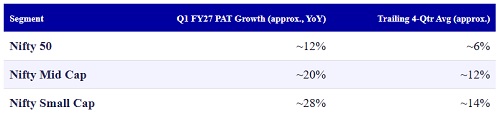
Q1 FY27 delivered the broadest earnings acceleration in ten quarters. Nifty 50 PAT grew at its fastest pace in 10 consecutive quarters, prompting Motilal Oswal, PhillipCapital and other brokerages to raise FY27 estimates, while the broader market ran hotter still — mid-cap PAT up ~20% YoY, small-cap PAT up ~28%. Sector leadership was broad: capital goods, autos, metals, financials and healthcare all beat, while IT, chemicals and real estate lagged. Two straight quarters of double-digit growth — 18% in Q4 FY26, accelerating further in Q1 FY27 — mark a regime shift from FY26's slower single-digit pace. Real GFCF grew 11.9%, confirming a genuine investment-cycle pickup rather than a one-off beat.
The H2 2026 IPO Surge — A Confidence Signal Worth Noting: August triggered the largest listing rush in 11 months — 23 mainboard IPOs, taking 2026 mainboard capital raising past Rs 80,698 crore. The H2 pipeline spans Rs 4.72 trillion across 238 companies, led by Reliance Jio (est. Rs 37,700 crore, 100% fresh issue, SEBI approval 28 August), NSE (est. Rs 30,000–31,000 crore, DRHP filed 4 September) and fintechs Razorpay (~$600m) and PhonePe (~$1.3bn) — a leading confidence signal for the primary market.
Macroeconomic Indicators Remain Supportive

India's real GDP grew 7.8% YoY in Q1 FY27, beating expectations and cementing its position as the world's fastest-growing major economy, up from 6.9% in Q1 FY26. Growth was broad-based — GVA +8.2%, nominal GDP +10.3%, services +9.3%, manufacturing +7.7%, construction +7.6% — with GFCF surging 11.9%, consumption up 7.1% and exports up 12.0%. Agriculture (+3.7%) and mining (–3.1%) were the only laggards. The RBI's August MPC held the repo rate at 5.25%, upgraded its FY27 GDP forecast to 6.7% and trimmed its inflation projection to 5.0% — supportive without being forced to act. The one caveat: August CPI is projected to hit a 20-month high on food, fuel and record sugar prices, a read-through of Hormuz-driven energy costs (US LPG now covers 73% of India's import needs) — not yet structural per the RBI, but the key variable into September's MPC.
The Valuation Angle — India's Multiple Normalises Even as Earnings Still Need to Deliver
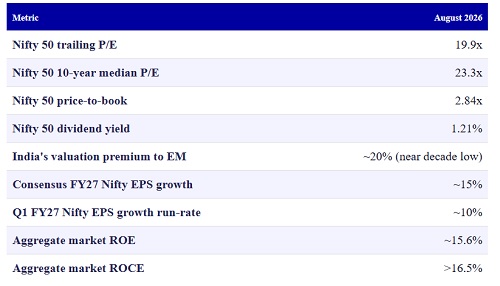
Indian equities are no longer uniformly expensive, with large-cap valuation comfort improving even as pockets of the broader market stay demanding. The Nifty 50 trades at ~19.9x trailing earnings — 10–15% below its 10-year median of 23.3x — with a P/B of 2.84x and 1.21% dividend yield pointing to the same normalisation. India's valuation premium to EM has compressed to ~20%, near a decade low. The multiple still needs earnings delivery: consensus expects ~15% FY27 Nifty EPS growth against a Q1 run-rate closer to 10%. Earnings quality remains strong, though, with aggregate ROE ~15.6% and ROCE above 16.5% — profitability still exceeding the cost of capital rather than being leverage-driven.
Siddharth Vora, Head – Quant Investment Strategies & Fund Manager, PL Asset Management
August Said What July Was Setting Up: Breadth Is Back, and It's Earnings-Driven
“What we were watching for in July was whether the earnings acceleration would broaden beyond a handful of sectors. August answered that. Q1 FY27 was the strongest quarter in ten, and it wasn't a concentrated beat — capital goods, metals, financials, autos and healthcare all delivered, with growth showing up at the PAT line across large, mid and small caps together. That breadth doesn't happen by accident; it reflects a genuinely running investment cycle, with Gross Fixed Capital Formation growing 11.9% in real terms.
The Nifty's 1.24% dip, against 1.7% and 2.5% gains in mid and small caps, is the market correctly pricing this shift — index heavyweights in FMCG, energy and IT carry more global rate and commodity sensitivity than the domestic recovery names lower down the cap spectrum. Our strategies have been positioned for this divergence, and August's performance across AQUA, ATOM, TRINITY and ELEVATE reflects that.
Both pools of capital are now pointed the same way for the first time since early 2026. FIIs put Rs 29,631 crore to work in August — the most in 23 months — after Rs 20,200 crore in July, while DIIs have bought for 38 straight months. Foreign ownership is near a multi-year low, so the room for incremental buying to move prices is larger than usual. We're watching closely rather than treating it as a permanent shift, but the direction and scale are meaningful.
We're not blind to the risks. Inflation is heading to a 20-month high on food, fuel and sugar — a read-through of elevated crude and Gulf shipping disruption, with US LPG now covering 73% of India's imports. The Fed's Jackson Hole tone was hawkish, September brings a live rate decision, and the Rs 4.72 trillion H2 IPO pipeline will draw secondary-market liquidity. These are real headwinds, which is why we keep prioritising earnings quality over chasing momentum.
But the core of the thesis is intact. Earnings confirmed, flows turning, domestic macro supportive and the investment cycle running.”
- Siddharth Vora, Head – Quant Investment Strategies & Fund Manager, PL Asset Management
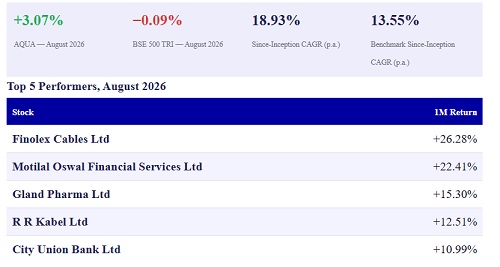
AQUA: +3.07% in August; Since-Inception Track Record Extends to 18.93% p.a.
Open-ended · Benchmark: BSE 500 TRI · Manager: Mr. Siddharth Vora · Inception: 12 June 2023 · Horizon: 5 Years+
* August Performance: AQUA returned 3.07% in August against –0.09% for the BSE 500 TRI, an alpha of 3.16%. The 1-year return stands at 12.98% vs 4.72% (alpha: 8.26%), and since-inception at 18.93% vs 13.55% (alpha: 5.38%) — reflecting the strategy's ability to adapt its factor, sector and size exposures as regimes evolve.
* Sector Positioning: Industrials (28.45%, the largest allocation) gained 3.53%; Financials (20.66%) added steady contribution. The strategy avoided Energy and Communication Services entirely, which fell 2.22% and 4.48% — a disciplined exclusion that added meaningfully to relative performance.
* Market Cap & Style: The portfolio stayed diversified — 33% large caps, 33% mid caps, 29% small caps, 5% cash — with highest weights in Momentum and Value, underweight Low Volatility and Growth. Beta stood at 1.08, moderately aggressive in line with the improving risk-on environment.
MADP: +2.84% in August; 1-Year Alpha Widens to 9.23 Percentage Points
Open-ended · Benchmark: Nifty Multi Asset · Manager: Mr. Siddharth Vora · Inception: 7 June 2021 · Horizon: 5 Years+
* August Performance: MADP returned 2.84% in August against 0.28% for the Nifty Multi Asset Index, an alpha of 2.56%. Over the past year, MADP has returned 16.77% against 7.54% (alpha: 9.23%).
* Asset Positioning: Gold (27.64%) was the standout contributor, rising 8.7% on debasement fears and dollar weakness. Within equities, mid caps (+1.72%) and small caps (+2.52%) added positive contribution while the 0.20% debt buffer maintained capital efficiency.
* Allocation Mix: Equity allocation: large caps 35.48%, mid caps 14.78%, small caps 21.90% — total equity 72.16%, gold 27.64%, a mix well suited to a month when both asset classes delivered.

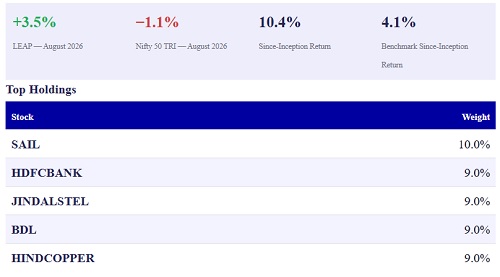
LEAP: +3.5% in August — A Sharp Reversal from July's Headwind
Open-ended · Benchmark: Nifty 50 TRI · Managers: Mr. Sandeep Neema and Mr. Siddharth Vora · Inception: 27 March 2026 · Horizon: 3-5 Years
* August Performance: LEAP returned 3.5% in August against a 1.1% decline for the Nifty 50 TRI, an alpha of 4.6pp — a sharp reversal from July's narrow-rally headwind. Since inception it has returned 10.4% against 4.1% (alpha: 6.3pp), a lead August extended further.
* Sector Positioning: Materials and Financials drove outperformance — Materials on improved commodity sentiment and infrastructure demand, Financials on easing yields and credit growth. A smaller IT allocation added incremental alpha as global AI sentiment recovered.
* Market Cap Allocation: The portfolio stays balanced across market caps — 47% Large, 52% Mid — benefiting from mid-cap leadership re-emerging after July's narrow large-cap concentration.
ATOM: +9.9% in August — Strongest Monthly Alpha Since Inception
Open-ended · Benchmark: BSE 500 TRI · Managers: Mr. Sandeep Neema and Mr. Siddharth Vora · Inception: 27 March 2026 · Horizon: 5 Years+
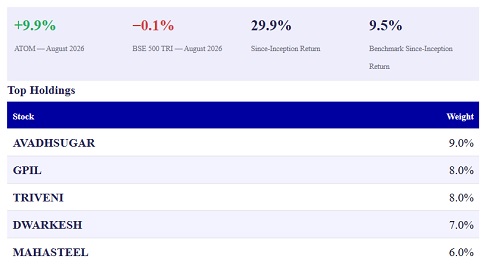
* August Performance: ATOM returned 9.9% in August against a 0.1% decline for the BSE 500 TRI, an alpha of 10.0pp — the strongest monthly alpha print since inception. Since inception it has returned 29.9% against 9.5% (alpha: 20.4pp), underscoring disciplined small- and micro-cap selection within a high-conviction, bottom-up framework.
* Sector Positioning: Materials led, with steel names benefiting from commodity tailwinds and a broader cyclical recovery. Consumer Staples complemented this on improving rural demand, with the sugar pick the standout within the sleeve.
* Market Cap Allocation: Small caps materially outperformed large caps, validating ATOM's structural positioning — the portfolio's 91% small-cap exposure was directly aligned to the rotation.
TRINITY: +8.6% in August — Strongest Monthly Outperformance Since Inception
Open-ended · Benchmark: BSE 500 TRI · Managers: Mr. Sandeep Neema and Mr. Siddharth Vora · Inception: 27 March 2026 · Horizon: 3-5 Years
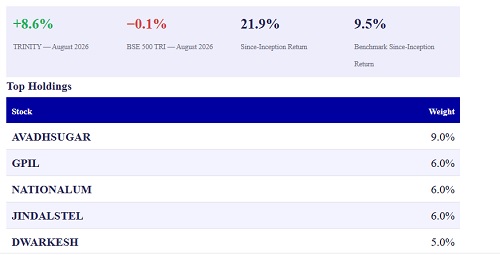
* August Performance: TRINITY returned 8.6% in August against a 0.1% decline for the BSE 500 TRI, an alpha of 8.7pp. Since inception it has returned 21.9% against 9.5% (alpha: 12.4pp), a lead August extended meaningfully.
* Sector Positioning: Materials drove performance, with breadth across steel and zinc names reflecting stock-selection quality over single-position reliance. The sugar pick in Consumer Staples stood out, and Financials contributed steadily on easing yields.
* Market Cap Allocation: The Large Cap 32% / Small Cap 53% / Mid Cap 14% mix aligned closely with August's leadership. The Dynamic Size Rotation Model's tilt toward the cap extremes, rather than the mid-cap middle, captured both the small-cap rally and large-cap resilience.
ELEVATE: +8.8% in August; 1-Year Return Reaches 42.6% Against 4.7% for Benchmark
Open-ended · Benchmark: BSE 500 TRI · Manager: Mr. Sandeep Neema · Inception: August 2023 · Horizon: 5 Years+
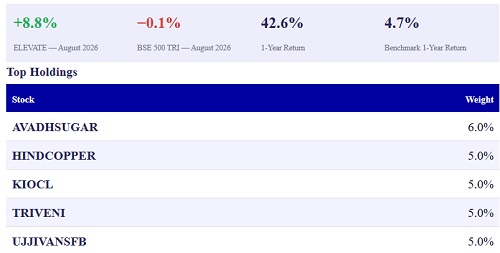
* August Performance: ELEVATE returned 8.8% in August against a 0.1% decline for the BSE 500 TRI, an alpha of 8.9pp. Its multi-period record remains exceptional: 1-year 42.6% vs 4.7% (alpha: 37.9pp), 2-year annualised 23.0% vs −0.1% (alpha: 22.9pp), since-inception 23.2% vs 12.1% (alpha: 11.1pp).
* Sector Positioning: Materials delivered the month's standout contribution, with commodity-cycle outperformers reflecting deep fundamental conviction. The sugar pick in Consumer Staples was the single largest driver of August's return; Financials added steadily as yields eased.
* Market Cap Allocation: The portfolio's meaningful small-cap exposure sat squarely in August's rotation, where small caps handily outperformed large caps — amplifying returns across the high-conviction position set.
India's Base Case Holds as Earnings, Flows and Breadth Align
PL Asset Management remains constructive on Indian equities over the medium to long term. Earnings grew broadly in Q1 FY27 — a ten-quarter high at the Nifty level, stronger still in mid and small caps — backed by a real investment cycle: GFCF grew 11.9%, and industrial output at 7.3% continues running well above its long-run average. The RBI held rates, raised its growth forecast to 6.7% and trimmed its inflation projection — supportive without being forced to act. Foreign investors have returned for two months running, adding nearly Rs 50,000 crore combined in July and August, and DIIs have not stopped buying in 38 months. Both pools of capital are now aligned for the first time since early 2026.
The Nifty's 1.24% dip is less concerning than it looks — FMCG, energy and a handful of rate-sensitive large caps pulled the index down, while the rest of the market did better, a composition story rather than a demand story. The swing factors into September remain the same ones that have driven markets all year: oil, the currency, the Fed, and whether Hormuz stabilises or deteriorates. Inflation is edging toward a 20-month high — worth watching, not yet hand-forcing. The firm continues to favour domestic consumption, financials, industrials, metals and select mid- and small-cap businesses, while monitoring crude, the Fed's September decision and Hormuz for any move that could revive inflation and currency pressure.
Above views are of the author and not of the website kindly read disclaimer