Debt Monthly Observer September 2026 by Sneha Pandey,Quantum AMC

The Case for the December Pivot
Why India's Next Rate Move May Be Up, Not Sideways Source: RBI Monetary Policy Committee Resolution and Monetary Policy Statement (August 2026); RBI MPC Minutes released 19 August 2026. www.QuantumAMC.com 32 For the last twelve months, Indian fixed income has been a story of comfortable pauses, benign carry, and a gently steepening curve. That story is now being rewritten. In its 62nd Monetary Policy Committee (MPC) meeting on 3-5 August 2026, the Reserve Bank of India left the repo rate unchanged at 5.25%, retained a neutral stance, and voted 6-0 - but the accompanying minutes released on 19 August were meaningfully more hawkish than the resolution itself. The market took note of this and has begun to flag a possible rate hike.
So, the question is no longer whether the RBI will move - it is when, how much, and how quickly. In this edition of the DMO, we examine whether the RBI's next move is likely to come sooner than markets expect. While we believe a rate hike at the 7 October 2026 policy appears unlikely on current evidence, the December meeting could emerge as the consequential inflection point. Should the inflation trajectory evolve in line with the RBI's projections, the Committee may be compelled to deliver not merely a symbolic 25 bps increase but potentially a larger 50 bps move, with cumulative tightening of up to 100 bps over FY2026-27 remaining a plausible outcome.
The Starting Point: What the RBI Actually Said on 5 August
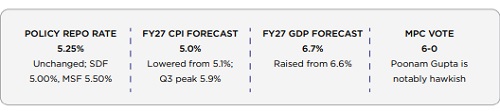
The August resolution kept the repo rate at 5.25%, retained the neutral stance, and cut the full-year CPI forecast to 5.0% from 5.1%. Growth for FY27 was nudged higher to 6.7% from 6.6%. Underneath the calm surface, however, the quarterly inflation path was quietly re-drawn: Q2 at 4.7%, a Q3 peak of 5.9%, and Q4 at 5.5% - a trajectory that spends three consecutive quarters above 5%1
"Core excluding precious metals is expected to converge to core inflation in the last quarter - which may itself suggest a recalibration of the policy rate." - Governor Sanjay Malhotra, August MPC Minutes
The minutes went further. Poonam Gupta said in plain language that "scope for further easing does not exist" and that a case for a hike may emerge during the year. That is the single most important guidance the RBI has o ered in this cycle. It tells the market the trigger for a hike is not just a headline print breaching a threshold - it is the persistence of underlying price pressure. This is hawkish forward framed framed as caution.
The next MPC meeting is scheduled for 5-7 October 2026, followed by the December policy - the sixth and last of the calendar year under the FY2026-27 bi-monthly schedule.
1. Pillar One - Headline Inflation Is Already Doing the Committee's Work
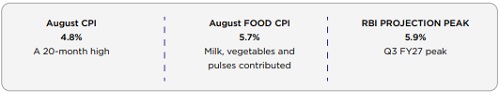
Headline CPI rose further to 4.82% in August from 4.45% in July, marking a third consecutive month above the RBI's 4% target. Food inflation remains the key driver, with the Consumer Food Price Index (CFPI) accelerating to 5.95% from 5.52%, led by continued pressure in key food categories. The latest print reinforces the upward inflation trend and leaves the RBI with limited room to turn dovish in the near term2.
The RBI's own forecast - Q2 at 4.7%, Q3 at 5.9%, Q4 at 5.5% - implies that by the time the December MPC meets, the committee will have on its desk two more monthly prints on the way to a Q3 peak just 10 basis points below the upper tolerance band of 6%3. Historically, the MPC does not sit still when it is that close to the tolerance line
The counter-argument, advanced by the RBI's own base case, is that the inflation broadening remains limited: core-core CPI is still near multi-year lows around 2%, generalization has not happened, and the impulse is largely supply-side. This is a reasonable read of the data today. It is harder to sustain if the December print validates the 5.9% projection.
2. Pillar Two - Food, Milk and the Second-Round Problem

Overlay a below-normal monsoon - IMD has flagged rainfall at ~92% of LPA, with an El Nino risk - and the setup for the winter crop looks less than reassuring. Members of the MPC named food, fuel, El Nino risks to monsoon, and conflict-related supply shocks as sources of the projected inflation hump.
The counter-argument: food inflation is volatile and often reverses. A good northeast monsoon and a favourable base could pull food CPI back sharply by Q4. But hoping is not monetary policy, and the composition of India's food inflation - protein-rich items and prepared foods - is now stickier than in past cycles.
3. Pillar Three - The Commodity Upcycle Refuses to Subside

Brent crude, having briefly softened around end-July on Iran talks, has firmed back to the $91-100+ range. On 21 August, Brent was at $93.82 on the second consecutive weekly rise; on 24 August, it eased to $93.17 ahead of the US sanctions announcement; oil rose again on 2 September on renewed US-Iran fighting5. The IEA Oil Market Report for August pen the Indian crude basket at about US$80 per barrel for FY27 - but that assumes a credible peace agreement between the US and Iran, an increasingly fragile assumption.
Q1 FY27 already registered a widening of the current account deficit to $4.2 billion (0.5% of GDP, versus $3.4 billion in Q1 FY26) and the balance of payments slipped into an $8.1 billion deficit on capital outflows - the first BoP deficit in five quarters6. If the commodity upcycle persists into H2 FY27, imported inflation will keep leaking into core over the next two to three quarters, exactly the convergence that Governor Malhotra warned about.
Above views are of the author and not of the website kindly read disclaimer