Buy LT Foods Ltd for the Target Rs.500 by Motilal Oswal Financial Services Ltd
LT Foods (LTFOODS) stands at a compelling strategic inflection point, where a confluence of external catalysts and internal financial discipline collectively reinforces the investment thesis.
LTFOODS' US business (~46% of revenue) has successfully passed on the majority of the 50% US tariff burden to customers, underscoring the brand stickiness of Daawat and Royal in its most important market. The new 10% US tariff rate now unlocks volume upside, margin recapture, and competitive parity against Pakistani basmati, converting what was a six-month earnings headwind into a durable structural tailwind.
Simultaneously, the company is navigating a near-term input cost challenge. Basmati paddy prices rose ~12% in crop 2025, driven by flood-induced yield shortfalls across Punjab's basmati belt. While this translates into an 830–940bp gross margin headwind in isolation, LTFOODS’ aged inventory model, premium export realizations of INR144/kg, and improving working capital discipline collectively contain the actual earnings impact, demonstrating the company's ability to absorb cyclical cost pressures without structural margin contraction.
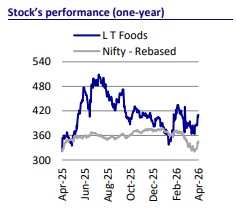
This resilience is underpinned by a balance sheet that has been deliberately and methodically strengthened over the past decade. LTFOODS has delivered revenue and adjusted PAT CAGRs of 16% and 27%, respectively, over FY20–25, generating cumulative free cash flow of ~INR16b. This strong financial profile reflects structural resilience capable of absorbing near-term macro pressures, and has supported the company’s CRISIL upgrade to AA/Stable in Feb’26.
Further supporting the outlook, a significant overhang on the organic business has been materially resolved. The US Department of Commerce's Final Order, dated 23rd Feb’26, slashed Ecopure's countervailing duty (CVD) rate from 340.27% to 75.48%, reducing the potential liability from INR1.63b to ~INR400m. This resolution de-risks a key subsidiary and reinforces our confidence in LTFOODS’ ability to navigate complex international trade environments.
However, the US–Israel–Iran conflict has created near-term risks, with ~400,000MT of India’s basmati stuck in transit and freight rates rising sharply (3–4x, with spikes of >1,000%), creating margin pressure and working capital stress for exporters. While disruptions in the Middle East (~9% of LTFOODS’ revenue; ~67% of India’s exports) weigh on the sector, a 5–6% correction in basmati prices partly offsets crop 2025 input cost inflation. Encouragingly, the recent two-week ceasefire has provided some relief, with potential reopening of the Strait of Hormuz and signs of price firming in the domestic market. Meanwhile, LTFOODS’ strong North America presence offers a structural buffer versus more Middle East-focused peers.
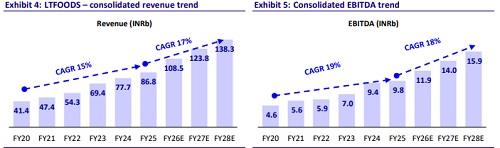
We expect LTFOODS to report a CAGR of 17%/18%/18% in revenue/EBITDA/PAT over FY25-28. We value LTFOODS at 17x FY28E EPS to arrive at our TP of INR500. Reiterate BUY.
US-India trade deal: From headwind to structural tailwind
A key positive in LTFOODS' US business (accounts for ~46% of the company’s overall revenue) over the past six months has been management's successful pass-through of the full 50% tariff burden to the majority of end customers (while absorbing some portion internally).
While this was not guaranteed, the premium and largely non-substitutable nature of basmati rice (owing to its unique aromatic profile, elongation characteristics, and textures that cannot be replicated by US-grown varieties), along with the strong consumer stickiness of LTFOODs’ brand ‘Royal’, enabled the company to absorb the cost increase.
As confirmed in the 3QFY26 earnings call, majority of the 50% duty was passed on, with the company maintaining 2-3 months of inventory in the US to ensure seamless supply.
With the new 10% baseline rate, the outlook for LTFOODS improves materially in three distinct ways:
* Volume upside: US retail prices for premium basmati can now be partially reduced, making LTFOODS' products more competitive against Thai Hom Mali and other aromatic rice alternatives in the Indian diaspora market.
* Margin expansion: The 40pp reduction in tariff (50% to 10%) could enable LTFOODS to partially recapture margins that were eroded during the high-tariff period. Notably, management had not increased export prices proportionately to the full 50% tariff, absorbing some portion internally.
* Competitive re-positioning against Pakistan: Pakistani basmati, which benefited from lower US tariffs due to not being subject to the same reciprocal tariff framework, gained a slight competitive advantage during the peak tariff period. At that time, the average price of basmati rice was USD1,200/MT; with the high tariff, another USD600/MT was added, raising the price to USD1,800. In contrast, Pakistan enjoys a lower tariff of 19%, resulting in a price of ~USD1,450, a difference of USD350/MT. This new US baseline tariff of 10% restores parity for Indian exporters.
Paddy prices: A headwind to navigate, but pricing power provides a buffer
The paddy price challenge and the US trade deal tailwind represent two sides of the same coin for LTFOODS—while one contracts margins, the other provides the headroom to absorb and eventually offset this contraction.
Paddy (raw rice) accounts for ~70-80% of LTFOODS' total input costs, making it the most critical variable in the company's cost structure. Crop 2025 has seen a meaningful price increase, presenting a near-term margin headwind, which we believe will be offset by the positive catalysts discussed above.
Basmati paddy prices saw an average increase of ~12% on a consolidated basis for crop 2025 (Oct’25 to Feb’26), driven by the following key factors:
Lower-than-expected yields in basmati-growing regions: Punjab, India's single largest basmati-producing state by volume (~45-50% production share), experienced unseasonal rainfall in Aug-Sep’25 and Oct’25, leading to significant crop damage and yield shortfalls.
Flooding in major basmati-producing districts further compounded supply concerns, with basmati paddy prices rising in Aug’25 (up 13% YoY) and remaining elevated to date (i.e., Feb’26).
Overall, non-basmati paddy prices also rose during certain periods, led by strong demand and lower yields due to heavy rainfall. Additionally, the kharif MSP for common paddy was revised upward to INR2,369/quintal for 2025-26 (up INR69 or ~3%), although market prices exceeded MSP for premium varieties.
India's record rice production of ~150m MT in FY25 (vs 137.82m MT in FY24) is partly offset by basmati-specific supply tightness, as the aromatic variety is grown only in specific geographies and cannot be expanded easily.
A 12% increase in paddy prices, given its ~70-80% share of total expenses, is expected to translate into ~830-940bp headwind on gross margins in isolation. However, several factors highlighted below are likely to limit the actual impact.
LTFOODS' aged inventory model implies that paddy procured during the crop season is processed and sold over a 12-18 month period, creating a natural lag. Consequently, the benefits of lower input costs from FY25 continue to flow through the P&L, partially cushioning the Crop 2025 price increase.
Premium basmati exports command ~INR144/kg in export realization versus INR64/kg domestically, providing significant headroom to absorb cost increases on the export side.
Gross margins expanded from 33.2% in 9MFY25 to 34% in 9MFY26, demonstrating LTFOODS’ ability to effectively manage cost pressures while continuing to grow revenues.
Consequently, management has guided for double-digit revenue growth in FY27, and we believe the margin outlook will become clearer by the next quarter as the full extent of paddy procurement costs becomes visible.
Strong financial health to sustain macro headwinds
LTFOODS has compounded its revenue/Adj. PAT by 16%/27% over FY20-25, with EBITDA margins sustaining in the 11-12% range.
Over the same period, the company generated a cumulative FCF of INR16b, led by a significant improvement in working capital days from 244 in FY21 to 196 in FY25. This was largely due to the implementation of an effective paddy procurement strategy, wherein USD1 rice, which requires less or no aging, is sourced directly from mills, enabling 60-90 days of credit. This has helped the company extend payable days to 113 in FY25 vs 60 days in FY21.
In 9MFY26, revenue grew 25% YoY to INR80.4b, led by stable volume growth in both domestic and international markets, US tariff-led realization increase, and the consolidation of Golden Star (since Jun’26). PAT growth was ~10% YoY, impacted by lower margins due to tariffs, higher freight costs, and increased ad spends. Working capital witnessed a healthy improvement in 9MFY26 vs. 9MFY25 by 22 days, led by improvements across all parameters: inventory days (down by 13 days), payable days (up by 5 days), and receivable days (down by 5 days).
CRISIL recently upgraded LTFOODS’ long-term financial rating to AA/Stable in Feb’26. This upgrade reflects the culmination of a decade-long, deliberate financial transformation—from a working-capital-heavy commodity exporter rated BBB- in 2013 to a globally diversified branded FMCG business now occupying the AA credit tier.
Such a double-digit revenue trajectory, achieved even through periods of export bans, freight disruptions, and geopolitical tariff shocks, is precisely the kind of evidence rating agencies demand before awarding the AA designation.
Organic business CVD resolution: INR1.63b liability significantly reduced
On 23rd Feb’26, the US Department of Commerce issued its final order in the CVD administrative review covering Ecopure Specialities Limited's (step-down subsidiary of LTFOODS) exports of organic soybean meal to the US for the period 1st Jan to 31st Dec’23.
Ecopure is the company’s organic arm, with a portfolio that includes rice, pulses, soybeans, seeds, millets, nuts, flour, and extruded oils. The organic business contributed ~11% of total revenue in FY25. Among these, soybean is one of the products exported to the US, generating revenue of ~INR500m as of FY25 (~0.5% of LTFOODS’ consolidated revenue).
The duty rate was drastically reduced from 340.27% to 75.48%, implying a 264.79pp reduction. This significantly lowers the potential liability to ~INR400m from the earlier INR1.63b that had hung over the company since Jun’25.
LTFOODS had previously communicated that it was evaluating legal remedies. The successful outcome vindicates this approach and demonstrates management's ability to navigate complex international trade proceedings.
However, the company has not yet received any communication regarding payment of this amount and intends to contest the ruling in higher courts to seek a further reduction in the duty rate.
Brief context: The US DoC initiated an antidumping (AD) and CVD investigation on organic soybean meal imports from India in Apr’21. In the subsequent administrative review, the DoC applied the punitive 'Adverse Facts Available' (AFA) methodology to Ecopure in Jun’25, resulting in a provisional CVD rate of 340.27%. This was among the highest duties ever levied on an Indian food exporter and was imposed due to Ecopure's alleged non-cooperation during the investigation. However, revenue from these exports was relatively modest at INR500m for the period under review.
Had the 340.27% AFA rate been made permanent, it would have effectively banned Ecopure from the US organic soybean meal market, as export economics would not have been viable at such a duty level.
The revised rate of 75.48%, while still substantial, allows for commercial viability if pricing is adjusted accordingly. Premium organic products carry stronger pricing power than commodity categories.
If the 75.48% CVD rate remains in place, it would not be a negligible duty. Ecopure may need to price the duty into export contracts or explore market diversification for organic soybean meal. However, structural demand tailwinds in the organic food segment, such as rising health consciousness and ESG-driven sourcing preferences among US food companies, provide stronger pricing power that commodity exporters lack. Further, any future administrative review for 2024 or 2025 sales would be a fresh proceeding, and the company is now better positioned to cooperate fully and achieve a more favorable outcome.
The Middle East conflict a headwind, but diversification cushions the bl
The US-Israel-Iran conflict (since 28th Feb, 2026) introduced a rapidly evolving and two-sided risk for LTFOODS.
On the adverse side, ~400,000 MT of Indian basmati rice are currently stuck in transit, freight rates have more than doubled, and new export deals have stalled—directly affecting LTFOODS, given the Middle East contributes ~9% of its revenue (9MFY26).
The broader sector impact is significant; according to the APEDA data, the Middle East accounts for ~67% of India’s basmati exports, with key markets such as Iran (14%), Iraq (13%), and Saudi Arabia (19%) together forming ~46% of total exports. While LTFOODS does not have meaningful direct exposure to Iran, the disruption across the region is likely to weigh on its Middle East revenues and margins, especially amid sharply rising freight costs.
The logistics disruption is particularly severe, with freight escalation far exceeding the 2023–24 Red Sea crisis. Container rates on the India–Middle East route have surged within weeks, moving from ~USD1,200–1,800 to (forty-foot equivalent unit) alongside additional burdens from war risk insurance, fuel surcharges, and container shortages. Shipping disruptions around the Strait of Hormuz have extended transit times by 10-15 days and tightened container availability, leading to elevated working capital requirements and margin pressure. As a result, logistics—not demand—has become the key bottleneck for exporters.
There is a partial offset on the positive side. The conflict has triggered a 5–6% correction in basmati prices during the initial days. This decline comes after the price spike seen during the 2025 crop due to lower yields.
However, according to our channel checks, basmati rice has been reaching the Middle East, although with a lag and at a higher cost, and the demand-side headwinds have been limited. This, coupled with the recent two-week ceasefire announcement, has resulted in the firming up of basmati prices in the domestic market. This could support domestic rice companies (including LTFOODS) with better realization (in line with the rise in input costs from 2025 crops).
Overall, while the Iran conflict poses a near-term headwind through elevated freight costs and execution challenges, LTFOODS remains relatively better positioned due to its diversified geographic mix, with North America as its anchor market. LTFOODS is structurally better insulated than its peers, which are more heavily reliant on the Middle East. In fact, the current situation reinforces the strategic merit of its diversified geographic mix, with the US and European markets as core growth drivers
Another potential upside scenario is a successful peace agreement leading to the lifting of US sanctions on Iran. In such a case, basmati exports from India could see a sharp recovery, given that Iran, historically one of the largest importers, accounted for a significant share of India’s basmati trade (~23% in FY21, which dropped to ~11% in FY24 due to sanctions). A resumption of large-scale procurement could drive a strong rebound in export volumes and prices, with Iran potentially reclaiming its position as a key or leading destination for Indian basmati.
Valuation and view
LTFOODS stands at a rare convergence of catalysts: the India-US trade deal slashing tariffs from 50% to 10%, the Ecopure CVD liability shrinking from INR1.63b to INR400m, and a CRISIL AA/Stable upgrade validating a decade of financial transformation. While each catalyst independently moves the needle, together they present a structural re-rating opportunity.
Near-term headwinds from ~12% basmati paddy inflation are real but manageable. LTFOODS’ aged inventory model, premium export realizations, and disciplined working capital management provide sufficient buffers, as evidenced by gross margin expansion to 34% despite cost pressures in 9MFY26.
With revenue and PAT compounding at 16% and 27%, respectively, over FY20-25 and double-digit growth guided for FY27, LTFOODS has demonstrated strong financial resilience to turn macro adversity into a competitive advantage.
Key Risks: Sustained basmati paddy inflation beyond crop 2025, escalating Middle East conflict disrupting shipping lanes and payment channels, reversal of India-US trade deal terms, adverse future CVD review outcomes for Ecopure, sharper-than-expected margin compression from rising freight costs and advertising spends, and INR/USD currency volatility amid global geopolitical uncertainty.
We expect LTFOODS to report a CAGR of 17%/18%/18% in revenue/EBITDA/PAT over FY25-28. We value LTFOODS at 17x FY28E EPS to arrive at our TP of INR500. Reiterate BUY.
For More Research Reports : Click Here
For More Motilal Oswal Securities Ltd Disclaimer
http://www.motilaloswal.com/MOSLdisclaimer/disclaimer.html
SEBI Registration number is INH00000041