Soyabean Report As On 23rd june 2026 by Amit Gupta, Kedia Advisory
Highlights
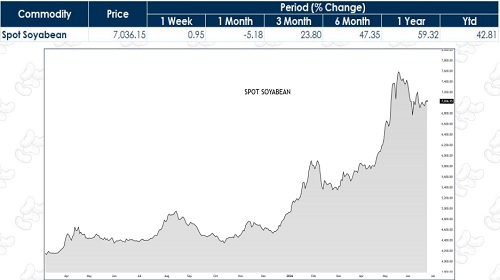
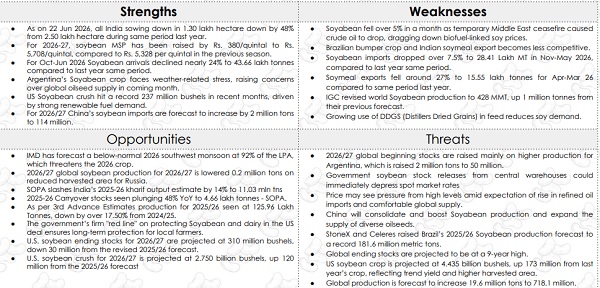
* Soybean prices fell over 5% monthly amid Middle East ceasefire reducing crude oil support.
* Brazil bumper crop and weak Indian soymeal exports reduced global competitiveness of soy complex.
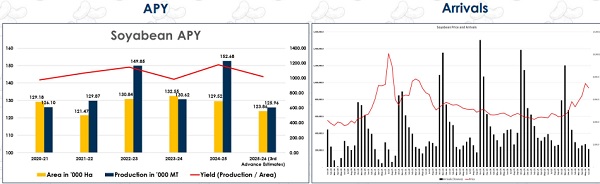
* India soybean sowing down 48% YoY at 1.30 lakh hectare as on 22 Jun 2026.
* Government raised soybean MSP by ?380/quintal to ?5,708 for 2026–27 marketing season.
* India soybean arrivals declined nearly 24% to 43.66 lakh tonnes in Oct–Jun 2026.
* IGC raised global soybean production forecast to 428 million tonnes, up one million tonnes.
* Argentina soybean crop faces weather stress, raising concerns over global oilseed supply outlook.
* US soybean crush hit record 237 million bushels, driven by strong renewable fuel demand.
* China soybean imports expected to rise by 2 million tons to 114 million in 2026/27.
* India soybean imports declined 7.5% to 28.41 lakh tonnes during Nov–May 2026 period.
* Soymeal exports fell sharply 27% to 15.55 lakh tonnes during Apr–Mar 2026 period.
* Increasing usage of DDGS in livestock feed continues to reduce soybean meal demand.
* IMD forecasts below-normal 2026 monsoon at 92% LPA, threatening India’s upcoming soybean crop.
* SOPA cut India 2025–26 kharif soybean output estimate by 14% to 11.03 million tonnes.
* India soybean carryover stocks expected to plunge 48% year-on-year to 4.66 lakh tonnes.
* US soybean ending stocks for 2026/27 projected lower at 310 million bushels.
* Global soybean production projected to rise 19.6 million tonnes, reaching 718.1 million tonnes.
* Global ending stocks forecast at nine-year high, indicating comfortable long-term supply situation.
Oilmeal Exports
The Solvent Extractors’ Association of India has provisionally reported oilmeal exports at 274,887 tonnes for March 2026, compared to 409,148 tonnes in March 2025, marking a decline of 33%.
India’s oilmeal exports continue to face significant market and logistical challenges, adversely affecting export realizations and profitability. Key issues include severe disruptions in Red Sea shipping routes, which have sharply increased freight costs and intense price competition from South American and European suppliers. As a result, India’s total oilmeal exports during April 2025 to March 2026 (2025-26), declined to 3,768,710 tonnes from 4,342,498 tonnes in the corresponding period of the previous year, reflecting a drop of 13%. In value terms, exports fell to Rs. 9,340 crore from Rs. 12,171 crore during the same period.
Key Points
China Emerged as a Mega Buyer: India's oilmeal exports to China skyrocketed, hitting 8.78 lakh tonnes during the April 2025–March 2026. This was largely driven by India's price competitiveness for rapeseed meal and China's restriction on Canadian canola. A major driver of Indian exports was China's 100% tariff on Canadian rapeseed/canola meal.
Sluggish Soybean Meal: Indian soybean meal exports remain uncompetitive globally due to price disparities with major producers like Argentina and Brazil. Furthermore, domestic livestock feed makers have increasingly shifted toward cheaper alternatives like DDGS (by-product of ethanol) at the cost of soymeal and other oilmeals.
Red Sea & Strait of Hormuz Crises: Geopolitical conflicts have forced shipping companies to bypass the Red Sea. Detouring around the Cape of Good Hope has added 10-15 days to shipping journeys, creating container shortages and inflating freight costs. Approximately 20% of India's oilmeal exports (destined for West Asia) and 15% (destined for Europe) are highly vulnerable to these logistical delays and costs.
Reduced Crush Availability: The temporary reduction and domestic high price of soybean, crushing activity dropped lead to lesser availability for shipping volumes.
Highlights
* Total oilmeal exports declined by 13% compared to the previous year.
* Rapeseed meal was the highest exported oilmeal with 1,754,916 metric tonnes.
* Soybean meal exports dropped sharply from 2.12 million to 1.55 million tonnes.
* Rice bran extraction exports surged dramatically, growing by more than tenfold.
* Total export value decreased from 12,171 crore to 9,340 crore rupees.
* September 2025 achieved the maximum monthly growth of forty percent.
* January 2026 registered the largest monthly export decline of 42%.
The Solvent Extractors' Association of India (SEA) has reported that India's imports of vegetable oils (edible and non-edible) during May 2026 totaled 13.65 lakh tons, compared with 12.67 lakh tons in May 2025, reflecting an increase of 8 percent year-on-year. The imports comprised 13.39 lakh tons of edible oils and 26,202 tons of non-edible oils.
During the first seven months of the 2025-26 oil year (November 2025 to May 2026), total vegetable oil imports reached 93.65 lakh tons, up 12 percent from 83.39 lakh tons imported during the corresponding period of the previous year. Edible oil imports in May 2026 increased to 13.39 lakh tons from 13.07 lakh tons in April 2026. Cumulative edible oil imports during November 2025–May 2026 rose to 92.17 lakh tons, compared with 81.31 lakh tons in the same period last year, registering growth of 13 percent.
Country-wise Import of Palm Oil and Soft Oils
India imported a total of 92.1 lakh tons of edible oils, with Indonesia and Malaysia remaining the dominant suppliers of palm oils. Indonesia supplied 17.2 lakh tons, mainly crude palm oil, while Malaysia contributed 17.6 lakh tons including crude palm oil and palm kernel oil.
Argentina emerged as the largest supplier of soybean oil with 16.4 lakh tons, followed by Brazil of 5.66 lakh tons. Russia, Argentina and Ukraine were the major sources of sunflower oil imports, supplying 9.2 lakh tons, 4.2 lakh tons and 3.0 lakh tons respectively.
Nepal supplied 2.8 lakh tons refined soybean oil and small quantities of other oils. Overall, palm oil constituted the largest share of imports, followed by soybean oil and sunflower oil.
Above views are of the author and not of the website kindly read disclaimer