Textiles Sector Update : Strong 1H growth expected; major capex announcement awaited by Motilal Oswal Financial Services Ltd
Stability in US tariffs and improving retailer outlook offer momentum
* US tariffs weighed heavily on Indian textile exports this year, prompting buyers to shift sourcing toward Vietnam, Cambodia, and Indonesia. In FY26, tariffs stood at 50% for four months before easing to 10% under Section 122 and later Section 301. Currently, India and Bangladesh are subject to a 10% tariff vs Vietnam's 12.5%, narrowing the tariff gap. Bangladesh's labor costs remain ~35- 40% lower than India's (labor makes up ~30% of manufacturing costs), keeping it structurally cheaper. Hence, despite improved tariff parity, competition in the US market is expected to remain intense, particularly in knitwear, where Bangladesh holds a dominant position. Even so, we believe the added clarity on the US tariff framework is a sentimentally positive development for the sector. US apparel retail continues to witness strong momentum, with clothing and accessories store sales rising 0.63% MoM and surging 13.65% YoY in Jun’26. Apparel was also part of the strongest-performing category, with sporting goods, electronics, and apparel posting a combined 18.53% YoY growth, underscoring resilient consumer demand for the sector.
India-UK FTA: A structural growth catalyst for textile exporters
* The India-UK FTA (effective as of July 15, 2026) eliminates UK import duties of 8- 12% on Indian apparel, significantly improving India's competitiveness against countries such as Bangladesh, Vietnam, Pakistan, and Turkey. While the nearterm impact is expected to be gradual, the agreement provides a meaningful long-term opportunity to increase India's UK market share from ~6% to low double digits over the next few years. Exporters with an established UK presence are likely to be the earliest beneficiaries, although the pace of gains will depend on effective utilization of FTA benefits and compliance with rules of origin.
India-Europe FTA: Expected to be implemented by CY27
* India and the EU concluded FTA negotiations on January 27, 2026, with the deal expected to come into force in 2027 following parliamentary ratification by both sides. It will eliminate the current ~10-12% EU duty on Indian textiles and apparel, leveling the playing field with duty-free competitors like Bangladesh, Vietnam, Pakistan, and Turkey in the world's largest apparel import market. The EU currently sources heavily from China and Bangladesh but only marginally from India, reflecting decades of tariff-driven stagnation. The FTA unlocks a meaningful incremental export opportunity as European brands actively look to diversify away from China and Bangladesh, though the ramp-up will likely be gradual given the EU's fragmented market structure compared to the more homogeneous US market.
Higher cotton prices: Tailwind for spinners, headwind for made-ups
* Indian cotton prices rose ~9% over three months to ~INR174/kg, improving spreads by INR20-25/kg, a margin tailwind for spinners but a near-term headwind for made-ups. Given the typical 3–5-month pass-through lag, this appears to be a margin challenge (1HFY27) rather than a structural concern. With cotton prices likely near their peak, we expect them to ease over the next couple of quarters. The government's cotton import duty waiver (11%, until Oct'26) adds relief by neutralizing India's ~5% price premium over US cotton, supporting exporter competitiveness in the interim
India emerges as the preferred full-chain sourcing destination
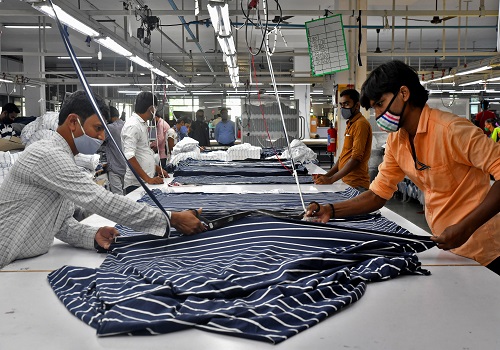
* India is the world's second largest cotton producer and holds the second-largest spinning capacity globally. China, India, Pakistan, Bangladesh, and Vietnam together account for ~65% of global spinning capacity. China has been reducing its spindle base, partly due to the shift away from Xinjiang-linked cotton and a growing focus on MMF, while Pakistan and Bangladesh remain reluctant to invest in backward integration, given the high capex and low asset turnover. In addition, Vietnam is gradually shifting toward electronics and services as per capita income rises. This leaves India as the only major sourcing hub still adding spindle capacity, while also having meaningfully closed the compliance gap with peer exporting nations over the past decade. From a retailer's standpoint, this makes India the more attractive long-term choice, given its full, integrated supply chain.
Outlook & valuation
* The government has taken an aggressive stance on textiles, targeting incremental share from Bangladesh in garmenting and Pakistan in home textiles. RoSCTL and RoDTEP together provide ~5.5-7.5% of FOB value; despite an earlier flagged rate cut, both schemes have been extended through Sep 30, 2026, with rates remaining unchanged. These incentives reportedly contribute ~35%/65% to EBITDA/PAT in our coverage, supporting continued export competitiveness. Most exporters expect mid-teens growth over FY26-28, led by mid-single-digit volume capex tied to the UK FTA and a US demand recovery, with the EU FTA not yet factored in, given its longer timeline. UK FTA-led volume clarity is expected by 1H, though major capex announcements remain awaited, and closing the gap with Bangladesh's scale would require far larger capex than currently visible.
* Historically, the textile sector has traded at a 10-year mean of 24x P/E and 14x EV/EBITDA (our coverage universe), with topline, EBITDA, and PAT growing just 6%, 4%, and 3%, respectively, over the last decade. Given the improved visibility, we expect our coverage to grow 14%, 26%, and 38%, respectively, over FY26-28. We have, therefore, assigned a 10% premium to the mean EV/EBITDA multiple, which we believe provides scope for a further re-rating, even though most stocks have already rallied 10-12% over the past month. We prefer Gokaldas Export, Arvind, and Pearl Global from the apparel space, while Indo Count Industries from the HT space.
For More Research Reports : Click Here
For More Motilal Oswal Securities Ltd Disclaimer
http://www.motilaloswal.com/MOSLdisclaimer/disclaimer.html
SEBI Registration number is INH000000412









More News

Capital Goods & Defense Sector Update : Rising costs amid continued West Asia crisis by Moti...