NBFC Sector Update : Credit Card Monthly: Spends slip from peak by InCred Equities
Credit Card Monthly: Spends slip from peak
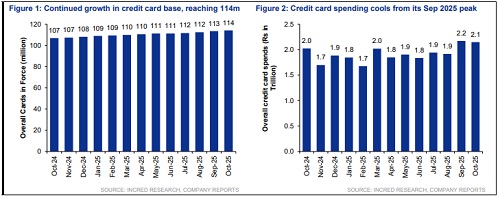
* Total spending at Rs2.1tr in Oct 2025 was down 1% from its peak, as online spending fell 13% mom but partially offset by a 22% mom rise in PoS deals.
* Cards in force reached 114m, up 60bp, indicating normalisation in the pace of card issuance post-festive season rise.
* HDFC Bank gained 97bp mom in spending share at 28.9%, driven by PoS transactions. SBI Cards largely flat. ICICI Bank & Axis Bank shed 88bp & 62bp.
Shift to in-store spending; e-commerce sales conclude in Sep 2025
Total credit card spending in Oct 2025 stood at Rs2.1tr, declining by 1% mom, due to a surge in spending in late-Sep 2025 aided by e-commerce sales, Goods and Services Tax (GST) rate cut and festive season-related spending. Strong discounts on high-value categories such as electronics, appliances, and smartphones drove front-loaded big-ticket buying in Sep 2025, leading to a shift towards lower-value festive purchases last month, primarily apparel, sweets, gifts, décor and accessories. Online spending fell by 13% mom to Rs1.3tr following heavy pent-up spending in Sep 2025 and Point of Sale (PoS) transactions growing by 22% mom to Rs0.9tr, supported by in-store festive shopping, particularly in electronics, apparel, dining and gifting categories. Going ahead, we expect spending in Nov 2025F to remain largely in line with Oct 2025 level, supported by onset of the wedding season and sustained GST rationalisation sentiment.
HDFC Bank expands spending market share as peers lose ground
Overall spending declined mom in Oct 2025 for most larger players, except HDFC Bank and RBL Bank. Among major players, HDFC Bank expanded its market share by 97bp mom to 28.9%, supported by its leadership position in PoS spending. SBI Cards sustained spending market share at 18.7% with a minor ~7bp mom decline. In contrast, ICICI Bank, Axis Bank and IndusInd Bank (IIB) saw their market share eroding by 88bp, 62bp and 122bp mom to 18.4%, 11.4% and 2.5%, respectively. Collectively, the top five credit card players (HDFC Bank, SBI Cards, ICICI Bank, Axis Bank & RBL Bank) saw their combined market share soften to ~80.9% in Oct 2025, compared with 81.8% in Sep 2025. Notably, RBL Bank moved up to the fifth position, displacing IndusInd Bank.
Stable CIF; issuance to normalise post-festive season
Cards in force (CIF) rose to 114m, rising 60bp mom. The market share in CIF remained largely stable mom for large players, barring Kotak Mahindra Bank which shed 2bp mom. HDFC Bank (~22%), SBI Cards (~19%), ICICI Bank (~16%) and Axis Bank (~14%) together held ~71% of the CIF, flat mom. We believe that growth in issuance will moderate going ahead on account of weakening discretionary demand post-festive season.
Outlook and valuation
We appreciate the stable market share of SBI Cards; however, a higher contribution of transactor customers results in a longer route to increasing the profitability. We believe that abatement in credit costs is limited and we remain uncomfortable with its valuation, given the mono-line business. Despite the rise in credit card spending and issuance, we continue to remain cautious on SBI Cards. We expect its return ratios to remain under pressure amid rangebound market share movement, tighter spending limit, constant regulatory eye on the industry, and elevated credit costs. We maintain our REDUCE rating on SBI Cards with a target price of Rs700, valuing the stock at 3.7x FY27F BV & 24x FY27F EPS.
Above views are of the author and not of the website kindly read disclaimer





Tag News
Poonawalla Fincorp shares down nearly 16 pc in a year