Internet Sector Update : Impact of commercial LPG shortages on restaurants by Motilal Oswal Financial Services Ltd

Food delivery platforms could see near-term hit on order volume
* Commercial LPG cylinder supplies have tightened in several cities, with restaurants reporting delays in deliveries owing to disruption in supply from the Strait of Hormuz.
* We address the key questions that might impact restaurants, and hence food delivery operations: 1) commercial LPG usage in India, 2) exposure to the Strait of Hormuz, 3) LPG usage intensity and buffers in restaurants, and 4) impact on food delivery volumes.
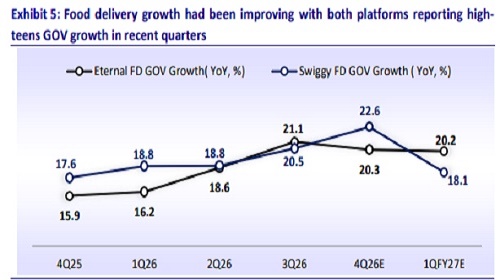
* Our view: Food delivery (FD) GOV growth has been improving in recent quarters (exhibit 5), but the LPG disruption could create a near-term hiccup if shortages persist through March. Reduced menus, limited cooking hours or temporarily shut kitchens at some restaurants may limit order availability on platforms, leading to temporary moderation in 4Q FD order volumes.
1) Commercial LPG usage in India
* India consumes roughly 28-30MMT of LPG annually. Around 55-60% of demand is met through imports (see exhibit 1), with the remaining 10-12MMT supplied by domestic refineries and gas processing plants.
* Household cooking dominates LPG consumption. Industry estimates suggest ~85-90% of demand comes from residential use, while commercial consumption (restaurants, hotels, catering) accounts for ~8-10%, implying ~2- 3MMT annual demand from the food-service ecosystem.
2) Exposure to Strait of Hormuz
* ~90% of LPG imports originate from Middle Eastern suppliers such as Qatar, Saudi Arabia, UAE and Kuwait.
* Industry estimates indicate that ~80-85% of India’s LPG imports transit through the Strait of Hormuz, making the commodity particularly exposed to disruptions in the region.
* Compared with other energy imports, LPG is the most-exposed fuel in India’s basket. By comparison, ~50-55% of LNG and ~40-50% of crude oil imports pass through the Strait.
* Unlike crude oil, India does not maintain strategic LPG reserves, which means supply disruptions tend to show up quickly in the market, particularly in the commercial segment where inventory buffers are smaller.
3) LPG usage intensity and buffers
* A small restaurant typically consumes 1-2 commercial cylinders (19kg) per day, mid-size restaurants 3-5 cylinders, and large hotel kitchens 6-10 cylinders daily, depending on scale and operating hours.
* Inventory buffers across restaurants tend to be limited. Most kitchens maintain 2-6 days of cylinder inventory (see exhibit 4), given storage constraints and frequent delivery cycles. As a result, any supply disruption can begin to impact operations within 48-72 hours.
* Storage restrictions: Storage of LPG above 100kg (about five 19kg cylinders) requires licenses and compliance with additional safety requirements, making this impractical for small restaurant outlets.
4) Implications for FD players
* FD growth had been improving in recent quarters. Platform GOV YoY growth for Zomato stood at ~15.9%/16.2%/18.6%/21.1% over the last four quarters, while Swiggy reported ~17.6%/18.8%/18.8%/20.5% YoY growth over the same period.
* Our estimates currently assume Zomato’s GOV growth at ~15.3%/18.0% in FY26/27E and Swiggy at ~20.2%/17.3%, supported by gradual market share gains and continued expansion across cities. ? However, if the commercial LPG shortage persists through the remainder of March, it could begin to reflect in a temporary decline in order volumes in 4Q.
For More Research Reports : Click Here
For More Motilal Oswal Securities Ltd Disclaimer
http://www.motilaloswal.com/MOSLdisclaimer/disclaimer.html
SEBI Registration number is INH00000041