1Q Fiscal Accounts : Centre and states not ringing alarm bells yet by Emkay Global Financial Services Ltd

The Centre’s 1QFY27 fiscal position is relatively comfortable despite revex pressure and poor gross tax revenue, while states have maintained fiscal discipline so far by regulating expenditure. Despite revenue pressure, the Centre has maintained strong capex momentum, driven by core sectors of Defence and Railways, while also pushing states via capex loans. However, states have controlled both revex and capex in the face of weak revenue growth. For FY27E, we expect the Centre to meet FY27BE FD/GDP of 4.3%, with several buffers available to offset Middle East crisis-linked strains. However, Brent sustaining above $90/bbl for an extended period would provide upside risk of 0.2% of GDP. States, on the other hand, are expected to see fiscal slippage of 0.2% of GDP vs FY27BE of 3.1%, due to revenue pressure as well as continued focus on capex.
Centre’s FD remains controlled in 1Q, but capex growth has been strong
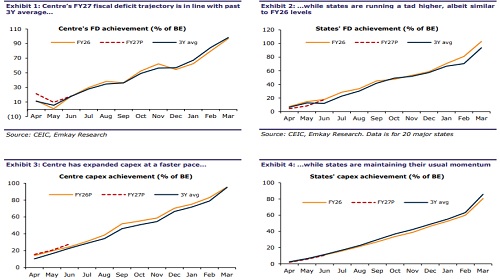
1QFY27 fiscal accounts show the Centre in a comfortable position, despite poor revenue growth and revex-led expenditure pressure. The Centre’s fiscal deficit (FD) at 18% of BE for 1Q is identical to last year’s and the 3Y average, reflecting the stable fiscal position. While gross tax revenue growth has been sluggish (4% yoy vs 9% BE), lower devolution to states, and relatively controlled expenditure have kept FD contained. Slower tax growth has been on account of indirect taxes (with cuts in fuel excise and GST rationalization), while direct tax revenue growth has been solid. The Centre’s revex has been under control after an initial surge (led by subsidies) due to the Middle East conflict, while capex momentum has been strong (24% yoy vs 14% BE; 28% of BE achieved).
States also running a tight ship, but by rationalizing expenditure
States are also in a stable position, despite 1Q FD achievement at 18% running higher than the 3Y/5Y averages of 12%/13% respectively, albeit similar to that in FY26. This is largely on account of poor revenue (3% yoy vs 24% BE), led by lower transfers from the Centre. Both devolution (-12% yoy) and grants (-38% yoy) are running far lower than last year’s levels – the major factor behind states’ slow revenue growth. However, lower devolution is largely an issue of timing; with the Centre having now released an extra installment in Aug26 (vs in July last year), this mismatch will be corrected imminently. States’ own tax revenue (OTR) is relatively healthy (12% yoy vs 21% BE). However, we note that robust SGST growth (12% yoy) is on account of higher IGST settlement from the Centre. Pre-settlement SGST growth was just 3% yoy for 1Q. States have kept expenditure under control (4% yoy), with both revex (4% yoy) and capex (7% yoy) being muted and achievement rates in line with 3Y averages. Capex has been muted despite the Centre’s capex loan disbursements running much higher than in 1QFY26. As a result, FD is in line with BE (6% yoy).
Centre likely to meet FY27BE FD/GDP of 4.3%, with several buffers available
While the Middle East conflict had raised fears of significant fiscal slippage for the Centre in FY27, we believe the Centre should be able to maintain the budgeted FD/GDP target of 4.3% (assuming Brent remains around current levels). The fiscal impact of potential excise duty cuts and higher fertilizer subsidies is likely to be offset by a combination of a drawdown from the Economic Stabilization Fund (ESF), modest rationalization of non-core capex and revex, a slightly higher-than-budgeted RBI dividend, and stronger import duty collections from precious metals. However, if global oil market imbalances intensify and Brent sustains above $90/bbl, the fiscal cushion would narrow materially, raising the possibility of a fiscal slippage to the tune of 0.2% of GDP
States’ revenue troubles and capex focus to lead to fiscal slippage in FY27E
While states have also had poor revenue so far, this is expected to improve in 2H, which is a seasonally stronger period for states’ revenue. Additionally, devolution from the Centre will improve as the extra installments are paid out. We also note that several major states (MH, AP, KA, TS, HR, UP) have raised alcohol excise rates and/or revamped their alcohol excise policies over the past 18 months; as a result, states’ excise revenue (13% yoy) is one of the few OTR heads to show double-digit growth so far. Nevertheless, states are expected to undershoot optimistic FY27BE revenue targets across both OTR and central transfers. While states will control expenditure to meet deficit targets, revex will be stickier, while capex will also remain robust, aided by the Centre’s capex loan program. As a result, we expect states to slip and deliver FY27E FD/GDP of 3.3% (vs FY27BE FD/GDP: 3.1%).
For More Emkay Global Financial Services Ltd Disclaimer http://www.emkayglobal.com/Uploads/disclaimer.pdf & SEBI Registration number is INH000000354