FOMC Meeting Review : Hold, But Barely by Choice Instituional Equities Ltd
Key Takeaways
* Fed held rates steady at 3.50%–3.75% on a rare 9-3 vote, signalling the easing cycle has likely ended.
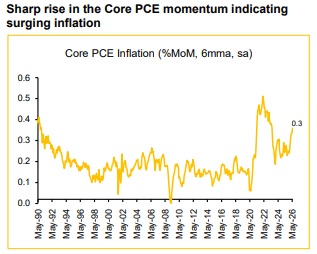
* Headline Personal Consumption Expenditure (PCE) hit 4.1% and core PCE 3.4% in May, highest in years and broadening beyond energy.
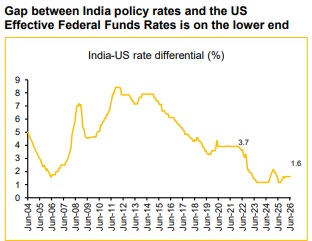
* Hawkish Fed hold narrows RBI’s room to ease; US–India rate differential risks compressing further, pressuring the rupee.
* Higher-for-longer Fed + firm dollar + Middle East oil risks elevate India’s imported inflation.
* Case building for start of RBI tightening cycle; probability of a rate hike toward end-2026 is rising
FOMC decision: Rates steady with rising dissent
The Fed held its benchmark rate steady at 3.50%–3.75% on a 9-3 vote. This is a notably contentious outcome by recent Fed standards; three dissents in favour of tightening are rare. The economic assessment was largely unchanged from the June meeting. Activity was described as “expanding at a solid pace despite elevated uncertainty that owes, in part, to the conflict in the Middle East,” while job growth has kept pace with a labour force that has itself contracted. As at the previous meeting, Fed Chair Warsh deliberately refrained from offering any forward guidance.
Rate-hike conviction is building
Taken as a policy outcome, this was a “hold, but barely.” The 9-3 vote signals genuine internal disagreement rather than consensus caution. A three-member hawkish dissent is unusual; it typically occurs only when inflation data are running uncomfortably hot, or the Committee fears falling behind the curve. Combined with the June dot plot’s upward revision (a hike now pencilled in for 2026, versus none previously), the overall message is that the Fed’s easing cycle from late 2025 has likely ended and the debate has shifted to when the next hike will be delivered. The market’s sharp equity sell-off after a hold decision is telling. It suggests investors had expected a more dovish stance following President Trump’s calls for rate easing. The gap between expectations that Trump would pressure the Fed toward easing and Fed officials’ signals of a possible rate hike is likely to increase volatility in the coming months. The Fed’s preferred inflation gauge has been moving unambiguously in the wrong direction. Headline PCE inflation accelerated for a third consecutive month in May 2026, reaching 4.1% YoY (+0.4% MoM), up from 3.8% in April, the highest reading since April 2023. Core PCE rose to 3.4% (+0.3% MoM), its highest level since October 2023. That is the critical tell: this is not just an energy story. Even excluding energy, core inflation continued to climb in May, signalling that the broadening of price pressures first seen in April persisted rather than faded. The yield-curve move (long end higher, short end slightly lower) reinforces the pattern that “the Fed is more worried about inflation than growth right now”
RBI’s narrowing room to manoeuvre
The Fed’s hawkish hold narrows the RBI’s scope to ease further. The RBI has already held its repo rate steady at 5.25%, maintaining a neutral stance amid a weakening rupee. With the Fed signalling that a hike, not a cut, is now the more likely next move, the US–India rate differential risks compressing further if the RBI were to hold rates steady. This adds fresh pressure on an already weakening currency. Risks from imported inflation are also strengthening. June’s headline CPI already edged higher on food and fuel, and the RBI has flagged elevated oil prices and an uneven monsoon as risks to the outlook. A Fed that stays higher-for-longer keeps the dollar firm and crude prices sensitive to Middle East escalation, both channels that push Indian imported inflation higher. This increasingly builds the case for the start of an RBI tightening cycle and raises the probability of a rate hike toward the end of 2026. For India’s yield curve, upward pressure across the curve can be expected, with the move likely more pronounced at the long end, mirroring the US pattern.
For Detailed Report With Disclaimer Visit. https://choicebroking.in/disclaimer
SEBI Registration no.: INZ 000160131







Tag News

India's future growth to be driven by innovation, startups, MSMEs: Commerce Minister