Credit Card Spending Growth Improves; PSBs Gain Market Share in June 2026 by CareEdge Ratings

Synopsis
• Credit card spending increased 10.0% year-on-year (y-o-y) to Rs 2.02 lakh crore in June 2026, with the improvement in the headline growth rate largely reflecting a favourable base effect. Despite the stronger y-oy growth from the previous month, spending remained broadly stable on an absolute basis.
• Private sector banks (PVBs) continued to dominate the credit card spending landscape. However, their market share continued its gradual decline, following a 418 bps y-o-y and 155 bps month-on-month (m-o-m) moderation. Meanwhile, public sector banks (PSBs) strengthened their position by improving their share by 410 bps y-o-y to 23.5%. The improvement in PSBs' share reinforced the ongoing shift in competitive dynamics within the credit card market.
• Overall, per-card spending across the industry moderated to Rs 16,590 in June 2026 m-o-m, reflecting softer spending growth relative to the continued expansion in the outstanding (o/s) card base.
• The o/s credit card base continued to expand at a healthy pace. While PVBs continued to lead new card issuance, PSBs also maintained steady portfolio expansion, supporting the industry's long-term growth trajectory.
• Online channels continued to account for the majority of credit card spending, underscoring the continued preference for digital commerce. At the same time, resilience in POS transactions indicates that offline spending remains healthy, pointing to a more balanced transaction mix rather than a shift in consumer payment behaviour.
Credit Card Spending Growth Accelerates on a Softer Base Figure 1: Aggregate Spending Trend (y-o-y %, Rs Lakh Crore)
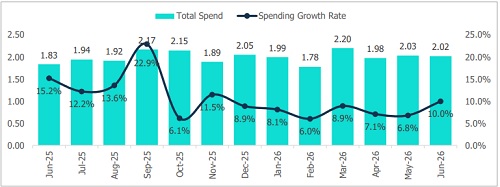
• Aggregate credit card spending increased to Rs 2.02 lakh crore in June 2026, registering 10.0% y-o-y growth. However, monthly spending has remained broadly range-bound over the past few months.
• PSBs outperformed PVBs during the month, with spending growing 33.0% y-o-y, significantly ahead of the 3.9% growth reported by PVBs. While PVBs continued to account for the majority of overall credit card spending, the stronger growth among PSBs reflects their increasing traction in card usage. Small finance banks (SFBs) also reported strong growth of 78.1% y-o-y, although this was on a relatively small base.
• Going forward, credit card spending is expected to remain on a steady growth trajectory, supported by continued expansion in the cardholder base, rising digital payment adoption and resilient discretionary consumption. Competition from UPI is expected to remain concentrated in lower-value transactions, with credit cards retaining their relevance for higher-value and credit-led spending.
Figure 2: Number of Credit Cards Outstanding Increase y-o-y and m-o-m (in crore)
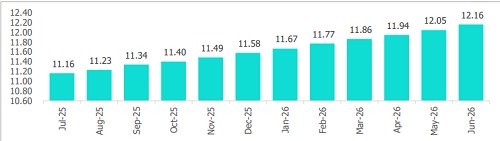
• The total o/s credit card base increased to 12.16 crore cards in June 2026, registering growth of 9.3% y-o-y and 0.9% m-o-m, reflecting continued expansion in credit card adoption. PVBs continued to lead card issuance, with their o/s base growing 9.7% y-o-y, supported by their established retail distribution and digital acquisition capabilities. PSBs also maintained healthy growth at 8.3% y-o-y, although the composition of incremental additions continued to come from PSBs excl. SBI.
• Foreign banks continued to report a contraction in their o/s card base, which declined 5.9% y-o-y to 0.43 crore cards. The moderation is consistent with the portfolio rationalisation and premium-segment focus observed across preceding months, reflecting their continued emphasis on profitability and premium customer segments over expanding card volumes.
Market Share Continues to Shift Towards Public Sector Banks Figure 3: Market Share of Spending of Credit Cards for Different Bank Groups (%)
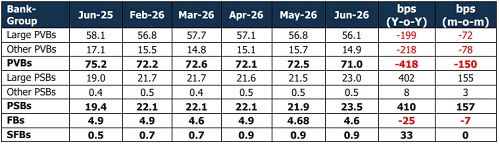
• The credit card spending remained highly concentrated, with the top five issuers accounting for nearly 80% of overall spends in June 2026, broadly unchanged from a year earlier. However, concentration among the largest issuers continued to increase, with the top three accounting for 65.5% of total spending compared with 62.9% a year ago. Against this backdrop, PVBs continued to dominate overall spending, although their market share moderated as PSBs steadily strengthened their position, reflecting evolving competitive dynamics within the credit card market.
• PSBs continued to strengthen their position in the credit card spending landscape, with their market share increasing to 23.5% in June 2026. However, the improvement remained concentrated among the larger PSBs, while smaller PSBs continued to account for only a limited share of overall spending. This divergence is also evident within the broader PSBs segment, where the recent broadening in card issuance has not yet been matched by a similar broadening in spending share, indicating that portfolio activation continues to lag customer acquisition for parts of the public sector banking segment.
• Foreign banks (FBs) and SFBs continued to occupy niche positions within the credit card ecosystem. Foreign banks’ market share remained under pressure as they continued to prioritise premium customer segments and portfolio quality, while SFBs gradually expanded their presence from a small base. Despite these shifts, the overall competitive dynamics of the credit card market have remained largely unchanged.
Per-Card Spending Improves Sequentially Amid Normalising Utilisation Trends Figure 4: Per Card Spending Bank Group-Wise (In Rs)
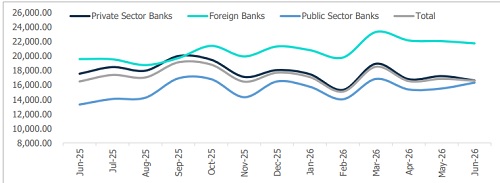
• Per-card spending moderated to Rs 16,590 in June 2026, declining 1.6% m-o-m while registering marginal yo-y growth of 0.6%. The sequential moderation follows the softer aggregate spending recorded during the month, even as the o/s card base continued to expand, diluting average utilisation. This indicates that while issuers continue to expand their card portfolios, incremental card additions are yet to translate into proportionately higher spending, indicating that customer acquisition is currently outpacing growth in card utilisation.
• At the bank-group level, per-card spending highlights the increasing importance of customer activation alongside card acquisition. As banks continue to expand their card portfolios, differences in average spending are expected to depend increasingly on how effectively newly acquired customers are integrated into regular spending behaviour, rather than on card issuance alone.
• Foreign banks continued to record the highest spending intensity at Rs 21,768 per card, up 11.1% y-o-y, consistent with their focus on premium customer segments alongside a contracting card base where higherincome customers typically exhibit stronger spending behaviour, allowing issuers to sustain elevated spend per card despite a smaller and gradually declining portfolio.
• Going forward, per-card spending is expected to remain broadly stable, with growth in average spends constrained as banks continue to expand their card portfolios across mass-market segments alongside persistent competition from UPI and other digital payment modes for low-value transactions. Consequently, the trajectory of per-card spending will increasingly depend not only on incremental card additions but also on issuers’ ability to activate newly acquired customers and deepen engagement within their existing card base.
E-commerce Continues to Lead Credit Card Spending Figure 5: Online vs Offline Share of Credit Card Spending (%)

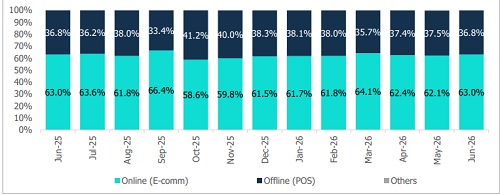
• Online (e-commerce) transactions continued to account for the majority of credit card spending in June 2026, contributing 63.0% of total transaction value at Rs 1.27 lakh crore. E-commerce spending grew 9.9% y-o-y and 0.7% m-o-m, reflecting the continued preference for digital commerce and the increasing integration of credit cards into the broader digital payment ecosystem. The resilience in online spending suggests that ecommerce continues to underpin credit card usage, even as overall spending growth normalises.
• POS transactions stood at Rs 74,262 crore, accounting for 36.8% of total credit card spending. POS spending grew 10.1% y-o-y, marginally ahead of e-commerce, continuing the recent trend of offline spending growth keeping pace with digital channels. This indicates that while e-commerce remains the dominant spending channel, offline card usage continues to strengthen, resulting in a more diversified spending mix.
• PSBs continued to outperform across both online and offline channels, recording 40.8% y-o-y growth in ecommerce spending and 20.3% growth in POS spending, compared with 2.2% and 6.7%, respectively, for PVBs. Foreign banks recorded 1.0% growth in e-commerce spending and 14.4% in POS transactions. The improvement across both channels indicates that the recent gains in PSBs' spending are visible across the broader payments ecosystem rather than being confined to a single mode of transaction.
• Going forward, both e-commerce and POS transactions are expected to remain on a healthy growth trajectory, supported by continued digital payment adoption and improving merchant acceptance. While online transactions are likely to retain their dominant share of credit card spending, the sustained growth in POS transactions indicates that offline spending continues to recover alongside digital channels, resulting in a more balanced transaction mix. As credit card penetration increases, future transaction growth will depend not only on wider card adoption but also on deeper integration of cards into consumers' everyday payment behaviour across both online and offline ecosystems.
Conclusion
Credit card spending remained resilient in June 2026, with monthly spends holding broadly above the Rs 2 lakh crore mark despite a marginal sequential decline. The industry also continued to add customers at a healthy pace, with the outstanding card base crossing 12 crore cards, indicating that penetration and adoption trends remain intact, reflecting sustained consumer adoption despite a more moderate spending environment. PSBs continued to gain share in overall credit card spending. Looking ahead, CareEdge expect credit card spending in July 2026 to remain in the range of Rs 2.11-2.16 lakh crore, supported by sustained cardholder growth, continued digital payment adoption, and resilient consumer spending across both online and offline channels.
Above views are of the author and not of the website kindly read disclaimer