Monsoon Recovery Signals an Improving Economic Outlook Despite Near-Term Inflation Pressures by Bajaj AMC

India's southwest monsoon has gained momentum in recent weeks, although cumulative rainfall remains 16% below the long-term average due to uneven regional distribution. While improving rainfall is expected to support kharif sowing in the coming weeks, the area under kharif sowing remains below last year's level. The progress of the monsoon over the remainder of the season will be key to assessing its impact on agricultural output and inflation.

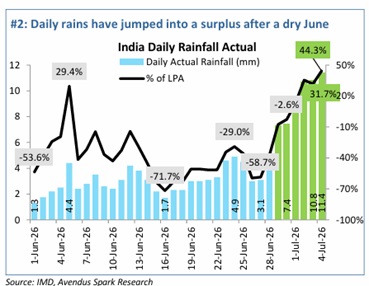
According to an analysis by Bajaj Asset Management Limited (Formerly known as Bajaj Finserv Asset Management Limited.), temporary supply-side pressures may keep food prices elevated in the near term. However, the recovery in rainfall, comfortable foodgrain stocks, resilient rural indicators and a supportive interest-rate environment may prevent the delayed monsoon from becoming a broader economic challenge.
Historical trends also suggest that the start of the monsoon does not necessarily determine the final outcome. Although June 2026 was among India’s driest in more than a century, the eventual impact on the economy will depend largely on how rainfall progresses through July, August and September.
In 1926, for instance, the monsoon experienced one of its weakest starts on record before staging a strong recovery between July and September. The season eventually ended with rainfall 11% above normal.
The analysis indicates that consecutive years of deficient rainfall generally have a more significant impact on farm incomes, rural consumption and economic growth than a single delayed monsoon.
From Farms to Corporate Earnings: The Monsoon’s Economic Impact
A weak monsoon initially affects agricultural production, reducing farm incomes and slowing rural consumption. Its effects are then felt across sectors linked closely to the rural economy, including tractors, two-wheelers, fertilisers and consumer staples.
Lower rural demand can eventually influence overall economic growth, food inflation and corporate earnings. In 2009, deficient rainfall contributed to weaker agricultural output and subdued rural consumption. Similarly, consecutive weak monsoons in 2014 and 2015 extended the slowdown and placed sustained pressure on the rural economy.
The full impact of this year's monsoon remains uncertain and will depend on how rainfall evolves over the remainder of the season, with implications for inflation, agricultural output, rural demand and the broader economy.
However, the outlook today, appears more encouraging for the year already. Rainfall recovered sharply during the final week of June and through July. Reservoir storage remains within comfortable levels, while most river basins are close to or above their long-term averages. Further, India’s food grain stock stands at five times the buffer level, which could be used to control cereal inflation.
Rural fundamentals are also holding up. Tractor sales rose 19% year-on-year in May, agricultural credit growth accelerated to nearly 15%, and robust non-farm income continues to support household spending despite delayed sowing.
Temporary Food Supply Pressures May Push Inflation Higher
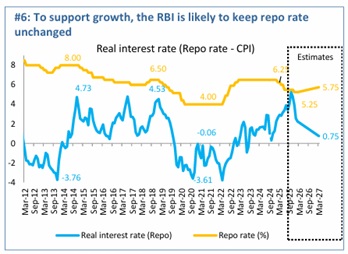
Against this backdrop, inflation may rise from its recent lows, with CPI inflation estimated to average 5–5.5% in FY27. This increase is likely to be driven largely by temporary pressures on food supply. However, underlying inflation remains contained, providing the Reserve Bank of India with room to keep the repo rate unchanged over the next few months, according to Bajaj AMC.
Stable policy rates could help keep bond yields anchored. At the same time, a recovery in rural demand may support sectors such as agricultural inputs, farm equipment, rural-focused automobiles and consumer staples.
Improving rural consumption could also strengthen market sentiment, which has remained under pressure amid geopolitical uncertainty and the resulting rise in crude oil prices.
If rainfall maintains its momentum through August and September, concerns over a deficient monsoon could ease, with 2026 ultimately seen as a delayed but recovering monsoon year, the fund house concludes.
Above views are of the author and not of the website kindly read disclaimer








.jpg)