Strong credit quality in H1; healthy buffers cushion India Inc. against H2 headwinds: ICRA

Rating agency ICRA highlighted that credit quality remained strong in H1 FY2027 despite some moderation in the rating activity. The credit ratio stood at 3.2x, compared with 2.8x in H1 FY2026 and 3.1x in FY2026. This was well above its 10-year average of 1.5x. While the annualised upgrade rate moderated to 14% from 17% in FY2026, the annualised downgrade rate declined to a multi-year low of 4%. This underscored the continued strength in underlying credit quality despite the ongoing geopolitical challenges.
Commenting on the outlook, K. Ravichandran, Executive Vice President and Chief Rating Officer, ICRA, said: “Indian corporates enter H2 FY2027 from a position of strength, supported by healthy balance sheets and substantial liquidity buffers. Looking ahead, elevated crude oil prices, deficient monsoon rainfall and rising inflation are expected to moderate consumption growth, particularly across rural-linked and discretionary sectors. However, strong corporate balance sheets should cushion the impact and prevent it from translating into broad-based credit stress. Nonetheless, renewed US tariff uncertainty adds another layer of risk for export-oriented sectors.”
Entity-specific factors drive upgrades across key sectors
Upgrades were driven largely by entity-specific factors, including stronger business profiles, improved parent credit profiles, lower project risks and deleveraging through equity infusion and scheduled debt repayments. Power, real estate, auto components, finance and capital goods, together accounting for around half of ICRA's rated portfolio, contributed around 50% to all upgrades.
Power-sector upgrades were concentrated in renewables, reflecting lower execution risks, improved operating performance, amended debt structures, increased scale and stronger parent profiles. Real estate upgrades were supported by higher occupancy, lower leasing execution risk, healthy residential sales and collections, and stronger parent profiles. Auto component upgrades benefited from sustained demand, improved operating leverage and an improved value-added sales mix. Capital goods upgrades reflected growth in scale and order books amid healthy demand from defence, power and data centres, among others, while financial-sector upgrades were supported by ownership changes and improvements in scale, asset quality and capitalisation.
Crude, monsoon and inflation pressures to moderate H2 growth
Following temporary relief from the highs of April 2026, renewed escalation in West Asia has pushed the Indian crude basket to a fresh high of $116 per barrel in September 2026, 68% above its pre-conflict level. With the Strait of Hormuz practically closed and traffic down by around 95%, higher energy and commodity import costs, compounded by rupee depreciation, are expected to put pressure on the corporate margins and household purchasing power. West Asia-linked exports and remittance inflows also remain vulnerable.
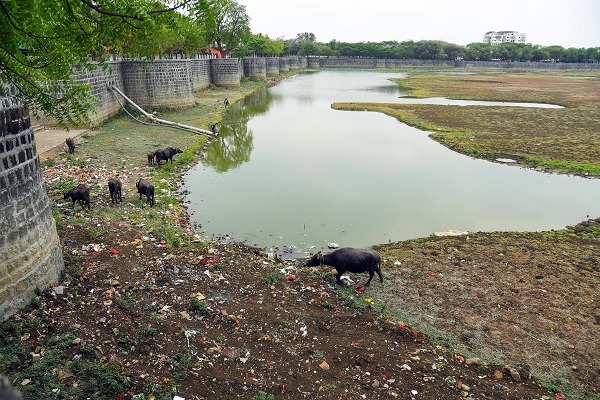
Strong El Niño conditions in 2026 resulted in the monsoon recording a seasonal rainfall deficit of around 12% relative to the long-period average. Additionally, reservoir storage stood at around 71% of full reservoir capacity as of September 24, 2026, compared with around 90% a year earlier, increasing risks for rabi output. While kharif acreage declined slightly, uneven rainfall and above-normal temperature could weigh on yields and food prices. The 39% share of non-crop activities in agricultural gross value added (GVA) and comfortable foodgrain stocks provide some cushion. However, softer crop income and negative real rural wage growth are likely to moderate rural demand. ICRA expects agricultural GVA growth to slow to around 1% in FY2027 from 3.3% in FY2026.
Elevated energy prices have also intensified inflationary pressures across major economies. Following a series of rate cuts in 2025, the global monetary policy cycle has started to reverse, with the US Federal Reserve and the European Central Bank, among other central banks, raising rates in 2026. Domestically, retail inflation is expected to average 5.0% in FY2027, up from 2.1% in FY2026. Against this backdrop, ICRA expects two repo rate hikes of 25 basis points (bps) each in October 2026 and December 2026, if crude prices remain elevated. Higher crude prices would raise the likelihood of further retail fuel price increases, which could broaden inflationary pressures.
Growth to moderate, but broad-based credit stress unlikely
The combination of softer rural demand and pressure on urban discretionary spending arising from higher interest rates and commodity price pass-through are expected to moderate growth in H2 FY2027. While Q1 FY2027 recorded strong GDP growth of 7.8%, aided by limited pass-through of higher fuel costs and companies absorbing a significant part of the increase, ICRA expects GDP growth for FY2027 to be slightly lower, albeit healthy, at 7.1%.
Rural-linked sectors such as tractors, two-wheelers and fast-moving consumer goods are likely to record slower, but positive volume growth, partly reflecting the high base in H2 FY2026 following the GST rationalisation-led demand surge. Discretionary segments such as automobiles, consumer durables, fashion retail, travel and quick-service restaurants could also witness some demand moderation, with spillovers across their supply chains and related industries. Microfinance could see some softening in collections and asset quality, albeit from significantly improved levels following the stress witnessed over the past two years. Further, vehicle finance could witness moderation in assets under management (AUM) growth, while weaker profitability of fleet operators could weigh on the asset quality.
Ravichandran added: “Slower growth does not imply contraction. Volumes across most rural-linked and price-sensitive sectors should continue to grow, while corporate credit profiles remain comfortable. ICRA, therefore, expects any emerging stress to remain granular rather than systemic. The banking system's healthy asset quality and capitalisation also provide substantial capacity to absorb stress while continuing to support credit growth.”
US tariff uncertainty adds another layer of external risk
US tariff uncertainty represents an additional risk for export-oriented sectors. The Lindsey O. Graham Sanctioning Russia and Iran Act of 2026 authorises tariffs of up to 100% on any country among the five largest buyers of Russian oil or gas, subject to presidential discretion. Russia accounted for around one-third of India's crude oil imports sourced over the last three years, with the share rising to 44% in 4M FY2027 following the West Asia conflict. The invocation of the act could materially increase tariffs on Indian exports. The timing and extent of any additional action remain uncertain, but higher tariffs could weigh on the competitiveness of Indian exporters.
Generic pharmaceuticals face an additional sector-specific tariff risk. A US proposal of July 2026 envisages a 100% tariff on generic pharmaceutical imports from August 2028, and rising to 200% from August 2029. The US accounts for around 35% of India's pharmaceutical exports, while Indian manufacturers meet an estimated 45-50% of US generic prescriptions. However, the extended implementation timeline provides scope for negotiation or modification, while Indian companies' existing manufacturing presence in the US and a potential India-US trade arrangement could provide mitigants.
Strong balance sheets and policy support provide buffers against these headwinds
Looking ahead, the duration of the West Asia conflict, crude oil prices, inflation transmission, rabi sowing and the evolution of US tariff measures will remain the key monitorables. However, India Inc. enters this period of heightened uncertainty from a position of considerable financial strength, with corporate leverage at a decade-low of 2.0x and cash balances covering close to half of total debt. These buffers, alongside healthy asset quality and capitalisation in the financial system, should help contain the transmission of macroeconomic and external shocks into broad-based credit stress.
Government policy measures, including calibrated energy-price pass-through, tax relief, targeted credit measures and sustained public investment, have supported the economy and the corporate sector. Continued policy support should provide an additional cushion against these headwinds, while the push towards infrastructure and clean energy should help anchor investment activity even as the private sector capex recovery remains gradual.
ANNEXURE
Credit ratio across select sectors
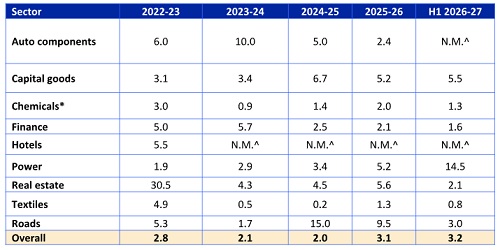
* Includes Agrochemicals and excludes Chemical traders; ^Credit ratio not meaningful — no downgrades in the period (Auto components H1 2026-27: 13 upgrades, nil downgrades; Hotels: 23, 17, 25 and 3 upgrades in 2023-24, 2024-25, 2025-26 and H1 2026-27 respectively, nil downgrades).

Above views are of the author and not of the website kindly read disclaimer