South Africa Economy Update 28th September 2026 by CareEdge Ratings
GDP contracts in Q2 2026
The South African economy contracted by 0.2% QoQ in Q2 2026, following growth of 0.4% in Q1 2026 (revised from the initial 0.5% estimate). The contraction marked the first decline after six consecutive quarters of growth and was driven by weaker activity in the trade, manufacturing and mining sectors.
GVA growth rates (seasonally adjusted)
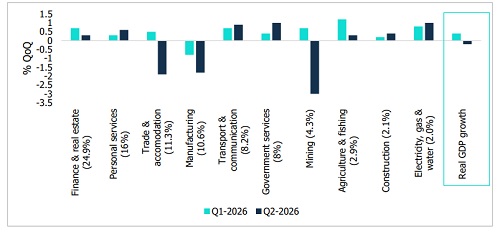
Mining activity contracted by 3.0% QoQ, reflecting lower production of platinum group metals (PGMs), manganese ore, gold and iron ore. The trade and accommodation sector contracted by 1.9%, reflecting softer wholesale trade, motor trade and food & beverages activity, though retail and accommodation remained comparatively resilient. Manufacturing recorded a third consecutive quarterly decline, with seven of ten divisions in negative territory, with food & beverages, furniture and other manufacturing, and basic iron & steel, non-ferrous metals, metal products and machinery being the largest negative contributors.
On the other hand, transport, storage and communication grew by 0.9%, supported by stronger land transport activity. Construction expanded for a second consecutive quarter on higher residential and nonresidential building activity, while agriculture recorded another increase, supported by higher production of horticultural products and field crops. However, the momentum in these sectors was not enough to lift the headline growth figure into positive territory.
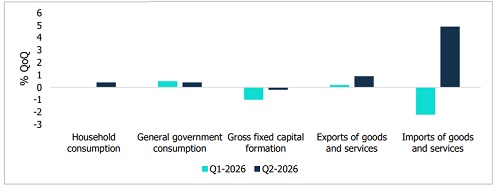
On the expenditure side, imports rose sharply by 4.9%, largely reflecting higher trade in machinery & electrical equipment and mineral products, which outpaced a 0.9% increase in exports led by pearls, precious & semi-precious stones and precious metals. Gross fixed capital formation contracted for a second consecutive quarter, with construction works and transport equipment the largest negative contributors.
This follows the scaling back of investment by public corporations and private business enterprises. On the other hand, general government spending increased slightly by 0.4%, the same as household consumption. Within the latter category, the strongest increases were recorded for food & non-alcoholic beverages, alcoholic beverages, and restaurants & hotels, broadly consistent with firmer retail trade and accommodation observed on the production side.
GDP by expenditure growth
Overall, the Q2 contraction ended six consecutive quarters of growth, the longest uninterrupted growth streak in almost a decade. Nevertheless, 2026 GDP growth is still expected to reach around 1.2% in 2026, with a recovery anticipated in the second half of the year as cost pressures that weighed on Q2 growth are expected to ease.
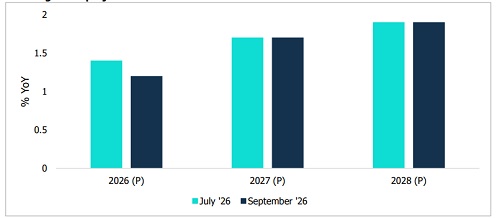
The growth projections for 2026 of Statistics South Africa are in line with those of the South African Reserve Bank (SARB). At its September 2026 Monetary Policy Committee (MPC) meeting, the SARB lowered its growth projections to 1.2% for 2026, 1.7% in 2027 and 1.9% in 2028, compared with July’s projections of 1.4%, 1.7% and 1.9%, respectively, while holding the medium-term outlook steady at around 2%. The downward revisions reflect a combination of heightened global uncertainty and reduced disposable incomes following escalated tensions in the Middle East. Higher oil prices, elevated inflationary pressures, and weaker global growth are expected to continue to weigh on household consumption and investment activity, which previously drove South Africa’s recovery.
At the same time, tighter global monetary conditions and higher long-term interest rates are adding to external pressures. In response, more central banks are raising rates, including the European Central Bank, the Bank of Japan and the US Federal Reserve (Fed), which hiked last week for the first time in three years, while longer-term interest rates also moved higher, reaching multi-decade highs on the back of a large fiscal deficit, inflation risk and heavy borrowing tied to artificial intelligence (AI) infrastructure investments.
SARB’s growth projections
Headline inflation edges higher in August
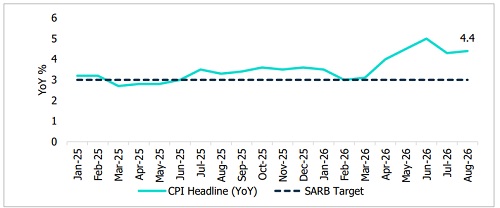
South Africa's headline inflation increased marginally to 4.4% YoY in August 2026 from 4.3% in July 2026. The marginal increase was driven by changes in residual components, while price pressures across the major expenditure categories were broadly contained.
Transport contributed 1.2 percentage points (pp) to headline inflation, driven by fuel prices, which increased by 20% YoY, reflecting the pass-through of higher global oil prices to domestic fuel costs. Housing and utilities inflation remained elevated at 5.2%, contributing a further 1.3 pp, while Insurance and financial services inflation remained elevated at 5.7%, contributing 0.6 pp to overall inflation.
Food and non-alcoholic beverages inflation remained one of the lowest-contributing categories at 1.1% YoY, with strong crop production helping to keep food price pressures contained, notwithstanding the risk of an anticipated El Nino event later in the year. Core inflation, which excludes food, non-alcoholic beverages, fuel and energy, eased to 4.1% in August from 4.2% in July, coming in slightly below expectations and suggesting that underlying, broad-based price pressures remain relatively moderate even as the headline rate edges higher.
Inflation is expected to remain above SARB’s target of 3% in the near term, with the outlook still hinging on developments in global oil markets and the durability of the Middle East ceasefire.
Headline inflation
SARB raises repo rate to 7.25% as fuel-driven inflation risks mount
The MPC raised the repo rate by 25 basis points to 7.25%, effective 25 September 2026, in a unanimous decision. The decision reflects a re-intensification of fuel price pressures after a brief easing between June and August, with global interest rates also continuing to move higher. The rate hike action also highlights the growing concern over inflation risks and elevated global uncertainty.
SARB’s inflation projections

Headline inflation is now expected to average above 5% later this year and into early next year, peaking at 5.7% in November 2026, before gradually easing back towards the 3% target by the end of 2027. The upward revision reflects a sharp increase in the SARB’s Brent crude oil assumptions – to USD 90.9/bbl in Q3 2026 and USD 95.1/bbl in Q4 2026, up from USD 78.5 and USD 75, respectively, at the July meeting – with a more cautious rand path, alongside looming second-round effects. In contrast, the SARB flagged more favourable trends in food and core goods prices, with food inflation now at its lowest level since 2010, though services inflation remains elevated and inflation expectations still above target.
The MPC’s alternative scenarios suggest that a larger-than-expected rise in global interest rates, or a further deterioration in inflation expectations and wage growth, could weaken the rand and push inflation higher, requiring a more restrictive policy stance than the baseline currently implies. Consequently, the SARB
indicated that future policy decisions will remain highly dependent on developments in global energy markets, inflation expectations, and the broader geopolitical environment.
Looking ahead, risks to growth and inflation will be skewed by developments in global energy markets and geopolitical conditions. While the SARB’s own model points to a broadly stable policy rate for the remainder of 2026 with gradual cuts thereafter, elevated oil prices, rising costs and a difficult global backdrop are expected to weigh on economic activity in the coming quarters. Resultantly, the SARB is likely to maintain a cautious and data-dependent approach to monetary policy, with inflation developments remaining the key determinant of future interest rate decisions.
Above views are of the author and not of the website kindly read disclaimer