Retail Drives 58% of Incremental NBFC Credit as Overall Growth Hits 15.8% in August 2026 - CareEdge Ratings
Synopsis
Credit extended by NBFCs, including housing finance companies, grew 15.8% y-o-y to Rs 60.6 lakh crore as of August 31, 2026, compared with 10.0% a year ago, adding about Rs 8.3 lakh crore. Retail, the largest NBFC lending segment, grew 22.0%, increasing its share to 43.7% from 41.4% in August 2025. NBFCs' credit to industry grew 8.4%. Gold loans remained the fastest-growing segment, up 69.1% y-o-y to Rs 3.6 lakh crore. Higher gold prices likely raised collateral values and pulled in borrowers seeking quick, low-documentation credit. Consumer durables financing, vehicle finance and housing grew 56.4%, 15.4% and 12.1%, respectively. NBFC power financing growth slowed to 8.3% from 11.0% a year ago. Agriculture credit grew 17.4%, up from 5.1% a year earlier, though it remains a small 1.3% of the NBFC book.
“NBFC credit grew 15.8% y-o-y to Rs 60.6 lakh crore as of August 31, 2026, up sharply from 10.0% a year earlier, led by resilient retail demand and deeper penetration of asset-backed products such as gold loans and consumer durables financing. Bank credit has grown even faster, with non-food bank credit rising 18.8% y-o-y in August 2026 (10.2% a year earlier), ahead of NBFC credit growth of 15.8%. This keeps competition between banks and NBFCs for the most creditworthy borrowers intense. Going forward, the sustainability of NBFC growth will be contingent on disciplined underwriting, reliable funding sources, and adequate portfolio diversification, particularly given emerging downside risks: the potential impact of El Niño on rabi-season output and rural cash flows, as well as the risk that elevated crude prices and an extended West Asia crisis could lead to a steeper interest-rate trajectory,” said Vineet Jain, Senior Director, CareEdge Ratings.

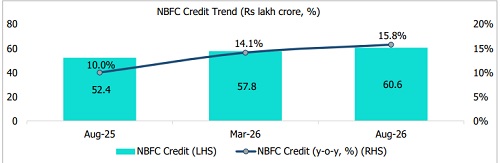
NBFC Credit Growth Rises to 15.8% from 10.0% a Year Ago
NBFC credit growth has re-accelerated over the past year, rising from 10.0% y-o-y in August 2025 to 15.8% y-o-y in August 2026, up about 580 bps. Part of this reflects a low base: over two years, credit grew about 12.9% a year. Growth also accelerated from 14.9% in July 2026. In absolute terms, outstanding NBFC credit increased by approximately Rs 8.3 lakh crore over the 12 months to August 2026, taking the total NBFC book to Rs 60.6 lakh crore. Month-on-month (m-o-m), credit expanded by about 1.3% in August 2026, and by 5.0% since March 2026. A broad-based revival in retail credit demand accounted for about three-fifths of the pickup, with a rebound in other loans contributing most of the rest. The RBI held the repo rate at 5.25% with a neutral stance in its August 2026 policy but raised it by 25 bps to 5.50% on October 7, 2026 and moved to a ‘calibrated tightening’ stance, which could lift NBFC funding costs
NBFC Credit Climbs from Rs 52.4 Lakh Crore to Rs 60.6 Lakh Crore Since August 2025
Retail Share Rises to 43.7%, Adding Nearly 3x Industry’s Rs 1.7 Lakh Crore
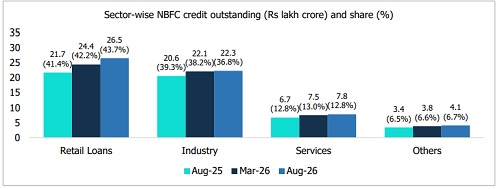
NBFC retail credit increased to Rs 26.5 lakh crore in August 2026 from Rs 21.7 lakh crore a year earlier. Its share in total NBFC credit consequently rose to 43.7% from 41.4%. This growth was supported by sustained demand for consumer finance, gold loans and consumer durables financing. In contrast, industry credit stood at Rs 22.3 lakh crore, with its share declining to 36.8% from 39.3%.
Services accounted for a stable 12.8% of total NBFC credit, while agriculture and other loans represented 1.3% and 5.4%, respectively. Overall, the portfolio mix indicates a clear shift towards asset-backed retail lending, particularly gold loans and consumer finance, alongside a declining share of large-ticket industrial and infrastructure financing
Retail Credit Grows 22.0%, Accounting for 58% of the Rise in NBFC Credit
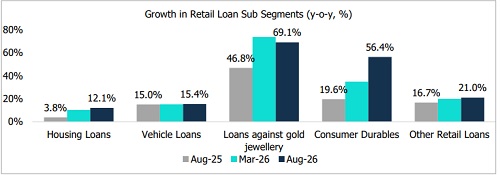
growth at 15.4%. Consumer durables financing recorded the sharpest acceleration, with growth rising to 56.4% from 19.6% a year earlier. Other retail loans also grew robustly by 21.0%.
Gold Loans Add Rs 1.5 Lakh Crore, the Largest Gain Among Retail Segments
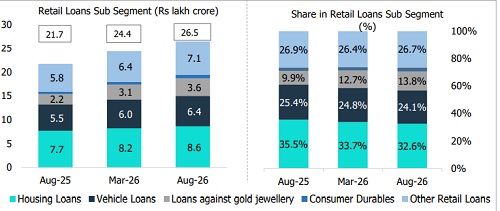
Gold Loans Grow 69.1%, Over Four Times the Pace of Overall Credit
Gold loans remained the fastest-growing NBFC retail segment, with outstanding credit rising to Rs 3.6 lakh crore in August 2026 from Rs 2.2 lakh crore in August 2025. Growth remained strong at 69.1% y-o-y in August 2026, although it moderated from 73.8% in March 2026. Sequentially, gold loans grew 3.1% m-o-m, second only to consumer durables (4.2%), as elevated gold prices likely lifted the collateral value of pledged jewellery and drew more borrowers toward gold loans as a fast, low-documentation source of liquidity. This reflects sustained demand and continued NBFC focus on gold-backed lending, supported by its relatively short tenor and faster turnaround.
All Retail Segments Grow Faster than a Year Ago
Housing Credit Growth Rises to 12.1% from a Low 3.8% Base
BFC housing credit grew 12.1% y-o-y to Rs 8.6 lakh crore in August 2026, a sharp pick-up from 3.8% a year earlier, partly reflecting a low base (two-year growth of about 7.9% a year). Housing's share of NBFC credit eased to 14.2% from 14.7%, indicating that housing credit grew in absolute terms but more slowly than overall NBFC credit. NBFCs nevertheless remain important housing financiers, supported by their wider reach and greater underwriting flexibility for relatively weaker home loan borrowers.
Industry Credit Grows 8.4%; Power Credit Growth Slows to 8.3%
Power-sector credit growth slowed to 8.3%, lowering power’s share of total NBFC credit to 23.9% from 25.5%. NBFC credit to industry grew 8.4% y-o-y in August 2026, broadly unchanged from 8.3% a year earlier. Infrastructure credit, the largest component of industry credit, grew 7.2% (unchanged from a year earlier). Within this segment, power-sector credit growth declined to 8.3% from 11.0%, though it has picked up from 7.4% in March 2026. Credit growth in other infrastructure segments improved to 4.6%, reversing a marginal contraction of 0.9% a year earlier, though it has slowed from 6.0% in March 2026, and the book has contracted 2.6% since then. Other industry credit, although smaller and more diversified, continued to grow strongly at 22.0% y-o-y, broadly in line with 22.1% a year earlier.
This indicates that NBFCs continue to support industrial working-capital needs, even as large-ticket infrastructure lending grows more slowly at 7.2%.
Power Is 65% of NBFC Industry Credit; Other Industry Grows Fastest at 22.0%
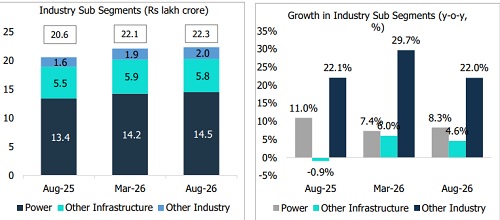
Infrastructure Credit Grows 7.2% to Rs 20.3 Lakh Crore
NBFC overall infrastructure credit stood at Rs 20.3 lakh crore in August 2026, up 7.2% y-o-y. RBI data show bank credit to industry grew 18.2% y-o-y in August 2026, with infrastructure among the segments recording buoyant growth. Banks' lower funding costs and greater competitiveness in large, long-tenor projects likely supported bank lending to infrastructure.
Services Credit Growth Slows to 16.2% from 24.0%
Services-sector NBFC credit grew 16.2% y-o-y to Rs 7.8 lakh crore in August 2026, slower than the 24.0% growth recorded a year earlier. Commercial real estate (CRE) was the fastest-growing services segment, with credit growth accelerating to 21.8% from 11.3%. Outstanding CRE credit rose 0.4% m-o-m after declines in the previous two months, indicating volatility in credit utilisation and repayment patterns. Trade credit and lending to transport operators grew 15.6% and 10.7%, respectively. Credit growth in other services moderated to 17.7% from 37.3% a year earlier.
Agriculture Credit Growth Rises to 17.4% from 5.1%
Agriculture credit, though it accounted for only 1.3% of the NBFC loan book, grew 17.4% y-o-y in August 2026, up sharply from 5.1% a year earlier, partly reflecting a low base. Higher NBFC lending in rural and semi-urban areas likely supported the growth. Other loans (mainly non-housing HFC loans) rebounded 20.3% y-o-y in August 2026 after a 21.3% fall a year earlier but remain 5.3% below their August 2024 level. However, the sharp increase may partly reflect a low base and changes in loan classification.
CareEdge Ratings’ View
According to Saurabh Bhalerao, Director, CareEdge Ratings, “The shift towards retail and asset-backed lending is likely to remain a key growth driver for NBFCs through the rest of FY27. The increasing contribution of gold loans and consumer durables financing provides some diversification from wholesale exposures, although the sharp acceleration in gold loans warrants closer monitoring of loan-to-value discipline and sensitivity to gold prices. With banks also increasing their participation in gold-loan financing, competitive intensity in the segment could rise further. Overall, while retail-led growth remains supportive, funding costs and asset quality will remain important areas to watch as the portfolio mix continues to evolve.”
Above views are of the author and not of the website kindly read disclaimer








.jpg)