
BoM hikes key rate by 25 bps by CareEdge Ratings

Bank of Mauritius raises key rate to 5.00% amid broadening inflationary pressures
The Monetary Policy Committee (MPC) of the Bank of Mauritius (BoM) unanimously increased the key rate by 25 basis points (bps), from 4.75% to 5.00% per annum, at its meeting on November 11, 2026. The decision marks a further tightening of monetary policy as the bank prioritises containing the risk of inflation becoming entrenched above its 2-5% target range, despite a still uneven domestic recovery and downside risks to growth.
Inflation concerns take precedence over growth
The MPC’s decision was driven by the broadening and intensification of domestic price pressures. Headline yearon-year (Y-o-Y) inflation reached 6.4% in October 2026, remaining above the bank’s 2-5% target range for the second consecutive month and reflecting not only persistent food and services inflation but also increasingly widespread price increases across the economy. According to the BoM, inflation risks outweigh concerns over moderating economic growth. The bank expects price pressures to remain elevated in the near term. Headline inflation is forecast at 4.7% by year-end, reflecting the petroleum price hikes implemented in August and September and the resulting second-round effects across categories. The bank expects inflation to exceed 5% in 2027.
Headline YoY and core inflation
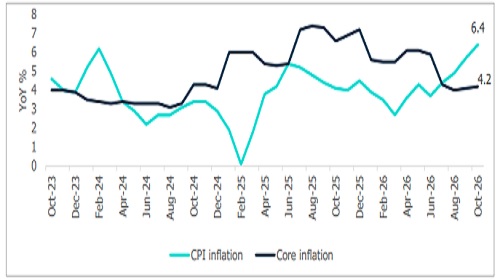
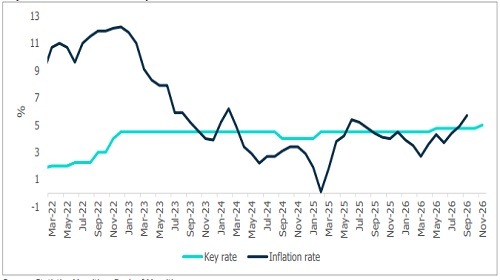
The BoM's policy decisions have broadly mirrored inflation trends in recent years. The rate hikes in 2022 were aimed at containing surging inflation, while the subsequent period of policy stability reflected easing price pressures. The latest increase in the key rate underscores renewed concerns about inflation persistence and signals a shift towards reinforcing price stability.
Key rate and inflation developments
Growth prospects face increasing headwinds
The latest rate hike comes at a time when Mauritius's growth outlook is already facing mounting challenges from a softer global economic environment, weaker external demand, rising production costs and ongoing pressures on export-oriented sectors. While tourism remains supportive, growth momentum has moderated amid heightened global uncertainty, slowing trade activity and competitiveness challenges in parts of the manufacturing sector. While the BoM expects real GDP growth to reach 3.0% in 2026 and 3.2% in 2027, the IMF has adopted a more cautious stance, revising its 2026 growth forecast down to 2.7%, while projecting 3.2% growth in 2027, in line with Statistics Mauritius. Against this backdrop, higher interest rates are likely to weigh on domestic demand through tighter credit conditions and higher debt-servicing costs for households and businesses. This could curb discretionary spending, dampen consumer confidence and moderate private sector activity at a time when external growth drivers remain subdued. Consequently, while the rate hike supports efforts to contain inflation and anchor inflation expectations, it also adds to downside risks facing an already fragile growth outlook.
Growth projections

Investment activity likely to face further pressure
The latest policy tightening could further weigh on investment activity, which was already showing signs of weakness. Gross fixed capital formation (GFCF) contracted by 9.7% Y-o-Y in Q2 2026, reversing the 6.1% expansion recorded in the previous quarter, amid sharp declines in investment in machinery and equipment (- 16.8%) and building and construction works (-3.7%). Against this backdrop, higher borrowing costs are likely to raise financing costs for businesses and increase the threshold for undertaking new capital expenditure. As a result, interest-sensitive investments, particularly in construction, real estate development, hospitality and business expansion, could be deferred or scaled back until financing conditions improve and demand prospects become clearer. While public infrastructure spending under the 2026/27 Budget and the Public Sector Investment Programme should provide some support, private sector investment, which accounts for the bulk of total capital formation, is likely to remain subdued. Consequently, investment activity could emerge as a key drag on growth over the coming quarters, particularly if the monetary tightening cycle continues.
External vulnerabilities remain despite adequate reserve buffers
Mauritius's external position continues to be supported by comfortable foreign exchange reserves, which were equivalent to 13.9 months of import cover (excluding GBC services imports) as of October 2026, providing a substantial buffer against external shocks. Nevertheless, the country's external accounts continue to face pressures. The IMF expects the current account deficit to widen to 7.9% of GDP in 2026 from 7.0% in 2025, before narrowing to 5.8% in 2027. While robust tourism receipts should continue to underpin foreign exchange earnings, improvement in the external balance is likely to be constrained by a challenging global trade environment, disruptions to key maritime shipping routes and uncertainty surrounding trade policies. In addition, elevated energy and food import costs, alongside higher freight charges, could sustain import demand and keep external financing requirements relatively high.
Key rate and exchange rate trends
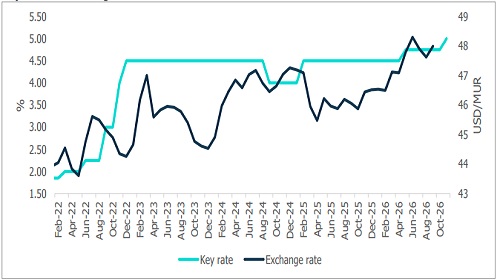
It is worth noting that the exchange rate and the key rate have not always moved in tandem over recent years, highlighting the significant role of external factors in shaping currency movements. Despite a cumulative 275 bps increase in the key rate since 2022, the Mauritian rupee (MUR) continued to face depreciation pressures against the US dollar (USD), reflecting the influence of external imbalances, global financial conditions and foreign exchange demand. This suggests that while monetary tightening can support currency stability, exchange rate dynamics are ultimately influenced by a broader set of domestic and external factors.
Exchange rate pressures likely to remain manageable but persistent
The latest policy tightening could provide some support to the MUR by improving the relative attractiveness of MUR-denominated assets and reinforcing investor confidence in domestic financial markets (encouraging capital inflows) as well as cooling domestic demand and import volumes. However, exchange rate developments are expected to remain largely driven by broader external factors, including the trajectory of the current account deficit, global commodity prices and capital flow dynamics. The currency is already under pressure, with the MUR depreciating by 4.9% against the USD and 0.5% against the euro (EUR) between October 2025 and October 2026. Although strong tourism inflows and adequate reserve buffers should help contain excessive volatility, persistent external imbalances and an uncertain global environment are likely to keep depreciation pressures on the MUR from fully dissipating. As such, the rate hike may help moderate exchange rate pressures at the margin, but is unlikely to materially alter the underlying drivers of currency movements. The longer-term impact would also depend on the Fed’s decision on its own rate in early December.
Financial stability risks remain contained
The latest rate hike is unlikely to pose immediate risks to financial stability, given the Mauritian banking sector's strong capital and liquidity buffers. Asset quality indicators remain broadly healthy, with the system-wide nonperforming loan (NPL) ratio improving to 3.6% in June 2026 from 4.1% a year earlier (June 2025), while provisioning levels have remained adequate and profitability resilient. Stress-testing exercises conducted by the BoM also indicate that banks are well positioned to absorb adverse macroeconomic and liquidity shocks. Nevertheless, the higher interest rate environment could gradually increase debt-servicing pressures among more leveraged borrowers. Vulnerabilities are likely to be concentrated in sectors already facing cyclical or operational challenges, including construction, manufacturing and smaller wholesale and retail businesses. Households and corporates with variable-rate debt may also face higher repayment burdens as lending rates adjust upwards. However, the current strength of banking sector balance sheets suggests that any deterioration in asset quality is likely to be gradual and manageable rather than posing a broader systemic risk.
Outlook
The latest rate hike underscores the BoM's commitment to restoring price stability amid broadening inflationary pressures and rising upside risks to the inflation outlook. While tighter monetary conditions should help anchor inflation expectations and support macroeconomic stability, they come at a time when growth momentum has softened, investment activity has weakened and external vulnerabilities remain elevated. Going forward, the policy path is likely to be data-dependent, with the BoM balancing the need to contain inflation against the risk of exerting excessive pressure on economic activity. In our view, the evolution of inflation, exchange rate dynamics and domestic demand conditions will be key determinants of future monetary policy decisions, but further efforts are required to address structural factors, including the widening current account deficit, to sustainably contain imported inflation and steer the economy on a more dynamic growth path.
Above views are of the author and not of the website kindly read disclaimer






.jpg)