India's Foreign Trade B2K Economy Bytes India November 2026 by B2K Analytics

Foreign Trade: Key Highlights for October
* Merchandise exports & imports recorded all-time highs in October 2026, rising to USD 49.5 Bn (45.1% YoY) and USD 89.4 Bn (16.5% YoY) respectively. With the ongoing festive season, the demand for exports and imports has risen. Merchandise exports grew faster than imports in October, with electronic goods and gems & jewellery being the biggest drivers outside petroleum products on a YoY basis. Elevated crude oil prices from the West Asia conflict also inflated the value of both India’s exports and imports. The merchandise trade deficit narrowed by 6.4% YoY to USD 39.9 Bn.
* On a monthly basis, both merchandise exports and imports saw robust growth in October 2026, though imports grew faster than exports causing the trade deficit to widen by 31.8% monthly. Demand for gold and silver saw a spike (202.7% MoM) in October as retailers and buyers stocked up ahead of Diwali. The export value of gems & jewellery fell by 4.9% MoM to USD 3.2 Bn in October 2026, as gold and silver prices recorded a fall of 4.3% and 9.8% MoM, respectively.
* India’s service trade improved in October 2026 on a YoY basis. Service exports were estimated to have risen by 15.2% YoY to USD 40.5 Bn, while imports are estimated to have grown by 16.9% YoY to USD 20.7 Bn. Meanwhile, the overall trade deficit (merchandise + services) narrowed to USD 20.1 Bn in October 2026 from USD 25.1 Bn a year ago, supported by the faster growth in merchandise exports.
* While India’s relationship with the US continues to remain tenuous due to the West Asia conflict, the delayed trade deal finalisation and the US insistence on tariff protectionism, a spark of hope has appeared. On November 15th, 2026, Commerce and Industry Minister Piyush Goyal stated that the US has agreed to give India preferential market access for its goods, giving it lower import duties than its competing countries. This is a hopeful sign that India and the US are close to a finalised trade deal, though negotiations are still ongoing to finalise the first phase of this deal. In the meantime, India continues to pursue trade diversification, with Minister Piyush Goyal currently chairing the 7th IndiaEgypt Trade Committee Meeting, with an emphasis on expanding bilateral trade between the two countries and promoting investment. While India’s merchandise exports to and imports from Egypt accounted for only 0.9% and 0.3%, respectively, in FY26, this low base offers significant growth potential for India if the two countries conclude a trade agreement.
* Ahead of the festive season, India’s exports and imports have seen a boost in October despite the prevalent global headwinds. While these headwinds remain a threat to the country’s energy supply and increasing import bill, the recent gains by the Democratic Party in the US November elections could hasten the end of the war. With the US’s involvement in the war growing increasingly unpopular with voters due to the higher gas prices, Democratic leaders have called for the US to withdraw from the conflict with Iran.
Merchandise Trade: Top Trading Partners
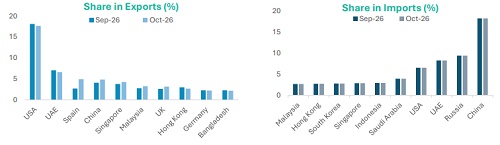
* On the exports side, shipments to the US, India’s largest export destination, rose by 8.6% MoM to USD 8.7 Bn in October, reflecting festive season demand. The India-US trade deal appears more likely to be finalised in the coming months, with the commerce minister’s announcement and the threatened 100% Graham Act tariff on India still waived. From official US trade data, imports from India only comprised 3.1% of the US’s total imports in 2025. The promised trade deal with the lower import duties could give India a tariff advantage over competitors such as Bangladesh and China, though these countries still hold an edge in manufacturing scale and cost.
* On a negative note, the India-UK Comprehensive Economic and Trade Agreement (CETA), the bilateral free trade agreement (FTA), which came into force on July 15th, 2026, faced its first test in recent weeks over import duties on Scotch. Indian customs authorities are currently holding dozens of containers of bulk Scotch whisky imported by Pernod Ricard and Diageo, as customs investigators seek a 150% import duty on these goods despite the CETA stating a reduced 75% rate. Indian Commerce Secretary Rajesh Agrawal stated on November 13th, 2026, that New Delhi will honour the duty concessions that were offered as part of the trade deal.
* On the import side, China remains the dominant source for India’s imports particularly for critical materials such as batteries, electronic goods, rare earths and other specialised tools. On November 9th, 2026, China extended the suspension of its rare earth export controls until January 10th, 2027, as part of a US-China truce. As the suspension applies to all importers, India also stands to benefit. China is India’s biggest source of rare earth materials, which are crucial for the manufacture of electronics, advanced defence technologies and renewable energy systems.
* India’s imports from Russia grew by 43.0% MoM and 73.2% YoY in October 2026, as Indian imports of Russian fossil fuels hit a record EUR 6.4 Bn in October, with crude oil accounting for 91% of the purchases, according to the Centre for Research on Energy and Clean Air (CREA). With the Graham Act’s tariff trigger currently waived, domestic refineries can continue purchasing Russian oil without exposing India’s exports to the threatened 100% US tariff.
Top 10 Export and Import Items
* India’s export basket was led by exports of petroleum & crude products which saw tremendous rise inOctober (43.0% MoM). The West Asia conflict has pushed crude prices higher and crude oil prices rose from USD 116.6 per barrel in September 2026 to USD 120.2 per barrel in October for the Indian basket. Higher prices, along with strong overseas demand for refined fuels, lifted the value of India’s refined product exports.
* Electronic goods, readymade garments, marine products and plastic & linoleum products also posted healthy MoM growth, supported by festive season demand.
* In contrast, gems & jewellery and leather & leather manufactures saw a MoM dip in exports, likely reflecting lower precious metal prices and seasonal trends.
* India’s import basket is once again led by imports of POL which accounted for the largest share, rising by 24.4% MoM to USD 22.8 Bn. The increase was driven by both higher crude prices and volumes, while the closure of the Strait of Hormuz pushed up shipping and insurance costs. Electronics imports slightly dipped by 3.0% MoM in October 2026, likely reflecting a normal variation in demand after retailers and manufacturers stocked up on inventory and raw materials ahead of the festive season.
* Gold and silver imports surged 202.7% MoM in October 2026, driven by festive-season stocking ahead of Diwali in addition to lower bullion prices. The rise was magnified by a weak September base, when imports were subdued following the customs duty hike to 15%. On October 15th , 2026, the government cut the duty drawback rates for gold jewellery by 3.1% to Rs 1,794.11 per gram and for silver jewellery and silver articles by about 9% to Rs 26,859.02 per kg, reducing the export refund available to jewellery exporters. Because the rates are fixed in absolute terms, they were revised downward to reflect lower gold and silver prices.
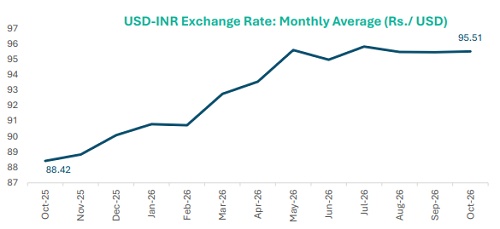
* India’s exports continue to be led by its manufacturing and commodity-linked sectors while imports are driven by energy. India’s reliance on imports for its energy needs is a critical vulnerability as it is extremely exposed to fluctuations in global crude prices. While consumers have seen some protection from prices, retailers are forced to absorb these costs due to lack of alternatives. WPI for crude petroleum & natural gas saw 70.8% YoY inflation in October 2026, highlighting the cost pressures faced by retailers. The rising crude import bill has also added to the pressure on the rupee.
* With the rising fuel inflation, India’s CPI inflation breached the upper limits of the RBI’s tolerance band in October, reaching 6.1% YoY. If the West Asia conflict persists, the MPC may be forced to conduct another repo rate hike in its upcoming December meeting.
* The Indian rupee weakened by 8.0% YoY against the USD in October 2026, reflecting the influence of continued foreign equity outflows, rising crude prices, and strengthening dollar demand. It also weakened against the GBP (7.5%), the EUR (4.0%) and the JPY (3.6%).
* A weaker rupee weighs on India’s external sector by inflating import costs, deterring foreign capital and widening the trade and fiscal deficits, though it does improve the price competitiveness of India’s exports.
* While India’s trade outlook has been uncertain for the past year, recent events have raised hopes for a return to stability. However, in the short term, India must still contend with higher fuel prices and rising inflation.
Above views are of the author and not of the website kindly read disclaimer






Tag News
Our aim is to transform Telangana into $3 trillion economy: Telangana Chief Minister
More News
Economy : CPI Above the Band, and the Pipeline Is Still Full by Choice Institutional Equiti...