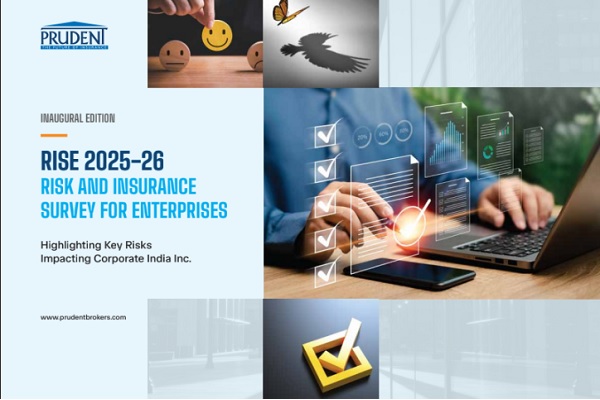
Prudent Insurance Brokers, one of India’s leading insurance broking firms, today announced the launch of the Risk and Insurance Survey for Enterprises (RISE) 2025-26. Leveraging insights across 7 key industries from 17 states, the survey explores how business leaders are redefining risk in an era of accelerated change. Based on responses and insights gathered from 1,200 data points, it captures perspectives from decision-makers across company sizes, industries and geographies. The survey reflects a highly experienced respondent base, with senior management accounting for 45% of participants, ensuring that the insights capture seasoned risk management perspectives shaped by multiple business cycles.
The findings point to a growing recognition that risk is no longer a standalone function. Despite this increased awareness, the data shows that only 16% of organisations operate at an optimised risk maturity level, with many still managing risks reactively. Additionally, insights from risk professionals across India highlight how foresight, agility, and preparedness are increasingly shaping modern risk strategies.
Mr. Pavanjit Singh Dhingra, Joint Managing Director, Prudent Insurance Brokers, said, “As Indian enterprises navigate an increasingly volatile risk environment, the findings of RISE 2025–26 clearly show that risk priorities are undergoing a fundamental shift. Insights drawn from the survey, highlight how organisations are moving beyond traditional operational risks to address systemic challenges such as cyber incidents, supply chain disruption, and business interruption.
While 71% of organisations aim to strengthen risk management, only 48% focus on developing a strong risk culture, which is crucial for shifting from reactive to proactive risk preparedness. This gap between awareness and execution highlights the urgent need to embed risk thinking into strategic planning, technology adoption, and capital decisions.
The objective of RISE 2025-26 is to equip organisations with actionable insights that help them strengthen resilience, align insurance programmes with real exposure, and make informed decisions in an environment where uncertainty is no longer the exception, but the norm.”
Sector-wise Findings Derived from RISE 2025–26
|
Automobile & Auto Components
|
- India’s automobile market, valued at approximately INR 22 lac crore in 2025, is projected to grow at a 7.3% CAGR by 2030, while the auto components segment, currently at INR 6.73 lac crore, is expected to expand at a faster 20% CAGR.
- The near-term risk outlook reflects supply chain disruptions as the top-most concern stemming from geopolitical disruptions and the challenges.
- Risk priorities in the sector are shifting, with cyber incidents and ransomware overtaking supply chain disruptions as the most critical strategic concern.
- The industry’s rapid move towards software-defined and connected vehicles is significantly increasing digital and operational exposure.
- Expanded connectivity and embedded systems have broadened cyber-attack surfaces, pushing cybersecurity into the boardroom.
- As digital transformation accelerates, cyber resilience is emerging as a core business imperative for the automotive ecosystem.
|
|
Construction & Engineering
|
- India’s construction sector is set to grow from INR 63.3 lac crore in 2025 at a CAGR 7.4% to reach INR 90.53 lac crore by 2030, led by infrastructure and policy push.
- Regulatory and policy uncertainty has emerged as the most considerable near-term risk for construction and engineering projects.
- Supply chain disruptions and rising cyber threats are increasingly impacting project timelines and costs.
- Natural disasters and fire-related risks dominate the sector’s long-term risk outlook.
- Rapid digital adoption through BIM, IoT and connected systems is reshaping efficiency while significantly increasing cyber exposure.
|
|
Pharmaceuticals & Chemicals
|
- India’s pharmaceuticals market is set to grow from INR 4.68 lac crore in 2025 to INR 10.63 lac crore by 2030, while the chemicals sector will expand to INR 27.63 lac crore.
- Cyber risks and business interruption are emerging as the most critical long-term threats as the sector accelerates digitalisation.
- Political and trade tensions, coupled with API-related supply chain disruptions, remain top near-term concerns.
- Regulatory and policy changes continue to pose significant compliance and operational challenges in a highly regulated environment.
- Strengthening resilience, cybersecurity, and regulatory agility is key to sustaining long-term growth and protecting enterprise value.
|
|
Energy & Utilities (Including Telecom)
|
- India’s power sector continues to scale, with installed capacity reaching 505 GW in 2025, over 50% from non-fossil sources, underscoring the pace of the energy transition.
- Supply chain disruption and cyber threats dominate near-term risk concerns for the sector.
- Cyber incidents and ransomware remain the top long-term strategic risk as grid digitalisation deepens.
- Natural disasters and business interruption continue to threaten asset integrity and service continuity.
- Ageing infrastructure, regulatory shifts, and climate exposure are pushing resilience and risk preparedness to the forefront.
|
|
IT/ITES & E-commerce
|
- India’s IT/ITES sector is set to grow from ?24 lac crore in 2025 to ?42.5 lac crore by 2030.
- Cyber risk remains the single biggest threat, dominating both near-term and long-term priorities.
- Regulatory and data-privacy changes continue to challenge compliance across global operations.
- AI and emerging technologies are accelerating innovation while amplifying governance and security risks.
- Business interruption risks highlight the sector’s dependence on always-on digital infrastructure.
|
|
Manufacturing
|
- Global supply chain exposure is making manufacturing more vulnerable to geopolitical and logistics shocks.
- Supply chain disruption leads near-term risk concerns for manufacturers.
- Cyber incidents and ransomware top long-term risks as Industry 4.0 adoption accelerates.
- Fire, property damage, and business interruption pose major threats to capital-intensive operations.
- Rising competition and automation are forcing manufacturers to strengthen resilience alongside efficiency.
|
|
Services (BFSI, Hospitality, Retail, Education)
|
- The services sector’s growing reliance on customer data and brand trust is reshaping its risk landscape.
- Cyber threats emerge as the top near-term and long-term risk across service-driven businesses.
- Third-party and vendor-related disruptions are rising as a key operational concern.
- Rapid adoption of AI in customer-facing and back-office functions is improving efficiency while increasing data privacy risks.
- Business interruption and reputational impact remain critical threats to service continuity and client confidence.
|
Above views are of the author and not of the website kindly read disclaimer