Mustard Market Outlook: Weather Stress, Tight Stocks and Global Edible Oil Rally May Support Prices by Amit Gupta, Kedia Advisory
Mustard Market Outlook: Weather Stress, Tight Stocks and Global Edible Oil Rally May Support Prices
India’s mustard market is entering the new season under a combination of weather uncertainty, moderate production growth, tightening stocks, and supportive global edible oil trends. These factors together suggest that while short-term volatility may continue, the broader market outlook for mustard prices remains firm.
Mustard is one of India’s most important oilseed crops and plays a critical role in the domestic edible oil balance. Changes in mustard production, stock availability, and global edible oil prices directly influence domestic oil prices, crusher margins, and farmer income.
Weather Stress Impacting Mustard Crop
One of the major concerns this season has been unusual weather conditions during the winter months.
According to weather forecasts and agricultural reports, the 2026 season has experienced higher-than-normal temperatures and a lack of winter rainfall, particularly across northern producing regions. Mustard crops typically benefit from winter showers, which help improve plant growth and yield potential.
However, this season several regions experienced dry conditions combined with rising temperatures, which accelerated crop maturity and affected seed development.
Market assessments suggest that yields in certain areas may be 15–20% lower, while oil recovery from the crop could also decline slightly due to heat stress.
Production Growth Lower Than Earlier Expectations
At the start of the season, mustard sowing was expected to increase significantly due to favorable prices in the previous year. Initial estimates suggested 10–15% growth in acreage.
However, updated data indicates that the actual increase in mustard sowing has been only around 3.25%, which means production growth will be moderate rather than sharply higher.
Current market estimates suggest that India’s mustard production may reach around 100 lakh tonnes (10 million tonnes) this season.
State-wise Production Estimate
|
State |
Estimated Production |
|
Rajasthan |
48 lakh tonnes |
|
Uttar Pradesh |
12 lakh tonnes |
|
Haryana & Punjab |
12 lakh tonnes |
|
Madhya Pradesh & Chhattisgarh |
14 lakh tonnes |
|
Gujarat |
4 lakh tonnes |
|
Other states |
10 lakh tonnes |
|
Total |
100 lakh tonnes |
Rajasthan remains the largest mustard-producing state, contributing nearly half of India’s total output.
Lower Carry-Forward Stocks Tightening Supply
Another supportive factor for the market is the relatively low carry-forward stock of mustard.
Current estimates suggest that old mustard stocks are only around 1.5–2 lakh tonnes, much lower than earlier expectations of 13–14 lakh tonnes.
As a result, total mustard availability this year may remain 8–10 lakh tonnes lower than last season, which could keep supply conditions relatively tight during the year.
Steady demand from crushers and the edible oil industry is also expected to support the market.
Global Edible Oil Market Providing Support
International developments are also influencing the oilseed market.
Crude oil prices have recently strengthened in global markets, with Brent crude trading above $100 per barrel and testing levels near $120 amid geopolitical tensions in the Middle East.
Higher crude oil prices typically increase the demand for biofuels such as biodiesel, which are produced using vegetable oils including palm oil and soybean oil.
As a result, global palm oil prices have rallied sharply, rising to around 4,570 MYR per tonne from nearly 3,900 MYR earlier, reflecting stronger biodiesel demand and tightening supply.
Because edible oil markets are closely interconnected, rising palm oil prices tend to support other vegetable oils and oilseed markets globally, including mustard.
Rupee Weakness Adds Further Support
Currency movement is another important factor affecting the edible oil complex.
India imports a significant portion of its edible oil requirements. When the Indian rupee weakens against the US dollar, the landed cost of edible oil imports rises.
Recent market trends show the rupee gradually weakening amid rising crude oil import bills and global financial volatility.
This combination of firm international edible oil prices and a weaker rupee increases import costs, which indirectly supports domestic oilseed prices such as mustard.
Current Market Situation
Mustard prices have shown some volatility in recent weeks.
Around 8–10 days earlier, Jaipur-condition mustard traded near ?6,600 per quintal, while Bharatpur mandi prices slipped close to ?6,011 per quintal.
Currently, Jaipur prices are trading around ?6,850–?6,900 per quintal.
Market participants believe that with tightening availability and stable demand, prices may gradually strengthen during the season
Technical Structure Also Supportive
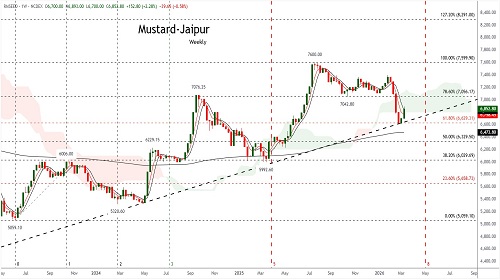
From a broader market perspective, mustard prices remain near an important support zone after the recent correction.
Last year, mustard prices had reached a high close to Rs7,600 per quintal. After the recent decline toward the Rs6,600 levels, prices appear to be stabilizing again.
Momentum indicators suggest that selling pressure has eased, while the overall structure remains constructive. If market sentiment improves along with supportive fundamentals, mustard prices may gradually move toward Rs7,200–Rs7,600 levels, similar to the range seen during the previous year.
Outlook
Considering the combination of weather-related crop stress, moderate production growth, lower carry-forward stocks, supportive global edible oil prices, and rupee weakness, the mustard market appears fundamentally strong.
While short-term volatility may continue due to market arrivals and global factors, the broader outlook suggests that mustard prices could remain supported during the current season.
With both domestic and international factors aligning in favor of the oilseed complex, the market sentiment currently indicates that buying on declines may remain a favorable strategy for market participants.
Above views are of the author and not of the website kindly read disclaimer