Mauritius economic update: New baseline, same direction by CareEdge Ratings

National accounts rebasing and methodological revisions
The latest National Accounts Estimates, September 2026 issue, introduces a comprehensive revision of Mauritius' national accounts, reflecting significant enhancements to both data sources and compilation methodologies. The revision is underpinned by three major developments: the rebasing of GDP to 2023 using the results of the Census of Economic Activities 2023, the phased implementation of recommendations from the 2025 System of National Accounts (SNA) and improved coverage of merchanting activities undertaken by Global Business Companies (GBCs) following technical assistance from the International Monetary Fund (IMF). The exercise also incorporates information from the Census of Agriculture 2024, the Household Budget Survey 2023 and an enhanced Supply and Use framework, thereby providing a more comprehensive representation of economic activity in Mauritius.
Revision to GDP growth rate
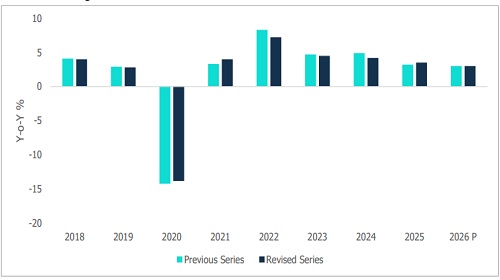
The revision of the national accounts resulted in a significant upward adjustment to the estimated size of the Mauritian economy. Under the revised series, nominal GDP for 2025 was increased by 9.1%, or MUR 67.3 billion, from MUR 743.0 billion to MUR 810.3 billion. The increase reflects the combined impact of the 2023 benchmarking exercise, the incorporation of selected recommendations from the 2025 System of National Accounts, and enhanced measurement of merchanting activities undertaken by Global Business Companies.
Taken together, the revisions suggest that while the Mauritian economy is larger than previously estimated, growth in recent years was generally weaker than that indicated by earlier data. The revised series points to a stronger recovery immediately after the pandemic, but a more moderate pace of expansion during 2022-2024. This implies that economic momentum may have softened sooner than previously thought. The upward revision to 2025 growth, however, suggests some improvement in activity, although overall growth remains below the rates recorded during the post-pandemic rebound.
Economic activity gained momentum in Q2 2026
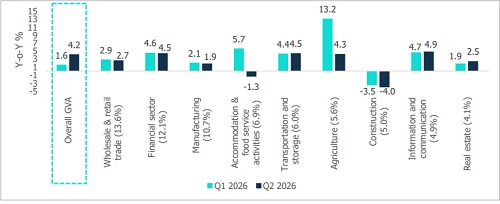
Latest figures based on the updated methodology show that economic growth accelerated to 4.2% Y-o-Y in Q2 2026 from 1.6% Y-o-Yin Q1 2026. Growth was supported by continued strength of the services sector, particularly financial services and ICT-related activities, while wholesale and retail trade remained resilient, reflecting steady domestic demand. However, performance across sectors was uneven. Tourism-related activities weakened during the quarter, with accommodation and food services contracting by 1.3%, likely reflecting disruptions to travel sentiment and booking patterns amid the Middle East conflict. Meanwhile, the construction sector remained under pressure, with output declining by 4.0%, extending the contraction recorded in the previous quarter, partly due to weaker infrastructure and major construction activity. Despite these challenges, the strong performance of key services sectors boosted overall economic growth.
Gross value added (GVA) growth rates
Domestic demand has recovered, but investment is lagging
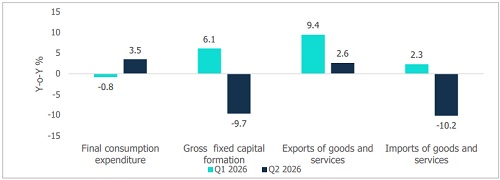
On the expenditure side, final consumption expenditure rebounded by 3.5% Y-o-Y in Q2 2026, following a contraction of 0.8% in the previous quarter, signaling a recovery in domestic demand. The improvement was driven by a sharp rebound in government consumption, which grew by 9.6% after contracting by 8.2% in Q1, alongside firmer household spending, which accelerated to 2.2% from 0.8%. Consumption expenditure by non-profit institutions serving households (NPISHs) also strengthened, rising by 3.4% compared with 2.9% in the preceding quarter, while expenditure by the Bank of Mauritius increased by 2.4% after declining by 2.2% in Q1.
In contrast, gross fixed capital formation (GFCF) contracted sharply by 9.7%, reversing the 6.1% expansion recorded in the previous quarter and highlighting continued weakness in investment activity. Export growth moderated to 2.6% from 9.4% in Q1, while imports of goods and services declined by 10.2% following a 2.3% increase in the previous quarter. Consequently, net exports supported economic growth, partly offsetting the drag from weaker investment spending.
GDP by expenditure growth
Economic growth faces a more challenging environment
Looking ahead, Statistics Mauritius forecasts real GDP growth of 3.0% in 2026, down from 3.5% in 2025, reflecting slower growth across several key sectors, including tourism-related activities, financial services, and information and communication. Nevertheless, financial and insurance activities, wholesale and retail trade, transportation and storage, accommodation and food service activities, and agriculture will continue to support growth. Investment activity is likely to remain a constraint, with GFCF projected to contract by 1.1% in 2026.
The outlook is further clouded by a challenging external environment. Heightened geopolitical tensions and higher global energy and commodity prices are putting inflationary pressures on imports, weighing on household spending and business activity. Against this backdrop, the latest World Economic Outlook from the IMF projects a slightly lower growth rate of 2.7% for Mauritius in 2026 (from 3.2% in 2025), compared with the 3.0% forecast by Statistics Mauritius. Similarly, the World Bank expects growth to moderate to 2.7% in 2026, citing softer external demand, heightened global uncertainty, rising input costs and supply-chain disruptions, before gradually recovering to 3.1% in 2027
Domestic risks have also increased following recent episodes of social unrest. Beyond the immediate disruption to commercial activity, uncertainty may weigh on consumer and business confidence, particularly in sectors such as retail trade, transport, tourism and other customer-facing services. Recent unrest in October 2026, including temporary curfew measures and disruptions to business activity, is expected to weigh on economic performance, with the impact likely to become more visible in the Q4 2026 data. In addition, weather-related risks remain elevated. Adverse climatic conditions, including the potential effects of El Niño on rainfall patterns and agricultural production, could pose further challenges to growth, given the sector's expected contribution to economic activity in 2026.
Tourism sector gains momentum as arrivals growth accelerates
Mauritius’s tourism sector showed signs of strengthening in September 2026, as tourist arrivals increased by 9.6% Y-o-Y to 114,506 visitors, the strongest annual growth recorded so far this year. Following positive performance in July and August, the latest data suggest that visitor demand remained resilient despite an uncertain global economic environment. Cumulative arrivals reached 1.04 million in January-September 2026, representing a 3.4% increase compared with the corresponding period of 2025. Of the Bank of Mauritius’s target of 1.47 million tourist arrivals in 2026, 70.9% had been achieved by September. Enhanced air connectivity, sustained marketing efforts and the diversification of source markets have helped broaden Mauritius’s tourism base beyond its traditional markets.
The positive trend in visitor numbers has been accompanied by robust growth in tourism receipts. The gross tourism earnings increased by 23.0% Y-o-Y to MUR 9.6 billion in August 2026, the strongest growth recorded so far this year. Cumulative tourism receipts rose 18.3% Y-o-Y to MUR 74.6 billion in January-August 2026. The substantial gap between growth in earnings and arrivals indicates that tourism revenue continues to benefit not only from higher visitor numbers but also from sustained spending per tourist.
Looking ahead, the tourism sector is expected to benefit from the peak travel season during the final quarter of the year, supported by continued air connectivity and strong year-to-date performance in arrivals and tourism receipts. However, downside risks have become more pronounced. A weaker global growth environment, higher energy prices-induced elevated travel costs and ongoing geopolitical uncertainties could dampen international travel demand. Additionally, recent episodes of social unrest may affect visitor perceptions and destination confidence if disruptions persist, potentially impacting travel decisions during the peak season. Nevertheless, strong visitor spending trends should continue to bolster tourism earnings.
Above views are of the author and not of the website kindly read disclaimer