India Strategy : Emerging headwinds to curtail broad based rally by Prabhudas Lilladher Ltd

NIFTY has been resilient in past few weeks as markets seem to shrug off the geopolitical uncertainty, deficient monsoons and disruption of global supply chain. 1Q27 corporate performance (PL coverage) shows 15.5% sales growth and 17% PAT growth Ex-Oil & Gas sector, which has been highest growth since 4Q24.
India is currently running at 13-14% deficiency in monsoon rains with 16-17 subdivisions shows deficient rains. Strong El Nino is likely to affect August/sept rains and Skymet has even predicted 15% deficit for the season. We believe strong El Nino will result in spike in prices of commodities like Coffee, Cocoa, Palmoil, Soybean, SMP etc. in the international markets in coming quarters. Given low base of inflation, we believe RBI estimates of 5.9% inflation in 3Q and 5.5% in 4Q is at risk.
Credit growth remained strong at 18.6% in June, FCNR bonds issue is likely to provide a flip to credit availability by USD 70-80bn (2.5-2.8% of system credit), currency stability. We see strong possibility of 25/50bps rate hike in fag end pf 3Q/4Q, depending upon the crude prices and geopolitical conditions, post interest rate hikes by ECB, Japan, South Korea and hawkish tone of US FED.
We fear a risk to demand and corporate profit growth in the coming quarters driven by 1) usage of higher priced raw materials in 2Q/3Q 2) deficient monsoons can impact farm income and rural demand growth 3) successive price hikes in essential goods will hurt consumer sentiment and 4) global spike in commodities and higher crude prices. We note that NIFTY EPS estimates have seen gradual and meaningful cuts in 5 out of last 8 years, we believe 17.7% NIFTY EPS growth is at risk.
NIFTY EEPS has seen a change of 1.2/0.4% for FY27/28 with 15.8% EPS CAGR over FY26-28 with FY27/28EPS of Rs1349/1537. NIFTY is currently trading at 17.3x 1-year forward EPS, which is at 11.7% discount to 15-year average PE of 19.6x. We value NIFTY at 10% discount to 15-year average PE of 17.6x with FY28 EPS of 1537 and arrive at 12- month target of 27123 (27019 earlier). We expect markets to remain volatile although medium term downside seems limited given -2% returns in last 12 months.
Domestic demand Steady, commodity prices affect margins
• PL Coverage universe posted a beat of 3.1/13.7/18.8% on sales, EBIDTA and PAT for 1Q27. Ex Oil and Gas sales/EBIDTA and PAT beat was 1.2/5.7/2.6% respectively. PL coverage posted sales/EBIDTA/PAT growth of 21.1/1.7/3.7% YoY. Ex-BFSI EBIDTA and PAT grew by 1/-3.4%. Ex- Oil & Gas EBIDTA and PAT grew by 9.6/17%, 5.7/2.6% beat to estimates.
• There were 19 rating upgrades and 17 rating downgrades, only 4 downgrades were having Reduce/sell ratings. Capital Goods, IT Services, Durables and Consumer 2, 6, 3 and 2 downgrades. Capital Goods had 6 upgrades, Banks 2, Oil and Gas 2, Chemicals, Durables and Consumers had 1 each.
• Major Rating Upgrade: ITC, Canara Bank, Federal Bank, Cummins India, Carborundum Universal, Hitachi Energy, Praj Industries, Polycab India, Home First Finance Company, Bharat Petroleum Company, Tata Power. Major Rating Downgrade: Kalpataru Projects International, Metro Brands, KPIT Technologies, HCL Technologies, Wipro, Tata Elxsi, TCI Express and Hindustan Petroleum Company.
• Major Estimates Upgrade: Reliance, Tata Power, Adani Energy Solutions, Bharti Airtel, Hindalco Industries, JSW Steel, National Aluminium Co., Mangalore Refinery & Petrochemicals, Indian Oil Corporation, Tata Technologies, Aster DM Quality Care, Home First Finance, ICICI Bank, Federal Bank, TVS Motor, Finolex Industries, SRF, RR Kabel, Nestle India, Apar Industries, Engineers India, Hitachi Energy, JSW Cement, Deepak Nitrite, Fine Organic Industries, Laxmi Organic Industries, KEI Industries, Asian Paints, Marico, Avalon Technologies and Cyient DLM. Estimate Downgrade: City Union Bank, Greenpanel Industries, Siemens Energy India, Thermax, Triveni Turbine, Ambuja Cement, PI Industries, Blue Star, Emami, ITC, DOMS Industries, LIC Housing Finance, Fortis Healthcare, Global Health, Krishna Institute of Medical Sciences, Max Healthcare Institute, Narayana Hrudayalaya, KPIT Technologies, Persistent Systems, Tata Elxsi, Tata Steel, Ahluwalia Contracts (India), Dilip Buildcon, H.G. Infra Engineering, Coal India, CESC, Brigade Enterprises, Sunteck Reality, Interglobel Aviation, Apeejay Surendar Park Hotels, Samhi Hotels, VIP Industries.
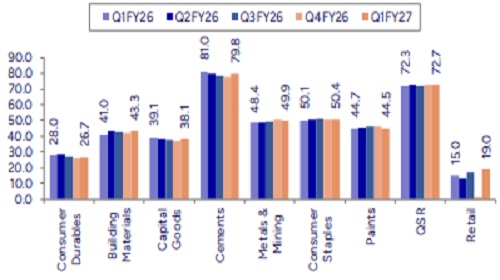
• Only Cement, Consumer, Infra, Power and Media posted single digit sales growth. Banks, Cement, Education, Travel and Oil & Gas posted decline in EBIDTA. Chemicals, EMS, Building Materials, Consumer Durables, Financial Services and Hospitals posted more than 20% EBIDTA growth.
• NIFTY EEPS has seen a change of 1.2/0.4% for FY27/28 with 15.8% EPS CAGR over FY26-28 with FY27/28EPS of Rs1349/1537. Consensus EPS cuts have been 1/0.7% respectively. Our NIFTY estimates are 0.9/2.5% lower than the consensus.
• NIFTY is currently trading at 17.3x 1-year forward EPS, which is at 11.7% discount to 15-year average PE of 19.6x and is at a discount of 14.8% to 10-year average PE of 20.3x. Base Case: We value NIFTY at 10% discount to 15-year average PE of 17.6x with FY28 EPS of 1,537 and arrive at 12-month target of 27,123 (27,019 earlier). Bull Case: We value NIFTY at PE of 19.6x and arrive at bull case target of 30,137 (30,021 earlier). Bear Case: Nifty can trade at 20% discount to LTA which gives a target of 24,971, which indicates that despite near term variations, we don’t expect major downside in NIFTY in medium term. We note that NIFTY has given -2% return in last 12 months.
• Model Portfolio: We are cutting weights on IT Services, Auto and Consumer and remain underweight. We are overweight on Banks, Capital Goods, Diversified Financials, Metals, Healthcare, Telecom and Ports. We are increasing weights on Metals, Capital Goods / Defence, NBFC, AMC’s, Telecom and Ports. We are adding Amber Enterprises India, Jindal Stainless, Tech Mahindra and Aster DM Quality Care in model portfolio. We are adding weights on ICICI Bank, Kotak Mahindra Bank, Bharat Electronics, Polycab India, Bajaj Finace, HDFC Asset Management Company, Bharti Airtel and Adani Port & SEZ. We are cutting weights on HDFC Bank, Britannia Industries, Titan Industries, Nestle India and Sun Pharmaceutical Industries. We are turning underweight on Sun Pharmaceutical Industries and equal weight on Nestle India and HDFC Bank. We remain underweight on both Tata Consultancy Services and Infosys. We are Equalweight on Reliance given expected headwinds in retail business which is more than 40% of its SOTP.
• High Conviction Picks: We are removing Britannia Industries, Titan Company, DOMS Industries and Rainbow Children’s Medicare from conviction picks. We are adding Supreme Industries, Amber Enterprises India, Aster DM Quality Care in conviction picks.
FCNR mobilisation stabilises INR, provides growth capital
USD INR remained stable from October 22 to April 25, ranging between a band of 82 to 84.5 at most times. However, since April25, there has been nearly 13% depreciation in INR, led by multiple factors like FII outflows, significant decline in net FDI flows, impact of west Asia war and spiralling oil and commodity prices. Despite regular OMOs by RBI, infused liquidity was mainly utilized to arrest rupee depreciation as INR11.5trln was spent between Oct’24 till May’26.
Introduction of the FCNR scheme
The RBI re-introduced the FCNR scheme to attract USD inflows from NRIs to (1) build up liquidity and support domestic banking stability (2) stabilize the external BoP situation (3) protect against exchange risk by keeping deposits denominated in USD. The RBI utilized special dollar-rupee swap windows tied to medium-term FCNR(B) deposits to incentivize commercial banks to aggressively mobilize foreign funds. By absorbing the hedging/currency risk costs for banks on specific 3-to-5-year deposits, the central bank has enabled institutions to offer more competitive and attractive returns to overseas depositors rapidly multiplying foreign exchange cushions
Banking sector to see improved liquidity, but lower NIM’s
As per RBI data FCNR deposit inflows till 14th Aug totalled to USD 52.3bn, since the window is closing on 31st Aug’26, inflows may reach USD 75bn.
• This would translate to 2.7% of system deposits as of Jul’26 while on the loan side, it would translate to 24% of incremental loan growth for FY27 (assuming 14% growth for system).
• It would improve system liquidity with ease in G-Sec yields and in turn bond yields which could lower funding cost of bonds and wholesale deposits.
• The FCNR mobilisation would be NIM dilutive (1-2bps) given spreads on leveraged deposits would be lower; however, this would partly be offset by lower wholesale deposit rates.
Impact on Indian economy
Strengthens the Balance of Payments (BoP): FCNR inflows are a source of foreign capital and improve India's external financing position.
Increases foreign-exchange reserves: India’s forex reserves peaked out at USD728 bn in Feb 2026, however post that it declined to INR667bn in June due to higher oil prices following west Asia crisis, FII outflows and RBI’s intervention in forex markets. Post FCNR issue, forex reserves have shown a big jimp and are back to USD717bn. Higher forex reserves provide much needed flexibility to RBI to face external shocks in the economy.
Reduces forex volatility: INR was under pressure and depreciated by 13% in last 12 months up to June, however announcement and inflows from FCNR have provided much needed stability to INR and the currency is relatively stable from last 3 months
Provides growth capital in economy: Mobilised funds have increased the resources available within the banking system by ~2.5-3% of total system level deposits. This will help Indian banks to meet their foreign-exchange requirements and support international trade. The amount mobilised is nearly 50% of the planned govt capex. We believe the improved liquidity will improve money flow and growth of the economy.
Strong El Nino a key risk to Inflation and demand
Monsoons started on a weak note with deficit of 40% in June which recovered 4% above normal rainfall in July. The North and Northeast and South Peninsula remained in deficit for the entire season while Central India had normal aggregate rainfall till first two weeks of August. The lowest point of deficit on a countrywide basis was 11%. The monsoons have lost steam in last 10-12 days and the overall deficit is now 14% with nearly 17-18 out of 36 metrological subdivisions having deficient rainfall.
Skymet’s forecasts 70% probability of drought
Skymet August forecast of Southwest Monsoon 2026 now gives 70% probability of drought and overall monsoon deficit to be 15%.
• Seasonal rainfall forecast cut to 85% of LPA, from 94% of LPA earlier. strengthening El Niño, to suppress rainfall, particularly toward the latter part of the monsoon.
• Spatial distribution to remain poor, August and September to increase the seasonal deficit.
IMD estimates for the monsoon season are at 90% of LPA with a plus to minus 4% which falls in the category of below normal. June and July had 13% monsoon deficit, and August has been deficient so far. El Nino conditions are present and strengthening and IMD is pinning hopes of IOD to partly neutralise the impact of El Nino. However, trends of past couple of weeks indicate that the monsoon deficit is increasing.
Please refer disclaimer at Report
SEBI Registration number is INH000000933