India’s Plastic Packaging Margins Expected to Decline 3 - 5% by H1FY27 by CareEdge Ratings

Synopsis
* The persistent rise in crude oil prices may lead to a 3-5% dip in margins of plastic packaging players by H1FY27 if crude oil prices spike again by 5-10%. The pressure is expected to be highest for flexible packaging, PET bottles, FMCG, and food & beverage players, where plastic usage is high and passing on costs takes time. Sectors like pharma, industrial packaging and e-commerce may see a relatively moderate impact, largely through margin pressure and slower price revisions.
* Higher crude oil prices increase the cost of oil-derived feedstocks which raises polymer (resin) prices. Since packaging relies on these polymers, raw material costs rise accordingly. As crude rises, key resins such as PP, PE, and PET become costlier, thus increasing input costs for packaging manufacturers.
* The Indian packaging industry continues to see healthy demand, driven by growth in packaged foods, organised retail, logistics and e-commerce. However, the sector remains vulnerable on the cost side because a large portion of its polymer raw material requirement is still dependent on imports, especially from the Middle East. Plastic remains the most used packaging material in India, which makes the industry highly sensitive to movements in crude oil prices.
* The current rise in crude is creating pressure beyond raw material prices. Higher freight costs, longer shipping routes and insurance-related surcharges are making the packaging supply chain more expensive and less predictable.
Industry Context: Strong Demand, Fragile Input Structure
The Indian packaging market remains a key driver of industrial demand, supported by growth of packaged foods, organised retail, logistics and e-commerce. Plastic continues to dominate the mix at nearly 46% of the market, mainly due to its low cost, versatility and wide use across food, FMCG and pharmaceutical applications.
In terms of value, plastic packaging is expected to remain in the largest segment with the market estimated at Rs 3,558 billion in CY25 and projected to reach Rs 5,169 billion by CY30, implying a CAGR of 7.5%. The segment is gradually shifting towards recyclable and higher recycled-content materials, driven by regulation, sustainability commitments and improving recycling capacity. However, the industry remains dependent on imported raw materials with domestic supply, not fully meeting demand for key polymers. West Asia continues to be the main sourcing region for Indian market due to scale, pricing and proximity, however, this leaves the sector exposed to disruptions in shipping routes, crude prices and gas supply.
Macro Trigger: Crude Oil Movement
Crude oil prices have increased over the past month mainly due to geopolitical tensions and supply-side uncertainty. Risks in key oil-producing regions and major shipping routes have led to concerns about potential disruptions which add a risk premium to prices. At the same time, controlled production by major oil producers and limited spare capacity have kept supply tight. Market sentiment and trading activity have further amplified this movement, making the recent price rise more uncertainty-driven than demand-driven.
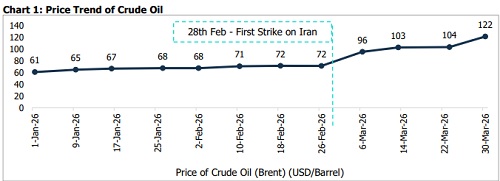
Brent crude prices rose sharply after remaining stable through mid-February 2026, driven by emerging supply-side risks. Prices spiked in early March, briefly crossing USD 118 per barrel, lifting the quarterly average from about USD 64 per barrel in Q3FY26 to around USD 80 per barrel in Q4FY26. Prices towards end-March, stayed well above earlier levels, indicating continued market uncertainty.
Impact Transmission of Conflict on the Indian Packaging Industry
The impact of higher crude oil prices on packaging is transmitted gradually through a multi-stage cost chain rather than immediately. As crude prices rise, feedstock costs such as naphtha move up, which in turn pushes resin prices higher, increasing raw material costs for packaging manufacturers. This pressure is often absorbed at the margin level initially because packaging contracts are typically revised with a time lag. At the same time, the shock is reinforced through higher energy sensitivity, given India’s dependence on Middle Eastern oil, LNG, and LPG, and through rising logistics costs caused by longer shipping routes, extended transit times and higher war-risk insurance. Together, these factors raise production and delivery costs, eventually flowing through to retail packaging prices.
Polymer Market Reacts to Rising Crude Oil Prices
The polymer market reacts quickly to rising crude oil prices because plastics are manufactured directly from oil-based inputs. Packaging is particularly exposed as it relies heavily on resins such as polypropylene (PP) for rigid containers and woven packaging, polyethylene (PE) for films and flexible packs, and PET for bottles and food-grade applications. When crude prices increase, the cost of these polymers usually goes up as well, even as the speed and extent of the increase varies across products. The impact is sharper in the current environment because India depends heavily on imports from the Middle East for key polymers and their raw materials. With supply concentrated in this region, any disruption raises not only prices but also availability risks, turning the crude oil shock from a simple cost increase to a complex stress test for the polymer and packaging supply chain.
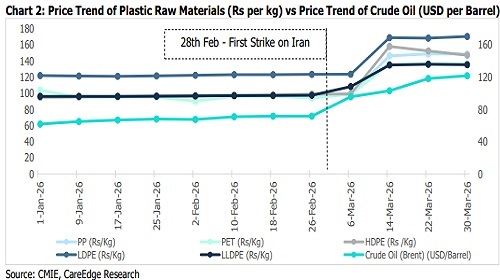
The aforementioned Chart 2 clearly shows how the oil price shock transmits into polymer prices. This nearsimultaneous spike across polymers reflects the dependence of resins on oil?based feedstocks and the concentrated import exposure. Chart 2 reinforces that polymers act as the immediate transmission channel of crude inflation, pushing cost pressure rapidly into the packaging value chain. In 2025, around 48% of India’s import value for polyethylene came from the UAE, Saudi Arabia, Oman and Kuwait. That makes the current disruption a supplychain stress test rather than a pricing event.
Impact of Crude Oil Spike in 2022 on Packaging Industry Margins
If crude prices continue to rise, plastic packaging players could see operating margins decline by H1FY27, as input cost increases are likely to outpace product price revisions. The impact is expected to emerge first at the packaging manufacturer level through margin compression and then gradually flow to end-user industries, particularly high-exposure sectors, via higher procurement costs and more frequent pricing negotiations. Should crude prices remain elevated, margin pressure may extend into the next pricing cycle, whereas any stabilisation or easing in crude prices would support a gradual recovery as input costs normalise.
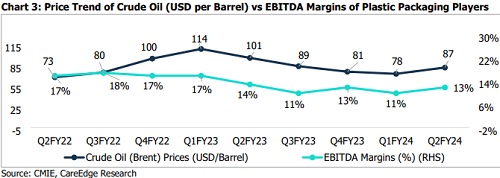
Past episodes of crude price volatility highlight a similar lagged transmission mechanism. During the earlier phase of disruption triggered by geopolitical conflict of Russia-Ukraine War and supply-side uncertainty, higher crude prices narrowed profitability as raw material costs rose sharply in a business where inputs form a large share of total expenses. EBITDA margins softened as packaging players were unable to fully pass on cost increases at the same pace due to competitive pressures, with margins declining from around 17–18% to nearly 11–13%. Even though oil prices started to normalise in Q3FY23 onwards, the margins remained in the similar range due to cheaper imports from China.
While margins generally recover with easing input conditions, the relationship is not linear, as profitability is also influenced by product mix, contract structures, capacity utilisation and import dynamics. Overall, the pattern underscores that sustained high crude prices tend to compress packaging margins unless cost pass-through is timely and effective.
Industry Impact on Packaging Players
Packaging industry players are usually the first industry participants to absorb the shock. Their raw material cost increases immediately, but customer price revisions happen later. This creates temporary pressure on operating margins. The effect is stronger in resin-heavy segments, especially flexible packaging and PET-based products. Companies with strong procurement systems and better pass-through power are able to manage the shock better.
Currently, the West Asia crisis has also impacted the supply chains leading to shortage of packaging materials. If the situation continues to remain the same, industries will face delays in productions and shipment schedules as well.
CareEdge Advisory’s View
“The plastic packaging industry remains sensitive to changes in crude oil prices because key raw materials are derived from oil-based polymers. A sustained 5–10% increase in crude prices may lead to margin pressure of around 3–5% for highly exposed players by H1FY27, particularly in flexible packaging and PET-heavy segments. In addition, higher freight, insurance and shipping costs may continue to impact profitability in the near term until cost increases are gradually passed on to customers across FMCG, food & beverage and related sectors,” says Sagar Desai, Assistant Director at CareEdge Advisory.
In the near term, the packaging industry is expected to face cost pressure rather than weak demand. If crude prices stabilise, resin costs should ease with a lag, supporting a gradual recovery in margins. However, sustained or higher crude prices would keep input costs elevated and make price negotiations more challenging, with greater impact on resin-intensive segments such as flexible packaging, PET and multilayer formats. While packaging demand is likely to remain steady, profitability will depend on how quickly costs can be passed on and inventory managed. Over the longer term, prolonged volatility is likely to push companies to diversify sourcing, increase recycled content and adopt lighter-weight packaging to reduce resin usage. Larger, integrated players with long-term contracts are better placed to manage such conditions, while smaller, spot-market-dependent players remain more exposed. Overall, the industry remains demand-resilient but continues to be sensitive to raw material cost shocks.
Above views are of the author and not of the website kindly read disclaimer