India holds National Exercise to bolster preparedness against Foot-and-Mouth Disease SAT-1
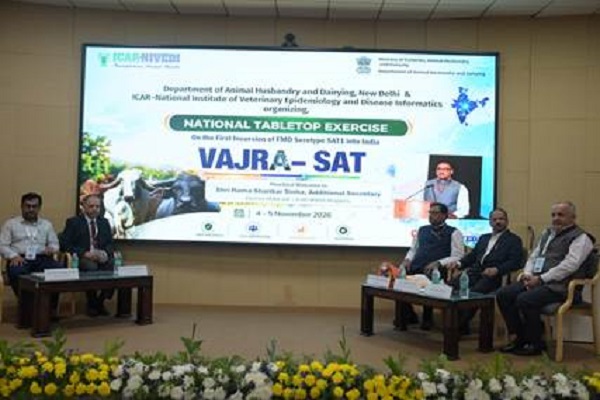
The Department of Animal Husbandry and Dairying (DAHD), in collaboration with the ICAR-National Institute of Veterinary Epidemiology and Disease Informatics (ICAR-NIVEDI), concluded a two-day national tabletop exercise on preparedness against Foot-and-Mouth Disease (FMD) serotype SAT-1, a strain that has not been reported in India but is increasingly being monitored due to its spread beyond Africa into parts of West Asia, it was announced on Friday.
Held under the theme “Detect Early, Confirm Fast, Contain Together,” the exercise focused on strengthening India's readiness to respond to potential incursions of the transboundary animal disease and safeguarding livestock health, farmers' livelihoods, and the broader livestock economy.
The exercise brought together 83 participants representing 25 states, three Union Territories, and key institutions, including state animal husbandry departments, ICAR institutes, veterinary diagnostic laboratories, veterinary universities, vaccine manufacturers, and defence and border guarding agencies.
Participants worked through simulated outbreak scenarios to assess preparedness in key areas such as disease detection, laboratory diagnosis, epidemiological investigations, animal movement controls, emergency vaccination strategies, risk communication, and coordinated response mechanisms.
Speaking at the inaugural session, Animal Husbandry Commissioner Dr. Naveena B.M. stressed the need for advance planning, early disease detection, rapid response measures, and close coordination between central and state authorities. Dr. Baldev R. Gulati, Director of ICAR-NIVEDI, highlighted the evolving epidemiological landscape of FMD SAT-1 and underscored the role of risk-based surveillance, epidemiological intelligence, and early warning systems in mitigating disease threats.
Dr. J.K. Mohapatra, Director of the ICAR-National Institute of Foot-and-Mouth Disease (ICAR-NIFMD), emphasised the importance of laboratory preparedness, rapid diagnostic capabilities, and vaccine readiness, while Brigadier M.M. Ramachandra from the National Security Council Secretariat stressed enhanced border vigilance and inter-agency cooperation to prevent the entry of transboundary animal diseases.
The concluding session was chaired by Rama Shankar Sinha, Additional Secretary (Livestock Health), DAHD, who called for strengthening preparedness at both national and state levels and enhancing diagnostic infrastructure, including regional FMD laboratories and Regional Disease Diagnostic Laboratories, with technical support from ICAR-NIFMD.