India Needs Nearly 2.5 Lakh Smart Meter Installations a Day to achieve Mar 28 target; Rs 1.84 Lakh Crore Opportunity Hinges on Prepaid Adoption: CareEdge Ratings

India will need to accelerate smart meter installations to nearly 2.5 lakh meters per day to meet the target of deploying 25 crore smart meters by March 2028, according to CareEdge Ratings. Around 6.5 crore meters had been installed across the country as of April 2026, representing approximately one quarter of the target. While installation rates have improved significantly, the required pace is more than 2.5 times the approximately 99,000 meters installed daily in FY26.
Smart Meter Installation (in crore) progress
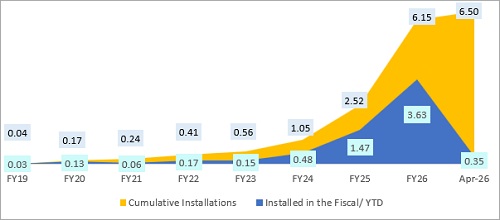
The acceleration is evident in annual installation trends. Additions increased from 48 lakh meters in FY24 to 1.47 crore in FY25 and 3.63 crore in FY26, according to the report. However, deployment remains uneven across states. Maharashtra accounts for approximately 1.1 crore installations, or 17% of the cumulative total, while Maharashtra, Bihar and Uttar Pradesh together contribute nearly 47% of all installations. Uttar Pradesh has installed around 32% of its sanctioned volumes, compared with approximately 52% in Bihar, highlighting the importance of execution capabilities and state level implementation in translating allocations into actual deployment.
CareEdge Ratings estimates that full scale smart meter deployment could generate cumulative additional revenue of approximately Rs 1.84 lakh crore over the five years ending FY31, through improved billing and collection efficiency and lower Aggregate Technical and Commercial (AT&C) losses. Sector indicators have improved, with AT&C losses declining from 20.73% in FY20 to 15.04% in FY25. Billing efficiency has reached approximately 88%, while collection efficiency stands at around 97%. The gap between Average Cost of Supply and Average Revenue Realised has narrowed from Rs 0.72 per kWh in FY19 to Rs 0.07 per kWh in FY25, although the gap remains open. At scale, smart metering could raise billing efficiency to 97% to 98%, increase collection efficiency beyond 99% under prepaid models and reduce AT&C losses to around 12%.
State-wise AT&C loss recovery
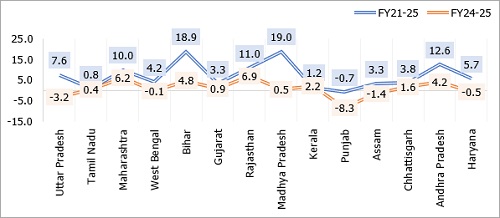
Prepaid adoption, however, remains a critical constraint. Despite approximately 6.5 crore installations, only around 9% of meters were operating in prepaid mode as of April 2026. Although nearly 89% of bills are generated using actual meter readings, only around 49% use automated readings. Further, only about 46% of electricity bills are paid digitally, constraining the effectiveness of the Direct Debit Facility, which provides payment security for Advanced Metering Infrastructure Service Providers. Concerns over the loss of the traditional credit period, fear of disconnection and limited digital literacy continue to affect adoption. Bihar's achievement of over 50% prepaid adoption demonstrates the potential of focused implementation and consumer engagement.
“The economics of smart metering will ultimately depend on how effectively utilities translate installation into operational change. Accurate readings must feed into billing and payment systems, while consumers need the confidence and tools to manage their consumption. Without this alignment, utilities risk underutilising infrastructure that has already attracted substantial investment. The next phase of implementation will therefore require equal attention to consumer participation, financial processes and the use of meter data for grid management,” said Ravleen Sethi, Director, CareEdge Ratings.
Smart metering also has implications extending beyond distribution finances. As India advances towards its 500 GW renewable energy capacity target, granular 15-minute interval consumption data from smart meters can support demand side management, time of use tariffs and load forecasting. These capabilities will become increasingly important for balancing variable solar and wind generation and maintaining grid stability. Smart metering is consequently emerging as foundational digital infrastructure for India's energy transition and long-term energy security.
The programme also represents a significant opportunity for India's energy ecosystem. The estimated investment required for 25 crore smart meters is around Rs 1.25 lakh crore, creating opportunities for domestic manufacturers, communications technology providers and data management companies. The sector has attracted more than US$2 billion in foreign capital.
Above views are of the author and not of the website kindly read disclaimer











Tag News
India must raise smart meter rollout to 2.5 lakh units a day to meet 2028 target