How Fast Charging Technology Works
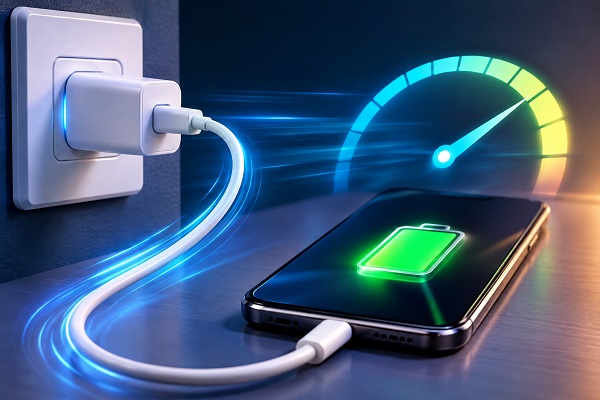
Fast charging has become one of the most useful features in modern smartphones and other electronic devices. Instead of waiting for hours for a battery to reach a useful charge level, fast-charging technology can provide a significant amount of power in a much shorter time.
But how does fast charging actually work, and why can some chargers charge a device much faster than others?
What Is Fast Charging?
Fast charging is a technology that allows a compatible device to receive electrical power at a higher rate than conventional charging.
Charging speed is mainly determined by **power**, which is measured in watts (W).
A simple way to understand it is:
**Power = Voltage × Current**
For example, a charger delivering 10 volts at 3 amps provides:
**10 × 3 = 30 watts**
Higher charging power can allow a compatible device to charge faster, although the actual charging speed depends on the phone, battery, charger, cable and charging protocol.
How Does a Fast Charger Work?
A fast charger doesn't simply force maximum power into a battery continuously.
Instead, the charger and device communicate with each other to determine how much power can safely be delivered.
When you connect a compatible fast charger, the device can request an appropriate voltage and current level. The charging system then adjusts the power according to the battery's condition and temperature.
This helps the device charge quickly while maintaining safety.
The Role of Voltage and Current
There are two major ways to increase charging power:
* Increase voltage
* Increase current
For example, a traditional charger might deliver relatively low voltage and current, while a fast-charging system can increase one or both to deliver significantly more power.
Different charging technologies use different combinations of voltage and current.
Why Doesn't a Phone Charge at Maximum Speed All the Time?
You may notice that your smartphone charges extremely quickly at the beginning but slows down as the battery gets closer to full.
This is intentional.
Lithium-ion batteries generally accept higher charging power when their charge level is lower. As the battery approaches a high state of charge, the charging system gradually reduces power.
This helps manage heat and protect the battery.
For example, a phone might charge very quickly from **10% to 50%**, while the final portion from **80% to 100%** may take considerably longer.
What Is USB Power Delivery?
**USB Power Delivery (USB-PD)** is a widely used charging standard that allows compatible devices and chargers to negotiate suitable power levels.
USB-PD can support a wide range of devices, including smartphones, tablets and laptops.
The exact charging speed depends on the capabilities of the charger, device and cable.
What Are Proprietary Fast-Charging Technologies?
Some smartphone manufacturers use their own fast-charging technologies.
These systems can be designed specifically for particular devices and may use specialized charging protocols, adapters or battery-management systems.
This means that a high-wattage charger does not necessarily make every smartphone charge at the same speed.
The device must support the relevant charging technology.
Does the Cable Matter?
Yes.
The charging cable can affect how much power can safely travel between the charger and device.
Some cables are designed to support higher power levels, while older or lower-quality cables may not support the same charging capabilities.
For high-speed charging, it is important to use a cable that supports the required power and charging standard.
Why Does Fast Charging Create Heat?
Higher charging power can generate more heat.
Modern smartphones therefore use several mechanisms to monitor temperature and regulate charging power.
If the device becomes too warm, the charging system may reduce the charging speed.
This is one reason why a phone may charge more slowly when it is being used heavily, exposed to high temperatures or placed in a warm environment.
Is Fast Charging Safe?
Modern fast-charging systems are designed with safety mechanisms to manage voltage, current and temperature.
However, using poor-quality or incompatible chargers and cables can create unnecessary risks.
For the best results, use reputable chargers and cables that are compatible with your device.
Does Fast Charging Damage the Battery?
Fast charging itself is not automatically harmful to a battery.
Battery lifespan is affected by several factors, including:
* Heat
* Charging habits
* Battery chemistry
* Number of charge cycles
* Charging speed
* Device temperature
* Overall battery age
Modern smartphones also include software and hardware controls designed to manage charging and reduce unnecessary battery stress.
How to Get the Best Fast-Charging Performance
You can improve charging performance by following a few simple practices:
**Use a compatible charger:** Make sure the charger supports the charging technology your device uses.
**Use a suitable cable:** A cable that supports the required power level can help ensure proper charging performance.
**Avoid excessive heat:** Keep the phone in a reasonably cool environment while charging.
**Avoid heavy usage while charging:** Gaming or running demanding applications can generate additional heat.
**Keep charging ports clean:** Dust or debris can interfere with charging connections.
Fast Charging vs Normal Charging
The biggest difference is the amount of power delivered during the charging process.
Normal charging generally uses lower power and takes longer.
Fast charging can deliver substantially more power, allowing the battery to reach a useful charge level much sooner.
However, faster charging does not mean the battery will always reach 100% proportionally faster because charging speed typically decreases as the battery gets closer to full.
The Future of Fast Charging
Fast-charging technology continues to evolve.
Manufacturers are working on better batteries, improved charging systems, more efficient power management and technologies designed to reduce heat.
As battery technology improves, charging may become even faster while maintaining battery durability and safety.
Final Thoughts
Fast charging works by allowing a compatible device to receive electrical power at a higher rate while continuously managing voltage, current and temperature.
The charger, cable and smartphone all play important roles in determining charging speed.
The key thing to remember is that **higher wattage alone doesn't guarantee faster charging**. The device must support the required charging technology, and the charger and cable must be capable of delivering the appropriate power.
For the best combination of speed, safety and battery longevity, use compatible and reliable charging equipment and avoid excessive heat during charging.