How Air Purifiers Measure Air Quality
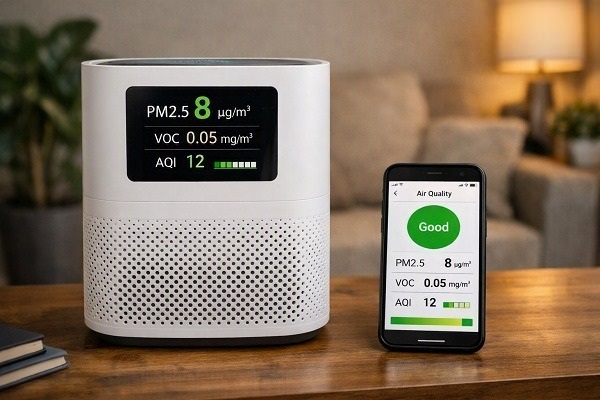
Air purifiers do more than simply circulate air through a filter. Many modern models also monitor the surrounding air and provide information about its quality. They do this using sensors that detect different types or concentrations of pollutants.
What Does an Air Quality Sensor Measure?
Most air purifiers use sensors to detect airborne particles. One of the most common measurements is particulate matter, particularly fine particles such as PM2.5.
PM2.5 refers to particles with a diameter of 2.5 micrometres or smaller. These particles can come from vehicle emissions, smoke, cooking, dust and other sources.
Some advanced air purifiers may also monitor larger particles, volatile organic compounds (VOCs), temperature and humidity.
How Particle Sensors Work
Many air purifiers use optical particle sensors. These sensors shine a small beam of light, often from an LED or laser, through the air.
When airborne particles pass through the light, they scatter it. The sensor detects this scattered light and uses the measurement to estimate the concentration of particles in the air.
The purifier then converts this information into an air-quality reading that may appear on its display or smartphone app.
What Is PM2.5?
PM2.5 is one of the most useful indicators of fine-particle pollution. A purifier with a PM2.5 sensor can continuously monitor changes in particle concentration.
For example, the reading may increase while cooking, burning incense or when outdoor pollution enters through an open window. Once the source is removed and the purifier filters the air, the reading may gradually decrease.
How VOC Sensors Work
Some premium air purifiers also include sensors for volatile organic compounds. VOCs are gases released by products and materials such as paints, cleaning products, adhesives and some household items.
VOC sensors typically detect changes in the concentration of certain gases and provide an estimated reading rather than identifying every individual chemical present in the air.
Why Humidity and Temperature Matter
Temperature and humidity sensors may also be included in smart air purifiers. These measurements do not directly indicate pollution, but they provide useful information about indoor conditions.
Humidity can also influence how certain particle sensors behave, which is one reason manufacturers may incorporate environmental sensors into their systems.
How the Purifier Uses the Sensor Data
The sensor readings can be used to automatically adjust the purifier's fan speed. When pollution levels rise, the purifier may increase airflow. When the air becomes cleaner, it can reduce the fan speed.
This automatic mode allows the purifier to respond to changing indoor conditions without requiring constant manual adjustments.
Are Air Quality Readings Always Exact?
Not necessarily. Consumer air purifiers provide estimates based on their sensors and calibration. Different sensors can produce different readings, and factors such as humidity, airflow and the type of particles present can affect measurements.
Therefore, the air-quality number shown on a home purifier should generally be treated as an indicator rather than a laboratory-grade measurement.
Why Sensor Quality Matters
A purifier's filtration performance and its ability to monitor air quality are separate features. A device may have an excellent filter but basic sensors, while another may offer more sophisticated monitoring.
When comparing models, it is useful to consider both the filtration system and the type of air-quality sensors included.
Final Thoughts
Air purifiers measure air quality primarily by using sensors that detect airborne particles and, in some models, gases and environmental conditions. Optical particle sensors are commonly used to estimate PM2.5 levels, while other sensors can monitor VOCs, temperature and humidity.
Understanding how these sensors work can help consumers interpret air-quality readings more realistically and choose an air purifier based on both its filtration capabilities and monitoring features.