Economy Macro-Cap : Monsoon recovery lowers risks to growth and inflation by Motilal Oswal Financial Services Ltd

* The southwest monsoon has recovered meaningfully after an exceptionally weak start, significantly reducing downside risks to agriculture and the broader economy. After recording a 38.6% rainfall deficit in June, rainfall improved sharply to 1.0% above normal in July, helping replenish soil moisture and accelerate kharif sowing. Although cumulative rainfall as of 12th Aug’26 remained 12% below the long-period average (LPA), the trajectory has improved materially.
* Rainfall distribution, however, remains uneven across regions and states. East and Northeast India continue to record the largest rainfall deficit (-27%), followed by the Southern Peninsula (-19%) and Northwest India (-11%), while Central India has largely normalized. Deficient rainfall has become more widespread this year, with 13 of 36 meteorological subdivisions reporting deficient rainfall compared with only five during the same period last year. Several key agricultural states, including Bihar, Punjab, Andhra Pradesh, Uttar Pradesh and Assam, continue to receive below-normal rainfall, although conditions have improved in Odisha, West Bengal and Gujarat.
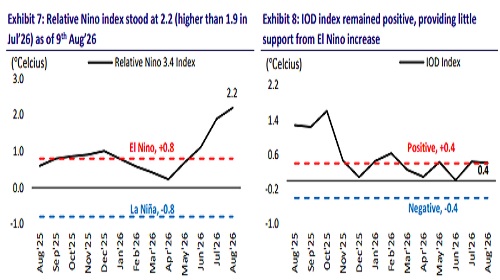
* Global weather indicators remain challenging, but their impact has been less severe than initially feared. The Niño 3.4 index strengthened further to 2.2 in Aug’26, confirming a strong El Niño episode. However, the expected adverse impact on India's monsoon has been moderated by improving domestic rainfall and a modestly positive (0.4 in Aug’26) Indian Ocean Dipole (IOD). As a result, the relationship between El Niño and monsoon performance has been weaker than witnessed during previous strong El Niño years such as 2015.
* Kharif sowing has improved considerably following the July rainfall recovery, although overall acreage remains below last year's level. Total kharif sowing as of 7th Aug’26 was 1.8% lower YoY, with oilseeds outperforming, while rice (- 4.4% YoY), pulses and coarse cereals continue to lag. Rice remains the key crop to monitor from an inflation perspective, as sowing remains below last year's level and rainfall deficits persist across several major rice-producing states despite extensive irrigation coverage in many regions.
* Reservoir storage has improved but remains below normal, suggesting weather risks have moderated but not disappeared. Live storage across major reservoirs stood at 53% of capacity as of early August, significantly below last year's level (78%). Water availability is the lowest in northern India, while western and central regions are relatively better placed.
* The improving monsoon has reduced downside risks to growth while moderating inflation concerns. Better agricultural prospects should support rural incomes, consumption and overall economic activity during 2HFY27. We peg our FY27 real GDP growth forecast in the range of 6.8-7.0%. At the same time, although the probability of a broad-based food inflation shock has declined, risks from lower rice acreage, uneven rainfall and higher crude oil prices remain. We, therefore, maintain our FY27 CPI inflation forecast at 5.1%, marginally above the RBI's forecast of 5.0%
* The improving inflation-growth trade-off reinforces our expectation that the RBI will remain on hold through CY27. With inflation pressure remaining largely food-driven and limited evidence of spillovers into core inflation, we expect the Monetary Policy Committee (MPC) to keep the repo rate unchanged at 5.25% through CY27 while maintaining a data-dependent approach and responding only if food- and fuel-led price pressures become broad-based.
El Niño strengthens further, while IOD remains unsupportive
* Global weather conditions remain challenging for the southwest monsoon as El Niño has strengthened further during the course of the season. The Niño 3.4 index increased to 2.2 as of 9th Aug’26, up from 1.94 in July and 1.24 in June, indicating a strengthening warm phase in the equatorial Pacific. (Exhibit 7)
* The impact of El Nino on the 2026 monsoon has been less severe than initially feared due to improving domestic rainfall conditions. Despite the strengthening El Niño, rainfall recovered sharply during July and has continued to improve through August, suggesting that the relationship between ENSO and the Indian monsoon has been weaker this year than historical episodes such as 2015. As a result, the probability of a broad-based agricultural shock has declined considerably.
* The Indian Ocean Dipole (IOD) has also moved into positive territory, although its influence remains modest. The IOD index improved to 0.4 as of 9th Aug’26, from -0.01 in late June, indicating a shift toward favorable oceanic conditions in the Indian Ocean. While a positive IOD typically helps offset some of the adverse effects of El Niño by enhancing moisture transport toward the Indian subcontinent, the current reading remains only moderately positive and is, therefore, expected to provide only a partial cushion against the ongoing El Niño episode. (Exhibit 8)
For More Research Reports : Click Here
For More Motilal Oswal Securities Ltd Disclaimer
http://www.motilaloswal.com/MOSLdisclaimer/disclaimer.html
SEBI Registration number is INH000000412










More News

Morning Brief ? August 13, 2026 by CareEdge Ratings