CPI Inflation in July Inches Up Marginally by CareEdge Ratings

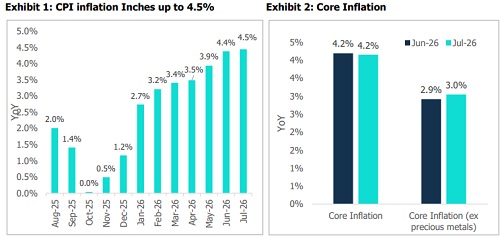
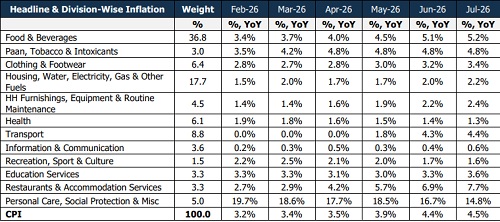
The CPI inflation edged up marginally to 4.5% in July from 4.4% in the previous month, breaching the RBI's 4% target. Inflation increased across most divisions, with eight of the twelve major divisions showing an acceleration in inflation in July. However, it was largely counteracted by a sharp 1.9 percentage point fall in inflation in personal care and misc. category. The moderation in personal care inflation was on expected lines as gold prices showed some moderation. Inflation in precious metal jewellery and watches remains high at 49% in July, but it has moderated from 57% in June.
Among the divisions showing major acceleration, inflation in restaurants and accommodation services remained elevated as businesses continued to pass on higher input costs—particularly food and energy costs—to consumers with a lag. Food and beverages inflation also edged up marginally, reflecting seasonal pressures and the delayed onset of the monsoon. Vegetable and fruits inflation in July moderated to 3.3% from 6.1% in June. Within vegetables, inflation has moderated across most major crops in July; however, the double-digit inflation in onion and garlic prices warrants monitoring. Among other major food categories, inflation in pulses and cereals remained benign at 2.7% and 1.7% respectively in July. However, inflation in edible oil prices remained elevated at 8.5% in July and remains a concern given higher global prices (FAO global vegetable oil prices grew by 17% YoY in July) and India’s import dependency on this product. We expect food and beverage inflation to average 6.4% in FY27. Core inflation remained steady at 4.2%. Excluding precious metals, core inflation remained benign at 3%. This reflects that much of the price pressures are supply driven providing some comfort to the RBI’s MPC.
Way Forward
Looking ahead, inflation outlook remains exposed to both external and weather-related risks. Uncertainty around transit through the Strait of Hormuz continues to weigh on global energy prices. Domestically, below-normal rainfall remains a key risk, with cumulative rainfall 12% below the long-period average and significant deficits across eastern, southern and northern India. Despite a delayed start, sowing activity has improved, with 87.6% of the normal area sown as of last week, only marginally below 89.9% recorded during the corresponding period last year. Nevertheless, concerns over agricultural yields persist. As of last week, sowing of cereals, pulses and sugarcane remained lower than last year. While ample buffer stocks should largely cushion cereal prices, lower sowing of pulses remains a concern. Edible oil prices remain a key monitorable given India’s large import dependence and high global edible oil prices. The eventual trajectory of food inflation will depend on the spatial and temporal distribution of rainfall in the coming months. There could be supply-side interventions from the government to contain food inflation if required. We expect food inflation to average 6.4% in FY27.
We project CPI inflation to peak in the third quarter of FY27 and average around 5.0% for the full fiscal year. On the monetary policy front, MPC will remain data dependent assessing evolving growth-inflation dynamics. We do not expect any further rate hike by the RBI in FY27 under our base case. However, the possibility of a rate hike later in the year cannot be ruled out if inflationary pressures prove persistent.

Above views are of the author and not of the website kindly read disclaimer