
Corporate Performance Robust in Q2 FY27 Despite Headwinds by CareEdge Ratings
In Q2 FY27, India Inc sustained the strong momentum witnessed in Q1. This performance is particularly noteworthy amid persistent geopolitical uncertainties, reflected in volatile energy prices, elevated freight and logistics costs, and ongoing supply chain disruptions.For a sample of 1,572 listed non-financial companies, net sales grew by a robust 24.5% (y-o-y) in Q2 FY27, marking the fourth consecutive quarter of double-digit growth. The strong top-line performance was broad-based, led by sectors such as oil & gas, automobiles, infrastructure, and iron & steel. The strong top-line growth also translated into healthy profitability growth, with operating profit rising by 23.6% in Q2 FY27. The turnaround in the oil & gas sector's profitabilityemerged as a key driver of aggregate profitability.
The following report presents an analysis of the corporate performance of listed non-financial companies. Section (A) of the report examines the aggregate quarterly performance of 1,572 companies, Section (B) presents a snapshot of the sectoral performance of 19 select major sectors (See Annexure 1 for details), and Section (C) analyses growth in employee costs across various sectors.
Aggregate Performance of India Inc Robust in Q2 FY27
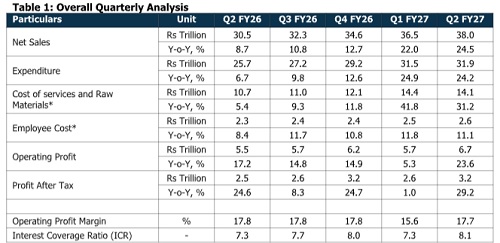
Our analysis shows that for a sample of 1,572 listed non-financial companies, net sales grew by a strong 24.5%(y-o-y) in Q2 FY27. This was higher than the 22% (y-o-y)growth recorded in the previous quarter, marking the fourth consecutive quarter of double-digit growth (Refer to Table 1). This performance has been supported by strong growth in sectors such as oil & gas, automobile & ancillaries, infrastructure and iron & steel.These sectors account for nearly 60% of the aggregate net sales of the companies analysed.
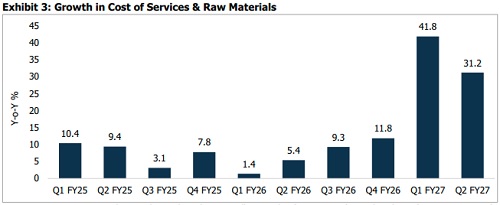
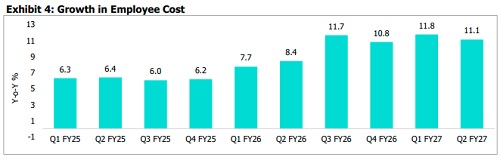
Profitability improved notably, with aggregate operating profit growth rising by 23.6% in Q2 FY27,compared to 5.3% in the previous quarter (Refer to Table 1). Aggregate profitability received a boost from the oil & gas sector, which gained on the back of higher refining margins due to a sharp widening of the diesel crack spread. This more than offset the losses these companies incurred on retail fuel sales. The oil & gas sector was the main drag on aggregate profitability in the previous quarter. Even after excluding the oil & gas sector from the sample, aggregate profitability remained healthy at 19.6% in Q2 FY27 (vs 20.3% in Q1 FY27).Notably, this double-digit growth in profitability came despite continued price pressures from rising input prices, elevated commodity prices, and higher freight and logistics costs. These cost pressures are reflected in the 24.2% growth in companies’ aggregate expenditure in Q2 FY27, due to higher input costs and elevated employee costs. The cost of services & raw materials rose by a sharp 31.2% during the quarter, compared to 41.8% growth seen in Q1 (Refer to Exhibit 3).Though energy and metal prices in Q2 FY27 cooled to some extent compared to the previous quarter, they remained elevatedcompared to levels a year ago. In Q2, Brent crude oil priceswere up nearly 34% (y-o-y). Furthermore, prices of industrial metals like copper and aluminium were also higher by 44% and 23%, respectively. Apart from higher input prices, employee costs also stayed elevated, rising 11.1% during the quarter, marking the fourth consecutive quarter ofdouble-digit growth.
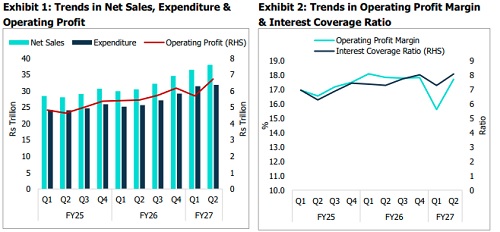
The corporates delivered strong growth in both the top-line and bottom-line numbers during the quarter. As a result, the aggregate operating profit margin of the sample companies analysed improved to 17.7% in Q2 FY27,
after having dipped to 15.6% in Q1. The interest coverage ratio also improved to 8.1 in Q2 FY27 from 7.3 in the previous quarter (Refer to Exhibit 2).
B. Broad-based Growth Supported the Overall Corporate Performance – Analysis of Select 19 Sectors
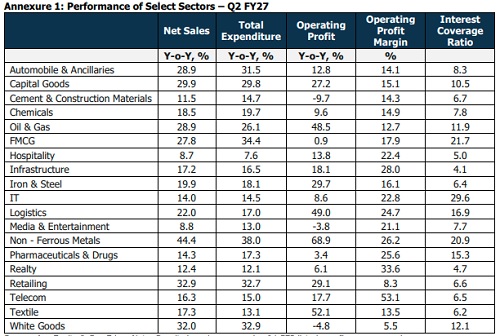
We performed a detailed analysis of the financial performance of 19 select sectors in Q2 FY27 (refer to Annexure 1). Of the 19 sectors analysed, 9 sectors witnessed a healthy growth of above 15% in both net sales and operating profit. These sectors include – non-ferrous metals, retailing, capital goods, oil & gas, logistics, iron & steel, textiles, infrastructure and telecom.
Growth in net sales was seen to be healthy in consumer-oriented sectors such as automobiles & ancillaries (28.9% in Q2 FY27 Vs 27.4% in Q1 FY27), FMCG (27.8% Vs 21.6%), retailing (32.9% Vs 44.8%) and white goods (32% Vs 19.6%). Despite persistent headwinds, domestic demand has remained steady, aided by policy measures such as last year's GST rate rationalisation, which supported growth across these sectors. Furthermore, net sales growth in commodity-related sectors such as non-ferrous metals (44.4% Vs 38.9%), iron & steel (19.9% Vs 14.7%) and oil & gas (28.9% Vs 29.2%) continued to benefit from elevated commodity prices. Export-oriented sectors such as textiles also recorded healthy net sales growth at 17.3% in Q2 FY27, accelerating from 9.4% in the previous quarter.
Profitability in the oil & gas sector witnessed a turnaround, rising sharply by 48.5% in Q2 FY27 after contracting in the previous quarter. The sector benefited from a higher diesel crack spread, which pushed up gross refining margins and helped offset weaker marketing margins. Aggregate profitability was also supported by sectors such as non-ferrous metals (up 68.9% in Q2 FY27), iron & steel (29.7%), textiles (52.1%), and logistics (49%). However, profitability in the consumer-oriented sectors came under pressure amid rising input prices. Operating profit growth in automobile & ancillaries moderated to 12.8% in Q2 FY27 from 20.6% in Q1 FY27, while profitability in the white goods sector contracted by 4.8%. Operating profit growth in the FMCG segment remained subdued for the second consecutive quarter (at 0.9% in Q2 FY27 Vs 0.5% in Q1 FY27). Among other sectors, profitability in the cement sector came under pressure contracting by 9.7% in Q2 FY27, despite healthy net sales growth of 11.5%. Rising cost pressures amid elevated input prices of fuel, petcoke and coal prices along with higher packaging costs weighed on the sector’s profitability.
C. Trends in Employee Costs Across Key Non-Financial Sectors
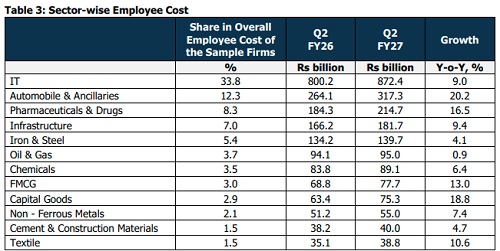
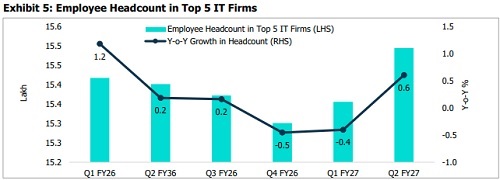
Among the major non-financial sectors, six sectors namely – Information Technology (IT), automobiles & ancillaries, pharmaceuticals & drugs, infrastructure, iron & steel and oil & gas account for 70% of the total employee costs in the sample. Aggregate employee costs rose by 11.1% during the quarter, marking the fourth quarter of doubledigit growth (Refer to Exhibit 4). This could reflect improvement in hiring or stronger wage growth. Employee costs in the IT sector (34% of overall employee costs in our sample) rose by 9% in Q2 FY27, following 11.2% growth in the previous quarter. Additionally, employee headcount in the top five IT firms edged up by 0.6% (y-o-y) in Q2 FY27, after having contracted for previous two quarters in a row (Refer to Exhibit 5).
Way Forward
Overall, India Inc has shown a robust performance thus far in FY27 despite persistent headwinds. While challenges persist on both the domestic and global fronts, we expect corporate performance to remain resilient in the coming quarters, supported by the momentum seen so far and firms' ability to navigate evolving challenges. On the domestic front, inflationary pressures have been building, with retail inflation crossing the RBI's upper tolerance band of 6% in October. WPI inflation has also risen sharply in recent months, reaching 12.3% in October, reflective of higher input prices. Domestic consumption faces headwinds from rising inflation, a weak monsoon, and uncertainty surrounding agricultural yields. Overall, challenges to domestic demand, rising inflationary pressures, and higher interest rates are the key monitorables for corporate performance going ahead. Globally, geopolitical tensions and supply-chain disruptions continue to pose risks to commodity prices. While prices have moderated recently, they remain elevated year-on-year, warranting close monitoring of their impact on inflation, costs, and demand. Moreover, uncertain global environment poses a risk to external demand and overall business sentiments.
Above views are of the author and not of the website kindly read disclaimer