
Nepal's Cement and Steel Sectors: Is the Infrastructure Cycle Finally Turning? by CareEdge Ratings

Overview
Cement and steel are among the construction materials most directly linked to Nepal's development cycle. Both industries expanded after the 2015 earthquake, as reconstruction, hydropower, highways, and private housing supported demand. By FY22 (FY refers to the twelve months ending mid-July), however, industrial capacity had outpaced realised construction demand. The subsequent five years exposed this imbalance through monetary tightening, lower government capital expenditure, recurring infrastructure damage and disruptions to electricity supply and cross-border logistics.
This article assesses the FY22-FY26 transition and the FY27-FY28 outlook through a credit lens. The key question is no longer whether Nepal has infrastructure requirements, but how effectively fiscal allocations, reconstruction needs and private investment translate into physical construction, material demand and producer cash flows.
Industry at a Glance
Nepal has developed substantial domestic manufacturing capacity in both cement and steel over the past decade, reducing its earlier dependence on imported construction materials. The two industries, however, have evolved differently. Cement is characterised by substantial excess capacity, with domestic consumption well below installed grinding capacity. At the same time, the steel industry has progressively increased domestic value addition through sponge-iron-based melting and billet production. Both remain closely linked to infrastructure activity, private construction, electricity availability and cross-border trade, making government capital expenditure and the broader construction cycle central to their operating and credit profiles.
Five-Year Macro and Fiscal Transition
FY22 marked the post-pandemic rebound, while FY23-FY24 brought monetary tightening, elevated borrowing costs and weaker construction activity. Financing conditions began to ease during FY25, supporting a gradual recovery in private demand, although political disruption and natural disasters subsequently affected activity in FY26. Real GDP growth moderated to 3.9% in FY26 from 4.4% in FY25, following 3.7% growth in FY24. Meanwhile, falling lending rates improved the financing environment for working capital, housing and commercial construction. The macro backdrop entering FY27 is more supportive, although the pace of public-sector infrastructure execution remains a key constraint on construction-material demand.
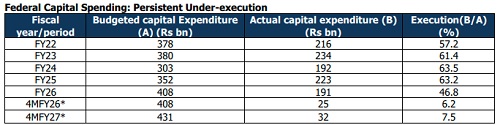
The five-year trend highlights the central demand constraint facing both industries: budgeted capital expenditure has consistently exceeded actual execution. Capital-budget utilisation improved through FY24-FY25 but deteriorated sharply to 46.8% in FY26. Moreover, expenditure has remained modest so far in FY27. For construction-material producers, capital allocations represent potential demand; meaningful material offtake occurs only after procurement, contract award, mobilisation, and physical construction. Weak execution can therefore constrain sales volumes while simultaneously prolonging contractor and project-linked receivable cycles.
FY27 Budget: Infrastructure Push, Execution Remains Key
The FY27 federal budget provides a more supportive backdrop for construction-linked industries, with a total outlay of Rs 2,124 billion, including Rs 431 billion (20.3%) for capital expenditure, alongside a 7% economic growth target. Infrastructure, connectivity and energy remain important policy priorities, creating a potentially stronger demand pipeline for cement and steel.
However, the sector impact will ultimately depend on execution rather than allocation. Faster project preparation, procurement, contractor mobilisation, and payment would support construction-material demand, while continued implementation delays could sustain the historical gap between budgeted capital expenditure and actual infrastructure activity.
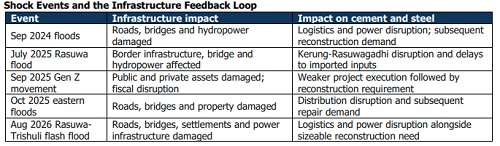
These events have had a two-sided impact on the sector. In the immediate aftermath, damage to roads, border infrastructure and power assets disrupts production and distribution; over the medium term, rebuilding generates additional demand for cement and reinforcement steel. However, infrastructure damage should not be equated with immediate construction-material demand, as the conversion into sector volumes depends on assessment, funding, tendering, contractor mobilisation and actual project execution.
Cement: Capacity Built Ahead of Demand
Nepal’s cement industry is characterised by structural overcapacity, with estimated installed grinding capacity of around 22 million tonnes (Mt) per annum against domestic consumption of approximately 8 Mt, translating into industry utilisation of broadly 35-40%. However, utilisation varies across plants and regions.
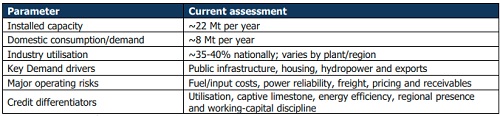
Cement demand is primarily driven by public infrastructure, private construction and exports. Demand remained subdued during FY23-FY24 as lower government capital spending coincided with higher borrowing costs and slower private construction. Lower interest rates have since improved the demand environment; however, lower capitalbudget execution continues to constrain institutional offtake. Persistent excess capacity limits pricing power, while volatility in fuel, electricity and freight costs restricts producers’ ability to fully pass on cost increases. Consequently, higher utilisation, captive raw-material access, energy efficiency, regional market strength and disciplined workingcapital management remain key differentiators of profitability, cash-flow generation and credit quality.
Steel: Upstream Integration Has Changed the Risk Mix
Nepal’s steel industry has progressively shifted from imported billets towards sponge iron and domestic melting, increasing domestic value addition while reducing reliance on imported semi-finished billets. However, the transition has changed rather than eliminated import dependence, as domestic melting remains reliant on imported ferrous feedstock. Imports of directly reduced iron increased by 20.0% year-on-year to Rs 58.5 billion in FY26 and further by 31.5% year-on-year to Rs 10.2 billion during the first two months of FY27. Greater use of induction-furnace melting has also increased the industry’s sensitivity to electricity availability and tariffs. At the same time, rawmaterial prices, foreign-exchange movements, and cross-border logistics remain key operating risks. Policy stability is equally important, as changes in customs duties on billets and sponge iron can materially alter the relative economics and competitiveness of different production routes.
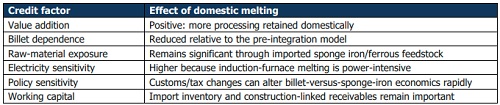
Steel demand remains closely linked to public infrastructure, hydropower, and residential and commercial construction, with TMT bars forming a key construction-related segment. Its demand cycle therefore broadly follows cement, although the industry's cost structure is more directly exposed to imported ferrous feedstock, international steel prices, foreign-exchange movements and electricity costs. Consequently, plant utilisation, power reliability and raw-material procurement remain important determinants of operating performance.
Power, Logistics and Regulatory Risk
Electricity availability is a common operating constraint for both cement and steel. Cement production requires substantial energy for crushing and grinding, alongside fuel for clinker production, while induction-furnace steelmaking is particularly power-intensive. Consequently, expanding reliable hydropower supply supports the sector, whereas flood-related damage to power and transport infrastructure can simultaneously constrain production, disrupt logistics, and increase freight costs. The legacy dedicated and trunk-line tariff dispute adds a further regulatory and liquidity risk for affected producers. Accordingly, the benefits of Nepal’s growing generation capacity will ultimately depend on reliable industrial supply, adequate transmission infrastructure and predictable electricity tariffs.
Cement Exports: Useful Utilisation Buffer, but Still Policy-Sensitive
India remains the natural export market for Nepal’s surplus cement and clinker capacity, providing an outlet for an industry operating well below installed capacity. However, export performance remains volatile and dependent on BIS certification, export incentives, cross-border logistics and price competitiveness. Delays in certification and incentive payments have periodically disrupted shipments, limiting exports’ ability to develop into a stable second demand engine. Cement and clinker exports remained subdued, declining marginally to Rs 2.6 billion in 11MFY26 from Rs 2.7 billion in 11MFY25. At the same time, the weakness continued into FY27, with exports moderating to Rs 592 million in 3MFY27 from Rs 794 million in 3MFY26 (3M and 11M refer to the three- and eleven-month periods of the respective fiscal years). Accordingly, exports are best viewed as an incremental capacity utilisation and foreign-exchange channel rather than a substitute for domestic infrastructure demand. A larger contribution would require predictable market access, timely export incentives and competitive logistics.
Reconstruction: Large Opportunity, Slow Conversion
Nepal’s reconstruction requirement following the FY24-FY26 floods, political unrest and infrastructure damage is significant, with preliminary and government assessments indicating several hundred billion rupees of affected assets and rebuilding needs. However, only a portion of these losses will translate directly into cement and steel demand, while some estimates remain subject to revision. Nevertheless, the scale of rebuilding is material relative to Nepal’s historical annual capital expenditure and could provide a multi-year demand pipeline for construction materials. The key constraint remains execution, as reconstruction demand reaches producers only after projects are funded, tendered, mobilised, and implemented.
Sector View
The sector’s outlook is cautiously positive for FY27-FY28 but remains execution-dependent. Lower borrowing costs, a larger capital program and the reconstruction pipeline should support a gradual recovery in demand, although benefits are unlikely to accrue uniformly across producers. In cement, structural overcapacity is expected to constrain pricing power even as utilisation improves, while steel remains sensitive to imported feedstock costs, electricity availability and tariffs. Accordingly, companies with stronger utilisation, operating efficiency, market position and working-capital discipline should be better positioned to benefit from the emerging infrastructure cycle.
Key Monitorable
• Capital expenditure execution: The pace of government capital spending remains the clearest indicator of institutional construction demand.
• Project and reconstruction mobilisation: Tender awards, contractor mobilisation, and actual construction progress will determine how quickly reconstruction requirements translate into cement and steel demand.
• Capacity utilisation and pricing: Higher volumes should improve fixed-cost absorption, but persistent cement overcapacity is likely to constrain pricing power.
• Power availability and input costs: Electricity reliability and tariffs, together with coal, sponge iron and other imported input costs, will remain important determinants of margins.
• Working-capital cycle: Receivables from contractors, institutional customers and dealers will remain an important differentiator of credit quality as demand recovers.
Above views are of the author and not of the website kindly read disclaimer