
Life Insurers' New Business Premium Rises 26.2% in October on Group Single Premiums by CareEdge Ratings

Synopsis
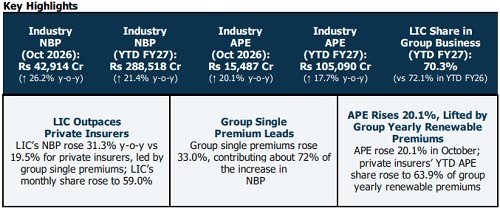
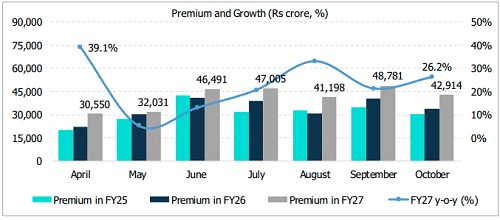
• Life insurers’ new business premium (NBP) rose 26.2% year-on-year (y-o-y) to Rs 42,914.3 crore in October 2026, faster than the 21.3% growth in September.
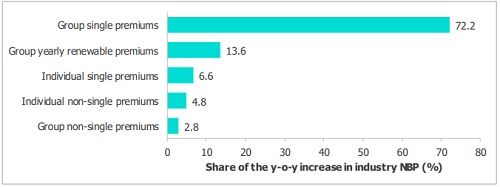
• Group single premiums drove the rise. They grew 33.0% y-o-y to Rs 25,926.9 crore and accounted for about 72% of the increase in NBP.
• LIC’s NBP grew 31.3% y-o-y, ahead of 19.5% for private insurers, helped by a 39.3% rise in its group single premiums. Excluding them, LIC’s NBP grew 11.7%, behind private insurers’ 20.5%.
• Individual premiums grew 7.9% y-o-y against a high base. They had risen 18.3% in October 2025, after the GST exemption on individual policies.
• Industry annualised premium equivalent (APE) rose 20.1% y-o-y to Rs 15,486.7 crore.
• In April–October FY27, group premiums grew 26.4% y-o-y, about twice the 13.1% growth in individual premiums.
“Group business remains the main source of growth for life insurers. Group premiums make up 65% of new business premium so far in FY27, and single premiums made up 71% of October’s total. These are lumpy institutional flows, so monthly growth is likely to stay uneven. Private insurers’ APE share rose to 63.9% in April– October FY27, mainly on group yearly renewable premiums. We expect healthy growth over the medium term,” said Vineet Jain, Senior Director, CareEdge Ratings.
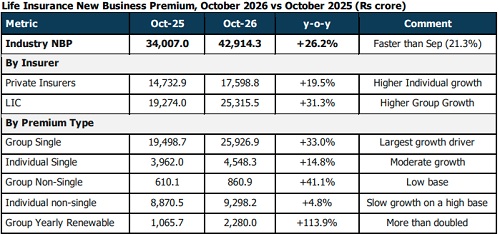
Group single premiums, which are lumpy institutional flows, drove the increase in NBP, contributing about 72% of it. Individual premiums contributed only about 11%, as their growth slowed to 7.9% from 18.3% a year earlier, when the GST exemption on individual policies lifted sales and left a high base. The slowdown was sharpest in individual non-single premiums, which rose 4.8% against 19.0% in October 2025.
Group Single Premiums Make Up 72% of October’s Rise in New Business Premium (%)
FY27 Monthly New Business Premium Stays Above FY26 in Every Month
LIC’s New Business Premium Rises 31.3% in October on Group Single Premiums
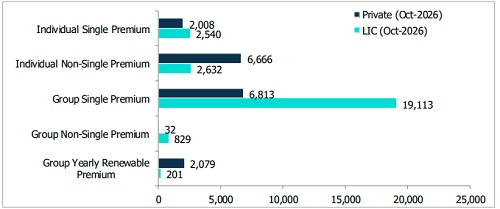
LIC’s NBP grew 31.3% y-o-y, compared with 19.5% for private insurers, as its group single premiums rose 39.3%. LIC accounts for 73.7% of the industry’s group single premiums, so its monthly growth depends heavily on their timing. Excluding group single premiums, LIC’s NBP grew 11.7%, against 20.5% for private insurers. Private insurers’ growth was supported by group yearly renewable premiums, which more than doubled to Rs 2,078.8 crore from Rs 921.1 crore; excluding these premiums, private NBP grew 12.4%, against 31.3% for LIC. In April– October FY27 (YTD FY27), private insurers’ NBP grew 22.0% against 20.9% for LIC. This lifted private insurers’ share of industry NBP to 41.2% from 41.0% in YTD FY26. Group yearly renewable premiums drove this: in YTD FY27 they rose 67.6% to Rs 12,288.5 crore for private insurers, against just 2.7% for LIC.
Group Single Premiums Make Up 75.5% of LIC’s New Business Premium (Rs crore)
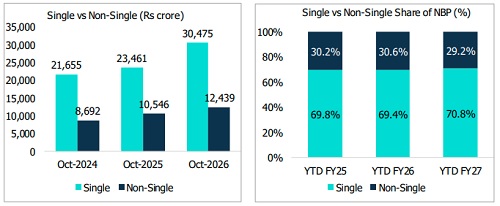
Single Premiums Rise 29.9% in October, Outpacing 17.9% Growth in Non-Single Premiums
Non-single premium growth slowed to 17.9% from 21.3% a year earlier because individual non-single premiums rose only 4.8% against a high base. Group yearly renewable premiums accounted for about 64% of the increase in non-single premiums. Single premiums therefore gained share, making up 71.0% of October NBP, up from 69.0% a year earlier. This shows that growth remains skewed towards single-premium, largely institutional, business.
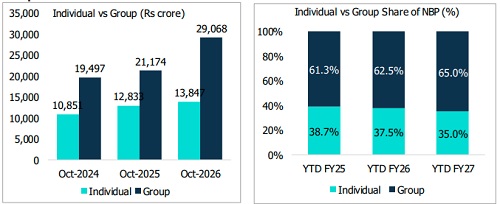
Group Premiums Rise 37.3% in October 2026, Far Ahead of 7.9% Growth in Individual Premiums
Individual premium growth slowed to 7.9% against a high base: individual premiums rose 18.3% in October 2025, the first full month after the GST exemption on individual policies took effect on September 22, 2025. LIC remained the dominant group player with a 70.3% share of YTD FY27 group premiums, down from 72.1% in YTD FY26.
Group Share of New Business Premium Rises to 65.0% from 62.5%
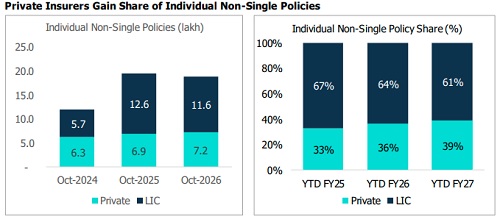
Individual Non-Single Policies Fall 3.5% to 18.8 lakh in October 2026
Individual non-single policy volumes declined 3.5% y-o-y to 18.8 lakh in October 2026, against a high base. Policy volumes had jumped 62.4% in October 2025 after the GST exemption, with LIC’s volumes more than doubling (up 120.1%). LIC’s policy volumes fell 7.9%, while private insurers’ volumes rose 4.3%. This lifted private insurers’ monthly share to 38.3% from 35.4% in October 2025. In YTD FY27, volumes rose 1.2% as an 8.5% rise for private insurers more than offset a 3.0% decline at LIC. Individual non-single premiums still rose 4.8% because the average premium per policy rose 8.7% to Rs 49,459. The industry average premium rose because a shift in mix towards private insurers, whose average premium per policy is about four times LIC’s, lifted it.
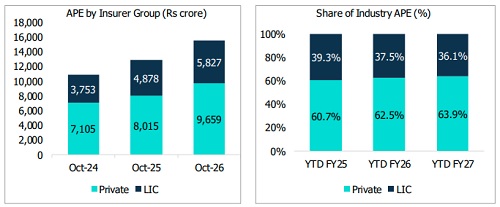
Industry APE Rises 20.1% in October, Led by Group Yearly Renewable Premiums
Industry annualised premium equivalent (APE) grew 20.1% y-o-y to Rs 15,486.7 crore in October 2026, with private insurers’ APE up 20.5% and LIC’s up 19.5%. Group APE rose 58.1%, mainly because group yearly renewable premiums, which are counted in full in APE, more than doubled. This rise alone accounted for about 47% of the increase in industry APE. Individual APE grew a more modest 5.2%. Excluding group yearly renewable premiums, APE grew 6.9% for private insurers and 18.9% for LIC. In YTD FY27, industry APE increased 17.7%, led by 20.3% growth for private insurers and 13.3% for LIC. Excluding group yearly renewable premiums, private insurers’ share of industry APE eased to 61.0% in YTD FY27 from 61.3% in YTD FY26.
Above views are of the author and not of the website kindly read disclaimer