Bank Credit Growth Jumps to 19.4% on Quarter-End Surge, Outpacing Deposits by CareEdge Ratings

Synopsis
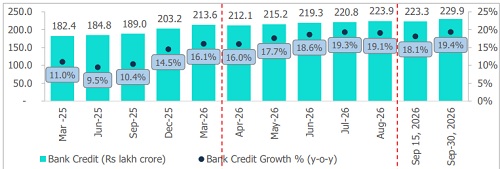
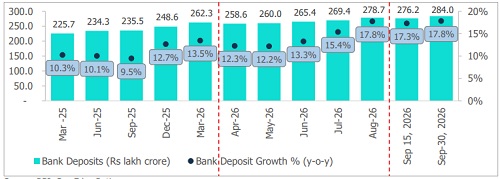
• Bank credit grew 19.4% year-on-year (y-o-y) in the fortnight ended September 30, 2026, while deposit growth stood at 17.8%, with both registering a sharp increase amid the usual quarter-end build-up. Deposits rose by Rs 7.73 lakh crore during the fortnight to Rs 284.0 lakh crore, after the Rs 2.49 lakh crore fall in the previous fortnight. Credit rose by Rs 6.65 lakh crore during the fortnight to Rs 229.9 lakh crore.
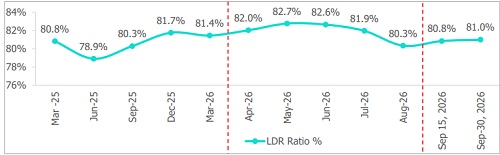
• The y-o-y credit-deposit growth gap widened to around 155 bps from about 80 bps as of September 15. The loan-to-deposit ratio (LDR) edged up to 81.0% from 80.8%.
• The liquidity surplus generated by the RBI's special FCNR(B) swap window, which peaked in early September, has narrowed, with the RBI's net outstanding liquidity at Rs 4.86 lakh crore as of September 30. The RBI also continued to absorb surplus liquidity through government bond sales.
• The weighted average call rate rose to 5.19% in the week ended September 25 from 4.97% two weeks earlier, staying 6 bps below the 5.25% repo rate then in force. On October 7, the RBI raised the repo rate by 25 bps to 5.50% and shifted its stance to calibrated tightening. The hike is expected to increase shortterm funding costs and influence banks' deposit mobilisation, prompting them to raise deposit rates to attract incremental deposits and support credit growth.
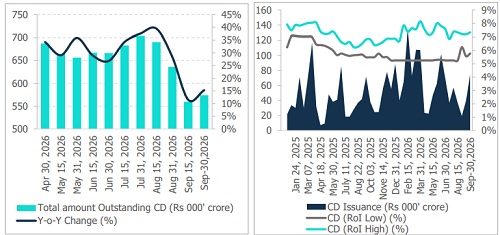
• Banks increased Certificates of Deposit (CDs) issuance to Rs 74.6 thousand crore at September-end from Rs 39.9 thousand crore in mid-September, indicating greater reliance on wholesale funding as credit growth continues to outpace deposit mobilisation
Bank Credit Growth Rises to 19.4%; Rs 6.65 Lakh Crore Added in Fortnight
Outstanding credit rose by Rs 6.65 lakh crore during the fortnight to Rs 229.9 lakh crore. On a y-o-y basis, credit grew 19.4%, up from 18.1% as of September 15 and well above the 11.4% recorded a year earlier. Credit typically rises in the last fortnight of a quarter. Credit added in H1FY27 stands at Rs 16.35 lakh crore, about 1.6 times the Rs 10.17 lakh crore added in the corresponding period a year earlier, and growth remains broad-based across agri, industry, services and personal loan sector. Strong deposit growth in recent months, driven by FCNR(B) inflows, should support further lending. Looking ahead, growth is expected to soften. The base becomes less favourable through H2 FY27, which will pull down reported growth even if fresh lending holds up. Interest rates have also begun to rise. Headline CPI inflation was 4.8% in August, and wholesale inflation 9.9%, and the RBI raised the repo rate by 25 bps to 5.50% at its October 7 review. The increase should feed through to lending rates, first on loans linked to external benchmarks such as the repo rate and then on MCLR-linked loans as banks' funding costs rise. The rate hike is expected to further moderate credit growth by raising borrowing costs, potentially dampening oan demand from retail and corporate borrowers. This, alongside the less favourable base in H2 FY27, is expected to moderate reported credit growth. We continue to expect bank credit growth of around 15.0%–16.0% in FY27.
Bank Deposit Growth Edges Up to 17.8% but Still Trails Credit by 155 bps
Deposits rose by Rs 7.73 lakh crore during the fortnight to Rs 284.0 lakh crore, after the Rs 2.49 lakh crore fall in the previous fortnight and supporting the quarter-end improvement in deposit mobilisation. On a y-o-y basis, deposits grew 17.8%, up from 17.3% as of September 15 and marginally above the end-August rate of 17.75%. Demand deposits, about an eighth of the total demand deposits, rose by Rs 4.00 lakh crore and contributing just over half of the total increase in deposits., while time deposits grew by Rs 3.72 lakh crore. The share of time deposits in total deposits eased to 86.8% from 87.2% last year, while time deposits grew 17.3% and demand deposits 21.6% y-o-y. Deposits added in H1 FY27 totalled Rs 21.67 lakh crore, up from Rs 15.18 lakh crore a year earlier. Competition for deposits has stayed contained while the system has been in surplus, but the surplus has narrowed, and short-term market rates are rising. The 91-day T-bill yield rose to 5.39% in the week ended September 25 from 5.21% two weeks earlier, and the lower end of CD rates rose to 5.77% from 5.57% last fortnight. These moves predate the RBI's October 7 decision to raise the repo rate to 5.50%. The hike rules out further cuts in term deposit rates for now and is likely to push them up, as banks need to fund credit that is growing faster than deposits while the liquidity surplus shrinks.
Loan-to-Deposit Ratio Rises to 81.0% as Credit Outpaces Deposits
The LDR rose by 14 bps to 81.0%, its second consecutive increase after August end, as credit grew 3.0% during the fortnight against 2.8% for deposits. The incremental credit-deposit ratio for H1 FY27 rose to 75.4% from 69.5% in same period last year. Credit added in H1 FY27 so far is 1.6 times the year-earlier amount, against 1.4 times for deposits. Even after this fortnight's increase, the LDR remains well below its May 2026 peak of 82.7%, so banks are better placed on funding than they were earlier in FY27. However, with incremental credit running at 75.4% of incremental deposits and the repo rate raised to 5.50%, funding further loan growth is likely to cost banks more.
Liquidity Surplus Narrows to Rs 4.9 Lakh Crore as RBI Sells Bonds
System liquidity peaked at about Rs 11.2 lakh crore in early September. Under the swap facility, banks handed the RBI the dollars they had raised and received rupees in return, and those rupees continued to enter the banking system until the execution window closed on September 11. The surplus pulled the WACR down to 4.97%. With longer-tenor VRRR auctions drawing weak demand, the RBI announced Rs 1 lakh crore of open market bond sales across three September tranches. Together with mid-September tax outflows, which built up government cash balances (net RBI credit to the government fell Rs 2.62 lakh crore in the fortnight to September 30), these narrowed the surplus: the RBI’s net outstanding liquidity, including end-of-day absorption, stood at Rs 4.86 lakh crore on September 30, after an outright sale of Rs 25,000 crore on September 29. Overnight rates are likely to move up towards the repo rate as the RBI continues to absorb surplus liquidity. The 10-year G-sec yield rose to 7.18% as of September 30, crossing 7% on global factors and added supply.
CD Issuance Nearly Doubles to Rs 74.6 Thousand Crore as Rates Climb
CD outstanding rose by Rs 14.5 thousand crore during the fortnight to Rs 574.1 thousand crore, its first increase after two fortnights of decline, though it remains below the mid-August level. Issuance nearly doubled to Rs 74.6 thousand crore from Rs 39.9 thousand crore last fortnight, as banks returned to the market alongside a narrower liquidity surplus. Issuance rates rose at both ends, to 5.77% from 5.57% at the lower end and to 7.33% from 7.18% at the upper end, narrowing the spread to 156 bps from 161 bps last fortnight. With the repo rate now at 5.50%, CD rates are likely to rise further, adding to the cost of wholesale funding for banks that use CDs to bridge the gap between credit and deposit growth.
Above views are of the author and not of the website kindly read disclaimer