Automobiles Sector Update : Earnings outlook materially improves for the sector by Motilal Oswal Financial Services Ltd
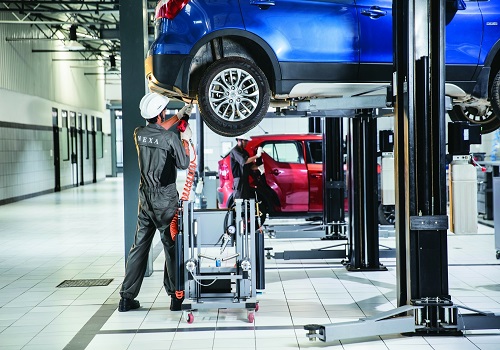
* Aggregate auto demand for all OEMs under our coverage universe grew 24.5% YoY in 1QFY27. Segmental trends: 2W up 26%, PVs up 24%, CVs up 20%, and tractors up 18%.
* However, due to a surge in RM prices in 4Q and the better part of 1Q and losses in TMPV due to headwinds at JLR, we expect our OEM coverage to post a 11% YoY earnings decline in 1Q.
* Auto ancillaries within our coverage universe are likely to post ~15% revenue growth and a much lower PAT growth of 10% due to margin pressure.
* Earnings outperformers among OEMs include BJAUT (+31%) and TVSL (+30%). HMIL is likely to underperform with a PAT decline of 40%. We expect TMPV to post a loss in 1Q, given headwinds at JLR.
* In auto ancillaries, key outperformers in 1Q include Gabriel (63%), SAMIL (+48%), SONACOMS (+36%), HAPPY (+37%), Craftsman (24%), and BKT (29%). Key underperformers include CEAT (-56%) and Bosch (-23%).
* Given the easing input cost pressure, price hikes taken by OEMs to partially offset the commodity hikes, and stable demand across segments, we expect renewed investor interest in the sector in coming quarters.
* Our top OEM picks are MSIL, TVSL, and MM. Top auto ancillary picks are MSWIL, ENDU, and SAMIL.
Demand remains healthy in 1Q across segments
Demand has continued to be encouraging across segments in 1Q, as reflected in strong retail growth reported in Vahan. As a result, the overall auto industry volume growth for 1Q stood at 24.5% YoY. More importantly, growth was driven by all segments: 2W up 26%, PVs up 24%, CVs up 20%, and tractors up 18%. In 2Ws, all OEMs delivered over 20% growth in 1Q. In PVs, TMPV and MSIL outperformed the industry, while HMIL was the only one to witness a volume decline in 1Q on account of supply challenges led by the fire incident at Hyundai Mobis. MM underperformed the industry on account of supply challenges from Tier 2 suppliers, which were resolved in June. Within CVs, TMCV outperformed with 26% growth in 1Q, while VECV and AL posted 10% and 15% growth, respectively. Further, within tractors, MM posted 18% YoY growth and Escorts’ volumes grew 21% YoY.
Severe impact on marginslikely in Q1; recovery expected in coming quarters
* On the back of a healthy recovery in volumes, auto OEM companies under our coverage are expected to post a strong 17% revenue growth. Within this, we expect 2W OEMs to post 32% revenue growth, followed by PV OEMs at 15% and CV OEMs at 18%. However, prices of key inputs have been on an uptrend since 3Q, and despite the price hikes taken, there is likely to be some under-recovery due to the sharp increase in a short span. As a result, aggregate EBITDA margin for our OEM coverage universe is estimated to decline 190bp YoY to 9.6%. In PVs, while most OEMs are expected to witness a 100-150bp margin impact in 1Q, HMIL is likely to be the most affected, with a 430bp impact on a YoY basis, also over a high base and TMPV is expected to see a 300bp YoY impact, given
the headwinds at JLR. Similarly, in CVs, we expect CV OEMs to witness a 100- 200bp margin contraction on a YoY basis.
* Two-wheeler OEMs with meaningful export exposure are likely to be the least impacted. For instance, we expect BJAUT, RE, and TVSL to see a marginal margin impact on a YoY basis. On the other hand, HMCL is likely to witness a 160bp margin pressure on a YoY basis.
* Overall, given the sharp surge in input costs and headwinds at JLR, we expect OEM companies under our coverage to report a flat EBITDA quarter and an 11% decline in PAT.
* Given the strong OE growth, auto ancillaries in our coverage are expected to post ~15% revenue growth. However, the surge in commodity prices and the lag mechanism for cost pass-through are expected to result in relatively lower EBITDA/PAT growth of 9%/10% for auto ancillaries. Mass-market tyre companies are likely to witness the sharpest margin contraction in 1Q
Auto earnings outlook improves with the resolution of the West Asia crisis
* As highlighted in the previous section, the demand has held up well in 1Q, especially in PVs and tractors. The resolution of the West Asia crisis has resulted in a sharp decline in crude oil prices alongside a dip in commodity costs. Needless to say, both these factors augur well for the auto sector. The decline in input costs suggests that the margin pressure is unlikely to sustain beyond 1Q for the sector. Given the improving macro environment and strong 1Q performance, we have raised our estimates for a few companies: APTY (+11%/+8%), BJAUT (+6%/+5%), ENDU (+5%/+9%), EXID (+7%/+11%), HAPPYFOR (+6%/+5%), MSIL (+5%/+6%), MSWIL (+5%/+6%), SONACOMS (+5%/+7%) and TMPV (+10%/+4%). On the other hand, companies that witnessed earnings downgrades include CEAT (-9% for FY27E) and AL (-6% for FY27E).
* A decline in crude is clearly beneficial for the overall economy as well as the CV segment. Given easing input cost pressures, price hikes taken by OEMs, and stable demand across segments, we expect renewed investor interest in the sector in coming quarters. The only lingering concern remains the probable impact of El Nino expected in the current year. In this scenario, OEMs with a healthy launch pipeline are likely to be preferred over others. Our top OEM picks are MSIL, TVSL, and MM. Among auto ancillaries, our top picks are MSWIL, Endurance, and SAMIL
For More Research Reports : Click Here
For More Motilal Oswal Securities Ltd Disclaimer
http://www.motilaloswal.com/MOSLdisclaimer/disclaimer.html
SEBI Registration number is INH000000412









More News

Insurance Sector Update : Further DAC approvals enhance addressable market By Motilal Oswal ...