Agriculture GNPA Ratio May Rise to 5.3%-5.6% by FY28 After Weak Monsoon by CareEdge Ratings
Synopsis
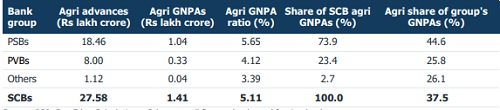
• The gross non-performing asset (GNPA) ratio of agriculture loans at scheduled commercial banks (SCBs) stood at 5.11% in June 2026, the highest among major sectors. Agriculture made up 12.9% of SCB advances but accounted for 37.5% of all SCB GNPAs in June 2026.
• The 2026 southwest monsoon ended at 87% of the long period average (LPA), the weakest since 2015. The shortfall was concentrated in states that hold most of the banks' farm credit: about 68% of SCB agriculture credit is in states where rainfall was 20% or more below normal, up from 48% in 2015. (The LPA is the average June to September rainfall over 1971-2020, which the India Meteorological Department (IMD) treats as normal.)
• We expect the agriculture GNPA ratio to ease to 4.6% to 4.8% by March 2027 as strong credit growth and write-offs continue. It is then likely to rise to 5.3% to 5.6% by March 2028, as some kharif crop loans in areas hit by the weak monsoon turn bad and are classified as non-performing assets (NPAs). Agriculture GNPA, at Rs 1.41 lakh crore in June 2026, could rise to Rs 1.47 lakh crore to Rs 1.53 lakh crore by March 2027 and Rs 1.9 lakh crore to Rs 2.0 lakh crore by March 2028, with most monsoon-related stress likely to show in bank books in FY28.
• The weak monsoon could add 70 to 80 bps to the agriculture GNPA ratio by March 2028. Public sector banks (PSBs) are likely to bear most of this increase. Including farm loans restructured in drought-hit areas, which stay classified as standard assets, stressed agriculture advances could reach 6.0% to 6.3% of agriculture advances.
• In an adverse scenario, with a poor rabi crop, larger state loan waivers and a sharper slowdown in bank lending as interest rates rise, the agriculture GNPA ratio could reach 6.1% to 6.4% by March 2028. With a good rabi crop and wide use of restructuring under RBI’s natural calamity framework, which would keep part of the monsoon-related stress classified as standard assets, it could be 4.7% to 4.9%.
“The agriculture GNPA ratio has improved over the last six years, but mainly because farm lending grew fast while the stock of bad loans has stayed between Rs 1.3 lakh crore and Rs 1.5 lakh crore since March 2021. The weak 2026 monsoon hit most of the states where banks lend the most to farmers, so we expect the stress to show in bank books from early 2027 and build through FY28, as some crop loans stay overdue and turn into NPAs. Public sector banks are likely to carry most of this impact. Restructuring under the new natural calamity framework can soften the hit. In contrast, new state loan waivers remain the larger risk, as they have historically caused the sharpest increases in farm NPAs.” - Vineet Jain, Senior Director, CareEdge Ratings
Agriculture Has the Highest GNPA Ratio Among Major Sectors of Bank Credit
The agriculture GNPA ratio of SCBs was 5.11% in June 2026, well above industry (1.48%), services (1.47%) and retail loans (0.96%). Agriculture accounted for 37.5% of all SCB GNPAs, and PSBs carry about three-fourths of these agriculture GNPAs.
Agriculture GNPA Ratio Halved Since FY20 as Outstanding Credit Grew Faster than Bad Loans
Agriculture Asset Quality by Bank Group, June 2026
The agriculture GNPA ratio of SCBs rose from 4.60% in March 2015 to a peak of 10.33% in March 2020.
The rise of 84 bps in FY16 came after two weak monsoons in a row, at 88% of LPA in 2014 and 86% in 2015. The much larger rise between FY18 and FY20 came during a wave of farm loan waivers. Ten states announced waivers of about Rs 2.4 lakh crore between 2014-15 and 2018-19. Some borrowers who could repay held back payments in hopes of relief. A fall of about Rs 1.05 lakh crore in agriculture advances at one large PSB in the September 2019 quarter, with little change in its agriculture GNPA, also lifted the ratio in FY20.
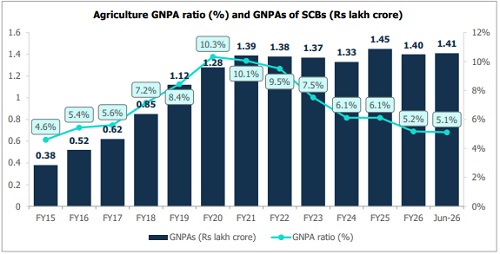
Since March 2020, the agriculture GNPA ratio has fallen by 522 bps to 5.11% in June 2026, even though the agriculture GNPA rose from Rs 1.28 lakh crore to Rs 1.41 lakh crore. The fall in the ratio does not mean that stress in farm loans has eased. Agriculture advances more than doubled over the same period, spreading bad loans over a much larger loan book, and banks wrote off more of their old farm loans, removing them from GNPA even though they have not been repaid. Banks wrote off 16% to 18% of the agriculture GNPA they held at the start of the year in FY23 to FY25, against 11% to 12% in FY20 to FY22.
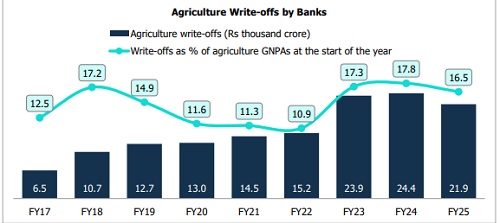
Weak rainfall was not a factor in this period, as the monsoon was normal or above normal in every year from 2019 to 2025 except 2023. Even the 2023 monsoon, at 94% of LPA, did not stop the decline in the agriculture GNPA ratio, and the ratio fell 140 bps in FY24 as agriculture advances grew 19.1%.
2026 Monsoon Shortfall Hit States With the Most Outstanding Farm Credit
The 2026 southwest monsoon brought 759.4 mm of rain between June and September, or 87% of the LPA of 868.6 mm, the fourth-lowest since 2001, according to the IMD. Rainfall was 76% of normal in the south peninsula and 74% in east and northeast India, the lowest for that region since 1901. June rainfall was only 65% of normal, which delayed kharif sowing. El Niño conditions strengthened through the season. October has also started dry: rainfall from October 1 to 13 was 76% to 98% below normal in Maharashtra, Karnataka, Andhra Pradesh and Telangana. This adds to the risk for rabi sowing and yields, as also noted in the CareEdge Economics report “Monsoon Ends on a Deficient Note and Weighs on Inflation Outlook” (October 9, 2026). However, IMD expects normal October-to-December rainfall in the southern peninsula.
The rainfall shortfall was more pronounced in the states where banks have lent the most to farmers. About 68% of SCB agriculture credit is in states where rainfall was below normal by 20% or more in 2026, which IMD classes as deficient. This is the highest share in the last ten years. Tamil Nadu, Andhra Pradesh, Karnataka, Maharashtra and Kerala, which together hold about 48% of SCB agriculture credit, received 20% to 30% less rain than normal. In the north, rainfall was 41% below normal in Punjab and 23% to 24% below normal in Haryana and Rajasthan.
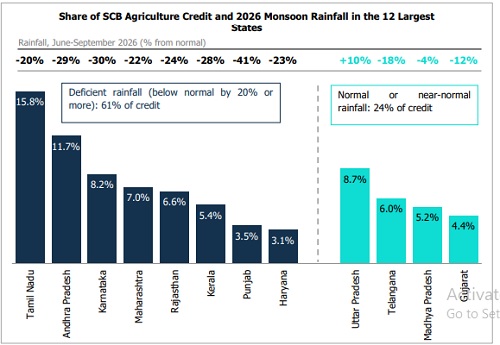
Four states have declared drought so far. Karnataka has declared 217 of its 240 taluks drought-hit, Maharashtra 265 of its 358 talukas, Andhra Pradesh 388 mandals and Telangana 320 mandals in 18 districts, while Rajasthan is still assessing crop losses. These four states hold about a third of SCB agriculture credit. A declaration allows banks to restructure farm loans in the affected areas under RBI’s framework for relief in areas hit by natural calamities, in force from July 1, 2026. Only loans that were standard, and not overdue by more than 30 days, when the calamity struck can be restructured. Banks must start the process within 45 days of a state’s drought declaration and complete it within 135 days, so the window for the declarations made between August and early October closes between January and mid-February 2027. Restructuring can turn an unpaid crop loan into a term loan repayable over a few years, with a moratorium set by the State Level Bankers’ Committee (SLBC). In Karnataka, banks have agreed to a 12-month moratorium for the taluks declared in August. Loans restructured in this way stay classified as standard assets, with banks setting aside an additional 5% provision. They are unlikely to turn into NPAs until the moratorium ends and repayments fall overdue again, likely after March 2028. Still, some may turn bad later, as happened after the 2014 and 2015 droughts.
Weak Monsoon Expected to Add About 70 to 80 bps to the Ratio by March 2028
Under RBI’s Income Recognition, Asset Classification and Provisioning Directions for commercial banks, issued on November 28, 2025, a crop loan becomes an NPA when a payment stays overdue for two crop seasons, or for one crop season if the crop takes more than a year to grow. Other farm loans, such as those for dairy or poultry, become NPAs after 90 days. As a result, the 2026 shortfall is likely to reach bank books with a lag. Some stress could show from early 2027, but kharif crop loans that are not repaid after the 2026 harvest are likely to turn into NPAs mainly in the second half of 2027.
Based on our forecast model, the agriculture GNPA ratio of SCBs is expected to ease to 4.6% to 4.8% by March 2027 in the base scenario, if farm lending continues to grow fast and banks continue to write off old bad loans. It could then rise to 5.3% to 5.6% by March 2028. Part of the rise in the June 2027 quarter is likely to be seasonal, as the ratio rose in the June quarter in eight of the last 11 years.
The weak monsoon is expected to add close to 70 to 80 bps to the agriculture GNPA ratio by March 2028, or Rs 25,000 crore to Rs 29,000 crore of GNPA in the base scenario. Farm loan waivers are expected to add about 45 to 50 bps more. A waiver does not stop a loan from turning bad. The loan stays due from the farmer until the state pays the bank, and states have usually paid less than half of the announced amount in the first year, while some borrowers who expect relief tend to stop paying. The Maharashtra scheme of Rs 36,585 crore, announced in June 2026, accounts for 23 to 27 bps of this, and the remaining 22 to 24 bps reflects the risk of new waivers in Uttar Pradesh and Punjab. Both states announced farm loan waivers after their 2017 assembly elections and go to the polls again in early 2027. With a normal monsoon, the ratio could be 4.6% to 4.7% in March 2028; without the waivers, it could fall to 4.1% to 4.3%.
Agriculture GNPAs of SCBs are expected to rise from Rs 1.41 lakh crore in June 2026 to Rs 1.9 lakh crore to Rs 2.0 lakh crore by March 2028 in the base scenario. In an adverse scenario, with a poor rabi crop if October stays dry, slower farm lending and waivers in both Uttar Pradesh and Punjab, agriculture GNPAs could reach Rs 2.1 lakh crore to Rs 2.2 lakh crore and the ratio 6.1% to 6.4%. In a benign scenario, with a good rabi crop and wide use of calamity restructuring, GNPAs could be Rs 1.7 lakh crore to Rs 1.8 lakh crore and the ratio 4.7% to 4.9%
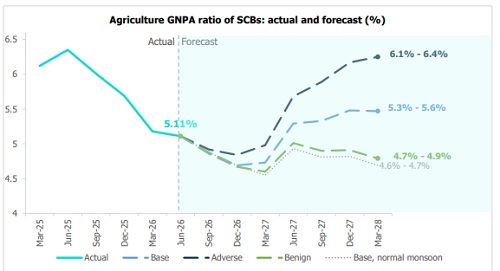
The agriculture GNPA ratio is expected to rise by only 20 to 50 bps between June 2026 and March 2028 in the base scenario, even though agriculture GNPAs are expected to rise by 35% to 45%, from Rs 1.41 lakh crore to Rs 1.9 lakh crore to Rs 2.0 lakh crore. Agriculture advances are likely to grow by about 31% over the same period, to about Rs 36.2 lakh crore. Had GNPAs stayed at their June 2026 level, this growth alone would take the ratio down to about 3.9%. Banks may also write off Rs 50,000 crore to Rs 53,000 crore of agriculture bad loans over these seven quarters if they write off about 19% of their agriculture GNPAs each year, close to the recent rate. Against this, new NPAs of Rs 1.0 lakh crore to Rs 1.1 lakh crore, including the effect of the weak monsoon and the loan waivers, are expected to push the ratio back up
GNPAs do not capture the entire stress. Loans restructured in drought-hit areas remain classified as standard assets. After the 2014 and 2015 droughts, such loans rose to about 1.2% of agriculture advances, up from 0.2% to 0.4% in most other years, according to RBI data. If restructuring follows a similar pattern after the 2026 drought, restructured standard agriculture loans could reach about 0.7% to 0.8% of agriculture advances, or Rs 25,000 crore to Rs 29,000 crore, by March 2028. Stressed agriculture advances, which are GNPA plus restructured standard assets, could then be 6.0% to 6.3% in the base scenario, 7.1% to 7.4% in the adverse scenario and 5.5% to 5.8% in the benign scenario.
Above views are of the author and not of the website kindly read disclaimer